- AI shifts Agile teams from reactive firefighting to predictive delivery, forecasting delays, bottlenecks, and resource constraints before they derail a sprint.
- Routine overhead like backlog grooming, task assignment, and status reporting can be automated, freeing teams to focus on creativity, problem-solving, and customer value.
- Generative AI now drafts Agile artifacts (user stories, acceptance criteria, sprint goals, meeting summaries), while AI coaching scales personalized retrospective and collaboration insights across teams.
- Successful adoption hinges on people and data, not tooling: address cultural resistance, skill gaps, data quality, and tool integration before expecting results.
- Guard against over-reliance, bias, and opacity by adopting ethical, explainable-AI practices so human judgment stays in the loop.
- Used well, AI amplifies Agile principles rather than replacing them, enabling adaptive workflows that adjust sprint lengths and task allocation in real time.
-
Benefits of AI-Powered Agile Workflows
Surveys six concrete payoffs of bringing AI into Agile: automated backlog and sprint management, predictive risk management, stronger collaboration for distributed teams, smarter quality assurance, personalized performance insights, and faster data-driven decisions. Each benefit is tied to real tools such as Jira, monday.com, Pluralsight Flow, and BI dashboards.
-
Challenges in Integrating AI with Agile
Outlines the main obstacles to adoption, including cultural resistance and fear of replacement, data quality and privacy concerns, technical skill gaps, tool-integration friction, the risk of over-relying on AI over human judgment, and complexity when retrofitting legacy systems.
-
Emerging Trends in AI-Powered Agile Workflows
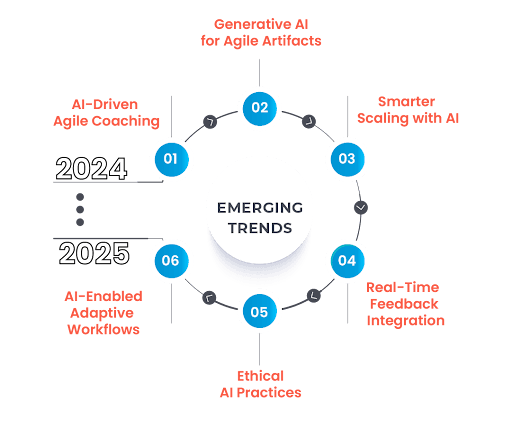
Highlights six forward-looking developments: AI-driven Agile coaching, generative AI for Agile artifacts, smarter scaling across enterprise teams, real-time feedback and sentiment analysis, ethical and explainable AI practices, and adaptive workflows that dynamically tune methodology to live conditions.
-
Conclusion
Frames AI-powered Agile as a fundamental shift that lets teams concentrate on creativity and customer value, while stressing that adoption must address culture, data governance, skills, and ethics. The core message: implemented thoughtfully, AI amplifies Agile principles rather than replacing them.
In today’s fast-paced digital landscape, agility is no longer optional, it is essential. Agile methodologies have long enabled teams to deliver value through collaboration, adaptability, and iterative execution. However, as projects become more complex and data-driven, organizations are increasingly turning to Artificial Intelligence (AI) to enhance Agile workflows.
AI’s ability to analyze large datasets, predict outcomes, and automate repetitive tasks makes it a powerful accelerator for Agile teams. From data-informed backlog prioritization to predictive sprint insights, AI-powered Agile workflows are transforming how teams plan, collaborate, and deliver value.
This article explores how AI is reshaping Agile workflows, the key benefits it delivers, the challenges organizations must overcome, and the emerging trends defining the future of AI-enabled Agile practices.
Benefits of AI-Powered Agile Workflows
1. Streamlined Task and Backlog Management
Backlog grooming, sprint planning, and progress tracking often require significant manual effort. AI automates these activities by prioritizing tasks based on urgency, complexity, historical velocity, and team capacity.
Machine learning models analyze past sprint data to:
- Predict task duration
- Optimize sprint allocation
- Identify potential blockers early
Agile tools such as Jira increasingly integrate AI to auto-assign tasks, update boards in real time, and surface risks, reducing administrative overhead and improving focus.
2. Predictive Risk Management
AI enables Agile teams to shift from reactive problem-solving to predictive risk management. By analyzing workflow patterns, dependency data, and delivery metrics, AI tools can forecast:
- Delivery delays
- Resource constraints
- Bottlenecks across teams
Platforms like monday.com use AI to predict delivery timelines, allowing teams to adjust plans early and maintain momentum.
3. Enhanced Collaboration
Distributed and remote teams benefit significantly from AI-driven collaboration tools. Virtual assistants can:
- Summarize meetings
- Track action items
- Provide real-time status updates
AI-powered chatbots integrated into Slack or Microsoft Teams ensure that project insights flow directly into daily conversations, reducing friction and misalignment.
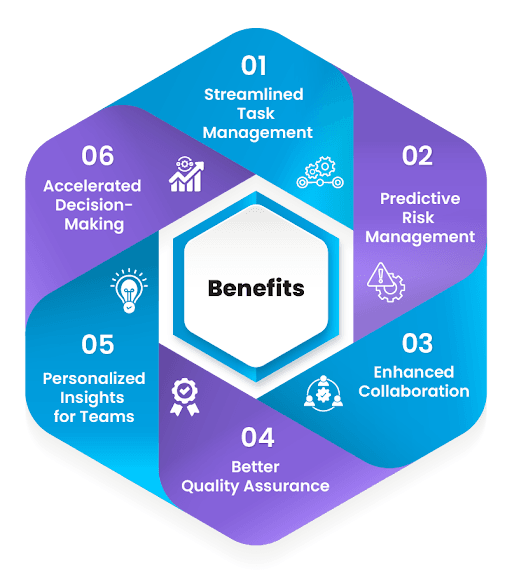
4. Better Quality Assurance
AI enhances quality assurance by automating testing, detecting anomalies, and predicting defects earlier in the development lifecycle. Machine learning algorithms analyze code repositories to:
- Flag potential defects
- Suggest code improvements
- Identify patterns linked to quality issues
This proactive approach reduces production risks and improves overall delivery quality.
5. Personalized Insights for Agile Teams
AI provides individualized performance insights by analyzing work patterns, skill utilization, and delivery outcomes. These insights help team members:
- Identify strengths and improvement areas
- Enhance productivity
- Support continuous learning
Tools like Pluralsight Flow offer data-driven feedback to help teams optimize performance without micromanagement.
6. Accelerated Decision-Making
Agile environments demand fast, informed decisions. AI simplifies complex decision-making by synthesizing large volumes of project data into actionable insights.
AI-powered dashboards built with Tableau or Power BI enable real-time visibility into trends, helping teams and stakeholders adapt quickly and align with organizational goals.
Challenges in Integrating AI with Agile
1. Cultural Resistance: Agile thrives on human collaboration, and introducing AI tools may be met with skepticism. Teams might fear AI replacing human roles, emphasizing the need for education and change management to position AI as a supportive rather than substitutive tool
2. Data Quality and Privacy: AI effectiveness depends on the quality of input data. Teams must ensure data integrity while addressing privacy and compliance concerns, especially when handling sensitive information
3. Skill Gaps: Using AI tools often requires technical proficiency. Organizations must invest in training Agile teams to use these tools effectively, bridging knowledge gaps and fostering a culture of continuous learning.
4. Tool Integration: Ensuring AI tools integrate seamlessly with existing Agile platforms like Jira or Slack can be a technical challenge. Thoughtful planning is necessary to maintain workflow continuity and avoid disruptions.
5. Over-Reliance on AI: Teams may begin to overly depend on AI for decision-making, risking the loss of human judgment and creativity. This can lead to missed nuances or context-specific insights that AI might not capture.
6. Integration Complexity with Existing Tools: Integrating AI into existing Agile tools and workflows can be challenging, especially in organizations with legacy systems. Compatibility issues and the need for extensive customization can slow down adoption.
Emerging Trends in AI-Powered Agile Workflows
1. AI-Driven Agile Coaching
AI is augmenting Agile coaching by analyzing team dynamics, sprint data, and performance metrics to deliver real-time improvement recommendations. Unlike traditional coaching, AI-driven insights scale across teams while remaining personalized.
Tools like ScrumGenius help teams optimize retrospectives, sprint reviews, and collaboration patterns.
2. Generative AI for Agile Artifacts
Generative AI is transforming how teams create Agile documentation, including:
- User stories
- Acceptance criteria
- Sprint goals
- Meeting summaries
Solutions such as GitHub Copilot and OpenAI tools reduce manual writing effort while improving clarity and consistency.
3. Smarter Scaling with AI
AI plays a pivotal role in addressing the complexities of scaling Agile practices across large enterprises. By analyzing interdependencies, team capacities, and overall project goals, AI tools enable organizations to orchestrate multiple Agile teams seamlessly. This includes identifying resource conflicts, managing dependencies, and aligning deliverables with enterprise objectives.
Scaling becomes more predictable and efficient, with reduced risks of misaligned priorities or redundant efforts across teams. AI’s ability to provide a bird’s-eye view of all team activities helps organizations ensure that their Agile implementations remain cohesive.
Tools like Rally Software (Broadcom) and SAFe’s Agile management platforms integrate AI-driven insights to improve coordination and dependency management across teams, making scaling more accessible and effective.
4. Real-Time Feedback Integration
AI is enhancing Agile workflows by providing immediate, actionable feedback during development cycles. This trend goes beyond traditional retrospectives, as teams can now adapt their strategies in real time based on sentiment analysis, performance metrics, or customer feedback.
Teams can address issues proactively rather than waiting for formal review sessions. This fosters a culture of continuous improvement and minimizes the risk of delayed course corrections.
AI-powered sentiment analysis tools, like those integrated with Slack or Jira, assess team morale and engagement during sprints, providing managers with insights to improve communication and collaboration.
5. Ethical AI Practices
As AI adoption grows, so do concerns about fairness, transparency, and bias in its applications. Agile teams are increasingly focusing on ethical AI practices to ensure the tools they use align with organizational values and societal norms. This involves creating standards for ethical AI integration and ensuring that algorithms driving decision-making are transparent and explainable.
This trend safeguards trust in AI-powered Agile workflows while fostering a responsible innovation culture. It also aligns Agile practices with emerging global standards for AI ethics.
Organizations are using tools like Explainable AI (XAI) frameworks to ensure transparency in AI-driven decisions, particularly for processes impacting team assignments, performance assessments, or product development priorities.
6. AI-Enabled Adaptive Workflows
A growing trend in AI-powered Agile is the use of adaptive workflows, where AI dynamically adjusts project methodologies and processes based on real-time conditions. Unlike static frameworks, these workflows evolve as teams encounter new challenges or opportunities, ensuring maximum flexibility and alignment with goals.
By analyzing progress metrics, team performance, and external factors, AI tools can suggest process adjustments, such as modifying sprint lengths or reallocating tasks, to optimize outcomes.
AI tools like ClickUp or Zoho Sprints are evolving to offer “adaptive templates” that change based on team progress and feedback, ensuring that workflows remain relevant throughout the project lifecycle. This adaptability helps teams respond more effectively to changes, a critical element of Agile methodology.
Conclusion
AI-powered Agile workflows represent a fundamental shift in how teams plan, collaborate, and deliver value. By automating routine tasks, providing predictive insights, and enabling faster decision-making, AI allows Agile teams to focus on creativity, problem-solving, and customer value.
However, successful adoption requires addressing cultural resistance, data governance, skill gaps, and ethical considerations. When implemented thoughtfully, AI does not replace Agile principles, it amplifies them.
As AI technologies continue to evolve, their integration with Agile methodologies will redefine the future of work. Organizations that adopt AI strategically and responsibly will not only improve efficiency but unlock sustainable innovation, one iteration at a time.
Meet the Author

Disha Jain
Contributing Writer
Disha Jain is a contributing writer at Skillbook Academy covering Agile, SAFe and AI topics.