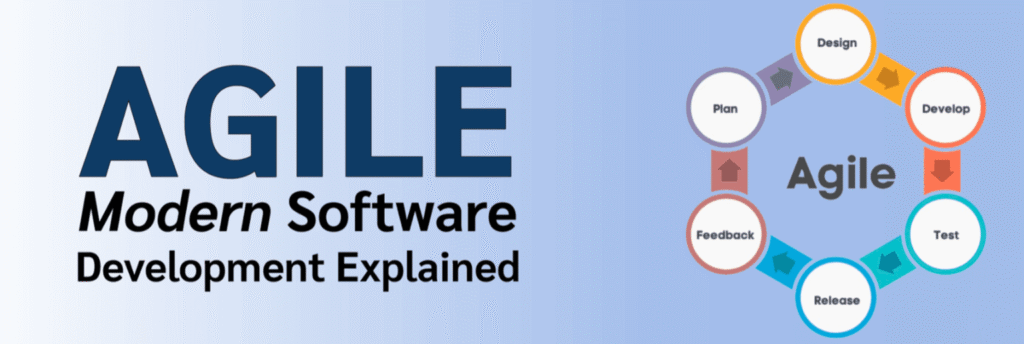
- Agile is a set of principles for software development where requirements and solutions evolve through collaboration among self-organizing, cross-functional teams, formalized by the 2001 Agile Manifesto.
- Agile delivers working software in short iterations (sprints) so teams gather feedback early and often instead of waiting on long, monolithic development cycles.
- The four Agile values prioritize individuals and interactions, working software, customer collaboration, and responding to change over rigid processes, documentation, contracts, and plans.
- Agile is an umbrella covering multiple frameworks: Scrum, Kanban, Lean, Extreme Programming (XP), Crystal, and DSDM, each fitting a different team context.
- Scrum suits time-boxed, sprint-based project delivery while Kanban suits continuous-flow, operational, and support work; pick the method that matches your team's needs.
- Technical practices like continuous integration, automated testing, frequent releases, and lean documentation are what keep Agile delivery fast and high quality.
-
What Is Agile Methodology? (In Brief)
Defines Agile as a principle-driven approach built on adaptive planning, iterative and incremental development, continuous delivery, and rapid response to change. Notes that Agile was formalized by the 2001 Agile Manifesto and is now one of the most widely adopted product-development approaches.
-
Agile 101: How Agile Works
Explains that Agile delivers working software frequently through short sprints that produce usable increments and early feedback. Lays out the four foundational Agile values that keep teams flexible, customer-focused, and outcome-driven.
-
Popular Agile Frameworks
Surveys the main Agile frameworks: Scrum (sprints, defined roles, events, and artifacts), Kanban (continuous flow with WIP limits), Lean (waste elimination), XP (TDD and pair programming), Crystal (tailored by team and criticality), and DSDM (governance and scalability). Includes a deeper comparison of Scrum versus Kanban collaboration, core principles of each, and supporting technical best practices like continuous integration, automated testing, frequent releases, and concise documentation.
Agile methodology is a term you’ve probably heard thrown around in software development. But what does it mean? In this article, we will explore what agile methodology is and how it differs from traditional software development methods. We will also discuss some of its roles and best practices of agile methodology. So if you’re curious about this topic, read on!
What Is Agile Methodology? (In Brief)
Agile methodology is a set of principles for software development where requirements and solutions evolve through collaboration between self-organizing, cross-functional teams.
It emphasizes:
- Adaptive planning
- Iterative and incremental development
- Early and continuous delivery
- Rapid response to change
Agile was formally introduced through the Agile Manifesto, published in 2001. Since then, Agile has become one of the most widely adopted approaches in modern software and product development.
Agile® 101: How Agile Works
Agile® focuses on delivering working software frequently, rather than waiting for long development cycles to complete.
Teams typically work in short iterations (sprints), delivering usable increments of the product and gathering feedback early and often.
Core Agile® Values
Agile® is guided by four foundational values:
- Individuals and interactions over processes and tools
- Working software over comprehensive documentation
- Customer collaboration over contract negotiation
- Responding to change over following a plan
These values help teams remain flexible, customer-focused, and outcome-driven.
Popular Agile® Frameworks
Agile® is an umbrella term that includes multiple frameworks, each suited to different contexts.
Scrum
Scrum is the most widely used Agile® framework. It divides work into time-boxed sprints (usually 2–4 weeks).
Key elements:
- Roles: Product Owner, ScrumMaster®, Developers
- Events: Sprint Planning, Daily Scrum, Sprint Review, Sprint Retrospective
- Artifacts: Product Backlog, Sprint Backlog, Increment
Scrum emphasizes transparency, inspection, and adaptation.
Kanban
Kanban focuses on continuous delivery rather than fixed-length sprints.
Core principles:
- Visualize work using a Kanban board
- Limit Work in Progress (WIP)
- Improve flow continuously
Kanban works well for operational, support, and service-based teams.
Lean
Lean Agile® focuses on eliminating waste and maximizing customer value.
Lean teams:
- Reduce unnecessary work
- Optimize flow
- Continuously improve processes
Lean principles strongly influence modern Agile® and DevOps practices.
Extreme Programming (XP)
Extreme Programming (XP) emphasizes:
- Continuous feedback
- High-quality code
- Strong collaboration
XP practices include test-driven development (TDD), pair programming, and frequent releases.
Crystal
Crystal is a family of Agile® methodologies tailored based on:
- Team size
- System criticality
- Project priority
It emphasizes communication, simplicity, and people over processes.
Dynamic Systems Development Method (DSDM)
DSDM is a structured Agile® framework focused on:
- Governance
- Predictability
- Scalability
It provides a disciplined approach to planning, execution, and scaling Agile® delivery.
How To Collaborate Using Scrum & Kanban
Collaboration is one of the most critical aspects of product design. It ensures that the latest information can be shared among team members and helps individuals to get feedback on their work. This article will take you through some of the best practices when collaborating with your team using agile methodologies.
Scrum and Kanban are two of the most popular collaboration methods, and they each have their strengths and weaknesses. To decide which collaboration method is suitable for your team, it’s essential to understand the basics of each one.
- Scrum is a framework that helps teams work together to complete a project in a set amount of time. It relies on regular check-ins between team members, called sprints, to ensure that everyone is on track and no one is falling behind.
- Kanban is a more flexible approach to collaboration, which emphasizes continuous improvement and incremental changes. Rather than working in sprints, Kanban teams focus on completing small tasks that move the project forward bit by bit.
Scrum and Kanban can be effective collaboration methods, but choosing the right approach is essential for your team’s unique needs.
Scrum
Scrum is a project management methodology emphasizing collaboration, flexibility and continuous improvement. It is often used in software development but can be applied to any project.
The fundamental principles of Scrum are:
-Self-organization: The team is responsible for planning, executing and monitoring the work.
–Collaboration: All team members should be involved in the process and share responsibility for the success or failure of the project.
-Continuous Improvement: The team should constantly strive to improve their process and skills.
There are three roles in Scrum: the product owner, the scrum master and the development team. The product owner is responsible for defining the goals of the project and setting priorities. The scrum master helps to keep the team organized and on track and removes impediments to progress. The development team are responsible for doing the actual work.
The Scrum process is iterative, meaning that work is divided into short sprints (usually 2-4 weeks) during which specific goals are accomplished. At the end of each sprint, there is a review period where feedback is gathered from stakeholders and used to plan for the next sprint. This feedback loop ensures that the project remains flexible and responsive to change.
Kanban
Kanban is a flexible system that helps you visualize your work and track progress. You can use it to manage any project, from a simple task to a complex multi-step process.
Kanban is based on the principle of flow, which says that work should flow smoothly from one stage to the next. To make this happen, Kanban uses three leading practices:
Visualize your work: Use a Kanban board to see all the tasks in your project, who is working on each task, and what stage each job is in. This makes it easy to spot bottlenecks and areas of concern so you can address them quickly.
Limit work in progress: When you have too many things going on at once, it’s easy to get overwhelmed and start making mistakes. Limiting the number of tasks you’re working on at any given time allows you to stay focused and avoid getting bogged down.
Continuously improve: Take time regularly to reflect on how your project is going and identify ways to improve your process. Then implement those changes and see how they affect your workflow.
Best Technical practices
Several best practices associated with agile methodology help make it a practical approach to software development. Some of these best practices include:
- Continuous integration: This practice regularly integrates new code changes into the main codebase. This helps to ensure that any potential issues are identified and resolved quickly.
- Automated testing: Automated testing is a vital part of ensuring the quality of the software being developed. It allows for rapid feedback on any code changes and can help to identify issues early on in the development process.
- Frequent releases: Releasing new software versions regularly helps ensure that users always have access to the latest features and bug fixes. It also allows for more feedback from users, which can be used to improve the software further.
- Agile documentation: Documentation should be kept concise and focused on what developers need to understand the code and build upon it. This helps to avoid information overload and ensures that only relevant information is included.
Conclusion
There are many ways to collaborate, and the best depends on the project you’re working on. For example, Scrum is an excellent method for managing software development projects, while Kanban can be used for manufacturing or other production-oriented processes. No matter what way you choose, the important thing is to ensure that everyone involved understands the process and knows their role in it. By following these tips, you’ll be well on your way to successful collaboration.
Meet the Author

Sam Martin
Contributing Writer
Sam Martin is a contributing writer at Skillbook Academy covering Agile, SAFe and AI topics.