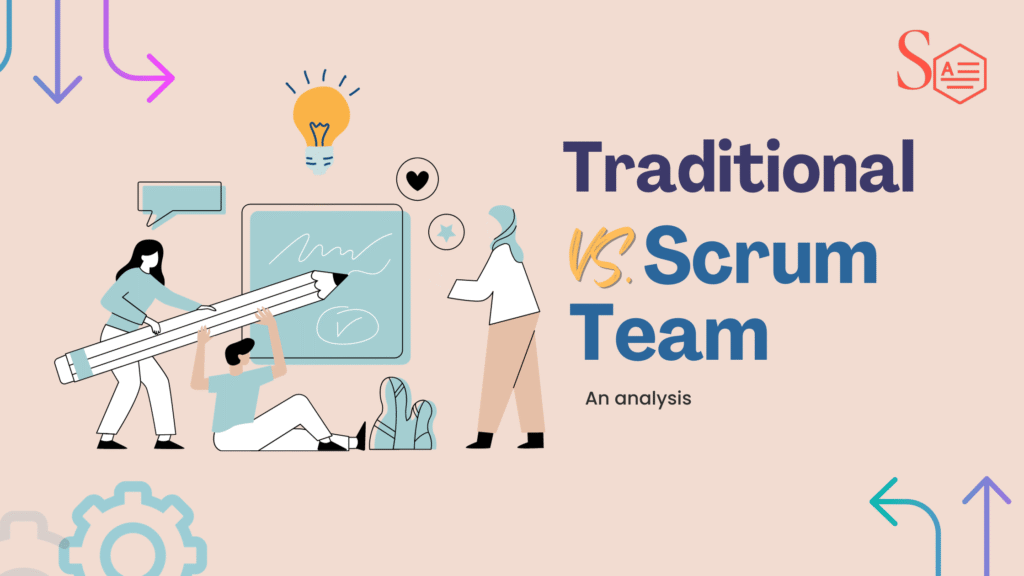
- Waterfall is a sequential, phase-gated model: each stage must finish before the next begins and you can't loop back, which makes mid-project change expensive.
- Scrum is iterative and incremental, delivering a shippable product every 2 to 4 week sprint so the work keeps pace with shifting market needs.
- Waterfall teams are hierarchical and role-specialized (Project Manager, Business Analyst, Developers, Testers); Scrum teams are flat, cross-functional, and self-organizing (Product Owner, Scrum Master, Development Team).
- A Project Manager controls scope, schedule, budget, and risk, while a Product Owner owns vision, backlog priority, and value, and does not manage people or timelines.
- A Business Analyst gathers and documents requirements; a Scrum Master coaches the team, facilitates events, and removes impediments rather than owning requirements.
- No framework is universally right: choose Waterfall for stable, well-defined projects and Scrum for fast-moving work that expects change, based on what the project actually demands.
-
The Waterfall Model: Stages and Roles
Introduces Waterfall as the traditional, sequential software development life cycle where each phase must be completed before the next and there's no going back, like water that can't flow upward.
-
Stages of Waterfall; the basics
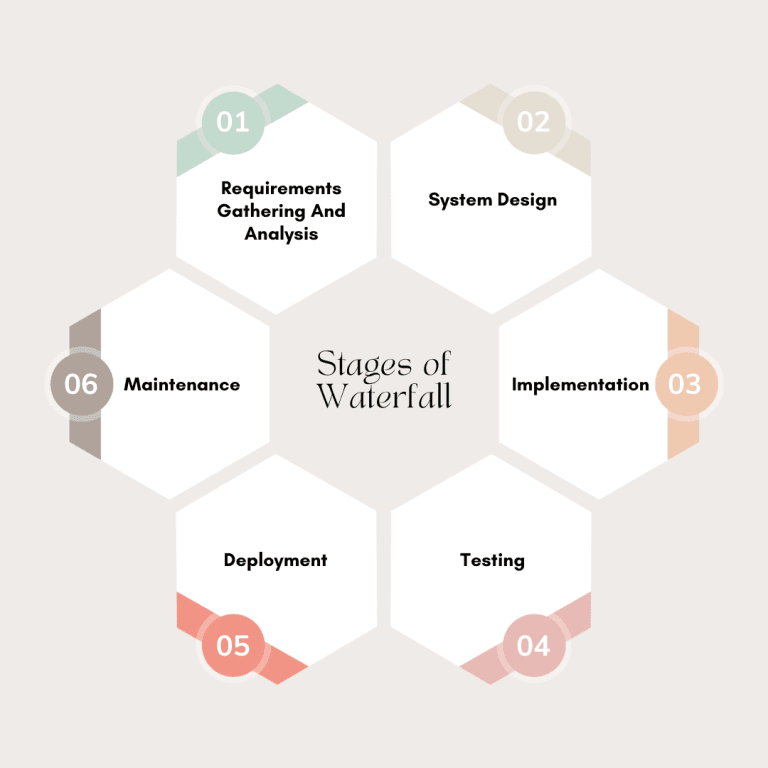
Walks through the six linear phases: requirements gathering and analysis, design, implementation, testing, deployment, and maintenance, with each phase fully completed before the next.
-
Waterfall Team Roles
Describes the specialized roles in a Waterfall team, Project Manager, Business Analyst, Developers, Testers, and supporting roles like quality managers and architects, each tied to specific phases.
-
Scrum Workflow and Roles
Explains Scrum as an agile framework that breaks work into 2 to 4 week sprints, requiring minimal upfront planning and producing incremental, shippable product versions each cycle. Outlines the workflow from Initiation through Sprint Planning, Implementation, Review and Retrospective, and Release.
-
The Scrum Team Roles
Defines the three Scrum roles: the Product Owner who owns the 'what' and the backlog, the Scrum Master as servant leader who facilitates events and removes obstacles, and the self-organizing Development Team that builds and delivers each increment.
-
Traditional vs. Scrum Teams: Key Differences
Contrasts the two approaches across structure, workflow, change handling, roles, delivery, and focus, then compares Project Manager vs. Product Owner and Business Analyst vs. Scrum Master to clarify how the roles differ.
-
Conclusion
Argues that no single framework fits every project: Waterfall suits stable, well-defined work while Scrum suits fast-moving, change-driven teams, so teams should choose based on their project's actual demands rather than convention.
With the world accelerating to grow digital, the tactics to thrive in the market changes are also increasing exponentially. Businesses have begun adopting frameworks and processes that best enable them to adapt to these advancements. There are several methodologies and frameworks to managing projects, with Waterfall and Scrum being two of the most well-known. Both Waterfall and Scrum have different team structures and workflow patterns. However, individuals sometimes need help understanding the differences between how both teams work. This blog will address your question, “What differs between a Traditional vs. Scrum Team? “We will also explore the basics of the frameworks and workflow patterns to understand the team roles better.
The Waterfall Model: Stages and Roles
Also known as traditional methodology, the waterfall is one of the earliest and oldest models of the software development life cycle. It takes a sequential approach to create software or applications. It consists of various stages one must go through during development. Each phase must be completed before the beginning of the next one, and developers can’t go back to earlier phases, just like water in a waterfall (water that falls cannot go up again
Stages of Waterfall; the basics
1. Requirements gathering and analysis: The technical and financial feasibility of building a software product is assessed as the first phase. The requirements are prioritized to meet the businesses’ and stakeholders’ needs. It involves identifying project risks, assumptions, quality requirements, costs, and timelines.
2. Design: The emphasis on “What to develop” in the initial stage shifts to “How to develop” in the design phase. It involves assigning, developing, and architecture. The design serves as a road map to finish the project, covering the timetable, budget, and goals.
3. Implementation: The project concept and design are implemented during this phase to create the intended product. Everything at this stage should be done extremely carefully and documented, including creating code, writing test scripts, etc.
4. Testing: Testing comprises verifying that the product meets all requirements. Before being made available to users, a piece of software is given to the software testers for testing. Once the product meets the various quality metrics, it is prepared for release. Otherwise, the product team has to go back and review the project from phase one.
5. Deployment: The fully tested software is released to users. This marks the final step in the linear development process, involving installation, configuration, and user training. It represents the transition from development to practical use.
6. Maintenance: Various upgrades may be necessary for a software product to continue working in the real world. This task is handled during maintenance by promptly modifying the software to meet the needs.
Waterfall Team Roles
Project Manager: Project managers are in charge of managing projects and controlling constraints, including scope, quality, cost, and time. They plan resources, manage risks, and create work schedules following those plans. To finish the project on time, they must ensure everyone is equipped with the required tools.
Business Analyst: A business analyst ensures all the requirements are considered and transformed into the system’s functional specification deliverables. A business analyst usually carries out the feasibility analysis of the software project. Once the project is approved, a project manager steps in to see it through.
Developers: Developers serve as the ones who bring an IT project to life. They write the code and need to be cautious not to make any mistakes because a single mistake might require the project to start over.
Testers: While the developers make the code, testers break the code. The last stage involves testing. Their task is to find errors and bugs in the software, which could lead to its return to the developers.
Other Roles: Different IT projects require different levels of support. Depending on the size of the project and organization, the requirements differ. Quality managers, system administrators, and technical architects will also likely be involved in some projects.
Scrum Workflow and Roles
Scrum is a project management framework that adheres to the agile philosophy. It allows teams to collaborate in an effective, structured manner. With Scrum, the development phases are divided into sprints, stages, or cycles. Not extensive, but just enough planning is required to start the project. Once it starts, the emphasis is on developing the project with the bare minimum of basic features before testing and reviewing it. By the end of the cycle, a shippable product is developed. This process takes around 2 to 4 weeks and is repetitive. It results in several distinct versions or incremental releases known as sprints.
Benefit? Significantly enhanced versions of the same product, each maintaining pace with external market progress.
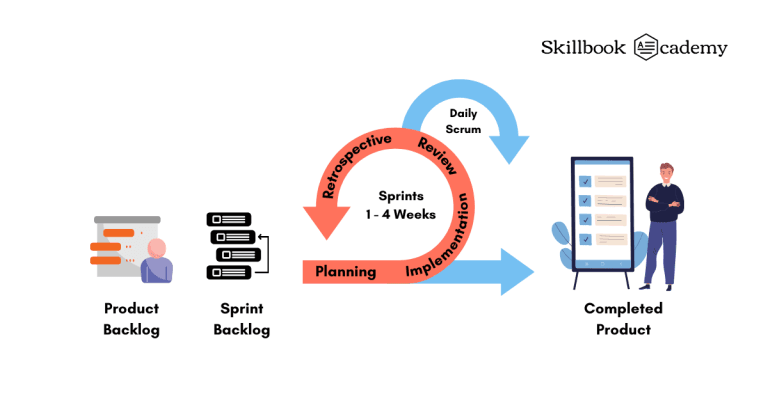
Scrum® Workflow
Initiation
Product vision is defined, stakeholders identified, and a prioritized Product Backlog is created.
Sprint Planning and Estimation
The team selects backlog items and defines a Sprint Goal. A Sprint Backlog is created.
Implementation (Sprint Execution)
The team builds, tests, and integrates features while holding Daily Stand-ups and refining the backlog.
Review and Retrospective
Work is reviewed with stakeholders, and the team reflects on improvements for the next sprint.
Release
Completed increments are released as needed. Lessons learned are documented and applied going forward.
Scrum® is iterative, meaning this cycle repeats until the product reaches its desired state.
The Scrum Team Roles
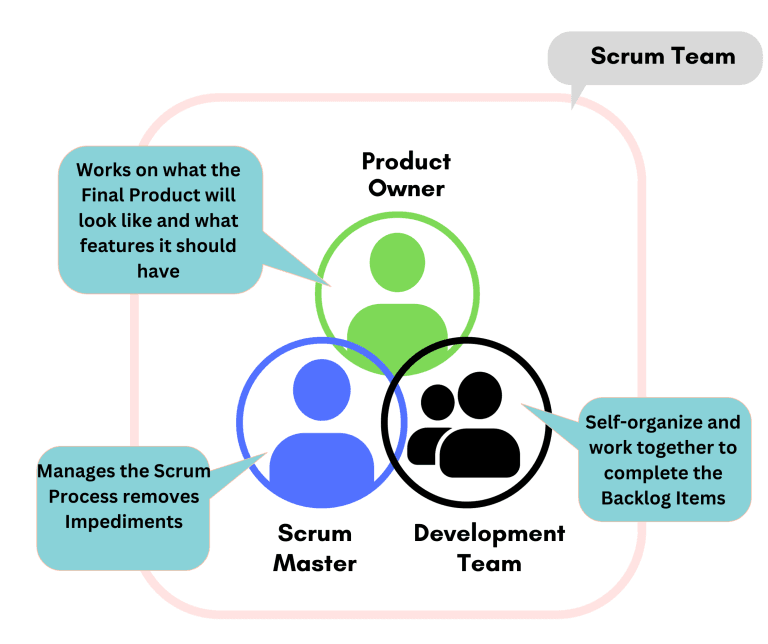
Product Owner: The product owner determines the “What” of a product. The product owner works on what the final product will look like and what features it should have. One of the essential duties is to interact with the stakeholder and customers, incorporate their needs into the product, and prioritize the work based on all of the information and customer goals. They must clearly define and maintain the product backlog, ensuring everyone knows the priority. They evaluate the work and provide feedback and suggestions for improving processes.
Scrum master: The Scrum master is a Servant Leader. They help the product team understand and apply Scrum to self-organize, focus on goals, and create product value. They help the product owner define the value to maximize ROI (return on investment). Daily stand-up meetings, sprint planning sessions, sprint reviews, and other activities are facilitated by the Scrum Master to keep the team on schedule and organized. The scrum master uses the data from these meetings to assist the product owner in maintaining and improving the backlog. They eliminate any distractions or obstacles that could impede the team’s progress.
Development team: They take a very “we”-focused approach to their projects. A development team consists of the individuals who plan, create, test and deliver the product increment. They work together to achieve necessary and promised objectives. Scrum teams self-organize and work together to complete the backlog items prioritizing quality within the sprint’s time. They participate in the scrum event and communicate frequently with the product owner and scrum master.
Traditional vs. Scrum® Teams: Key Differences
| Aspect | Waterfall Team | Scrum Team |
|---|---|---|
| Structure | Hierarchical | Flat, self-organizing |
| Workflow | Sequential | Iterative & incremental |
| Change Handling | Difficult and costly | Embraced and expected |
| Roles | Specialized per phase | Cross-functional |
| Delivery | End of project | Every sprint |
| Focus | Following plan | Delivering value |
Project Manager vs. Product Owner
- Project Manager (Waterfall)
Controls scope, schedule, budget, risks, and reporting.
- Product Owner (Scrum)
Owns product vision, backlog prioritization, and value delivery.
The Product Owner does not manage people or timelines in the traditional sense.
Business Analyst vs. Scrum Master
- Business Analyst (Waterfall)
Gathers and documents requirements, validates functionality, supports testing.
- Scrum Master
Facilitates Scrum events, coaches the team, removes impediments, and enables continuous improvement.
The Scrum Master focuses on process effectiveness, not requirements ownership.
Conclusion
Choosing a framework without understanding the project outcomes might not strike you as a wise business choice. To decide which approaches and team responsibilities are most compatible with your project, you should objectively evaluate the strengths and limitations of each because one size does not fit all.
Waterfall may be suitable for projects with clearly defined needs and less chance of change. Projects that require teams to complete each phase’s deliverables before moving on to the next can be successful with the waterfall method.
On the other hand, Scrum is better suited for teams who intend to experiment with market changes and move quickly. Scrum calls for a cooperative and self-driven squad and regular updates on the status of stakeholders and business owners.
The key is not to follow what the mass follows but what your project demands you to follow.
Related Courses & Certifications Training: Certified Scrum Master Certification Training | Advanced Certified ScrumMaster® Certification Training | Agile Coaching Skills Certified Facilitator Certification Training
Meet the Author

Kelly Clarkson
Contributing Writer
Kelly Clarkson is a contributing writer at Skillbook Academy covering Agile, SAFe and AI topics.