- Lean Portfolio Management (LPM) applies Lean thinking to portfolio governance, aligning the project portfolio with business strategy while minimizing waste and accelerating value delivery.
- SAFe LPM rests on three dimensions: Strategy and Investment Funding, Agile Portfolio Operations, and Lean Governance.
- LPM replaces top-down departmental control with collaborative, decentralized decision-making, lean budgets, and financial guardrails instead of rigid annual budgeting.
- Funding flows to high-value epics via tools like Portfolio Kanban and WSJF, with the PMO evolving into a value-focused VMO and a LACE supporting Agile Release Trains.
- Continuous, automated compliance and dynamic governance let organizations stay audit-ready and secure without slowing delivery.
- Adopting LPM helps enterprises break silos, respond faster to market shifts, and tie daily execution directly to strategic objectives.
-
What is Portfolio Management?
Defines portfolio management as overseeing a collection of projects, investments, and assets to meet strategic and financial goals. It balances risk against performance, optimizes resource allocation, and connects big-picture plans to execution across business, product, project, and IT portfolios.
-
What is Lean Portfolio Management (LPM)?
Introduces LPM as portfolio management infused with Lean principles to emphasize flexibility, speed, and efficient resource use. Covers how LPM aligns the portfolio with business objectives and holds top-level decision-making and financial accountability, then breaks down its three dimensions: Strategy and Investment Funding, Agile Portfolio Operations, and Lean Governance.
-
How is Lean Portfolio Management different from Traditional Portfolio Management?
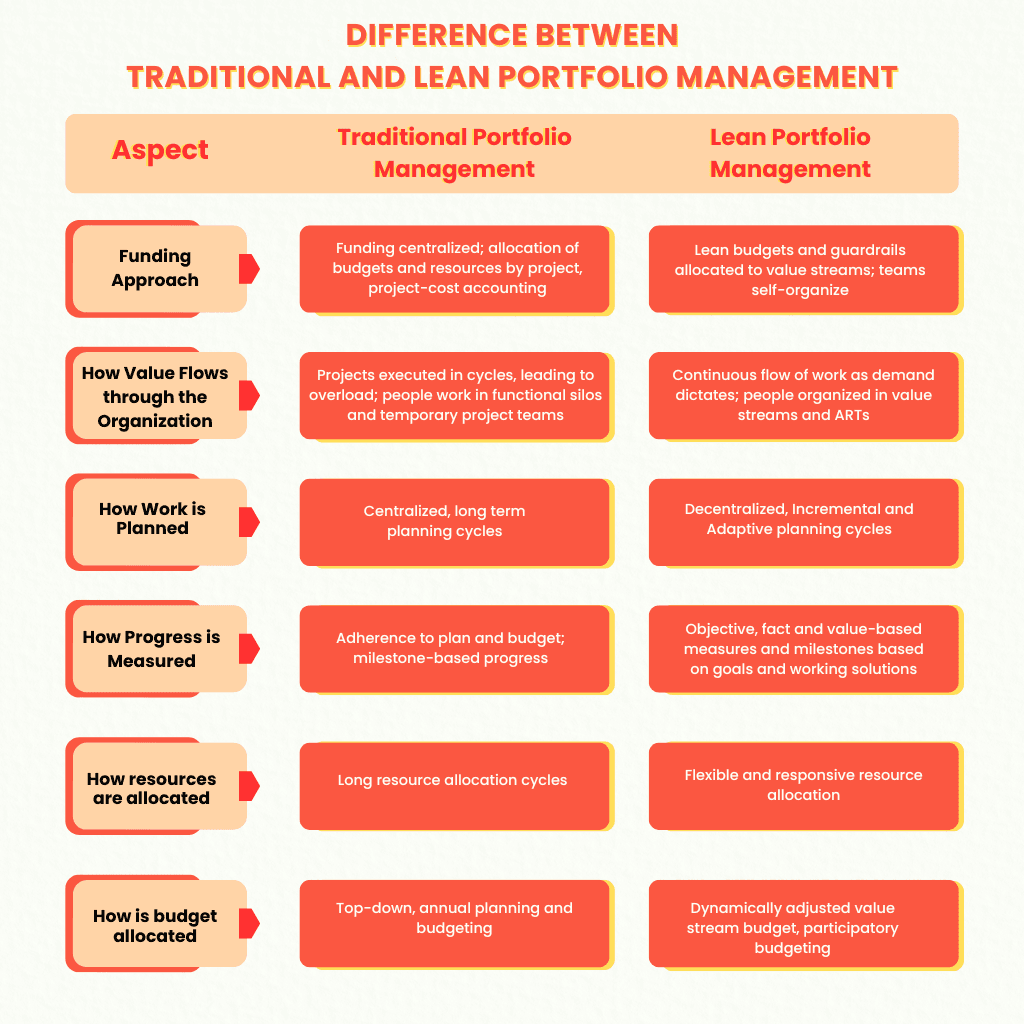
Contrasts SAFe's LPM with traditional models, noting LPM relies on collaborative financial decision-making and decentralized governance rather than a single department or chief manager. A comparison graphic illustrates the key distinctions.
-
Why you should consider Lean Portfolio Management in 2024?
Argues that traditional portfolio management is too slow for the digital age and positions LPM as a strategic necessity. It enables rapid responses to market shifts, smarter risk management, broken silos, better decisions, and tighter alignment between strategy and daily execution.
-
Benefits of Lean Portfolio Management
Lists nine benefits of LPM, including clear portfolio vision and alignment, adaptable roadmaps, lean budgets with guardrails, balanced workflows, decentralized execution via SAFe, lean governance, and continuous automated compliance that together create a responsive, competitive organization.
-
SAFe Lean Portfolio Management Course
Promotes Skillbook's SAFe LPM course, outlining learning objectives such as building a portfolio strategy and vision, managing Portfolio Epics and investment funding, applying Portfolio Kanban and WSJF, coordinating value streams and ARTs, and ensuring lean governance.
-
Concluding Thoughts
Closes by framing LPM as a vehicle for meaningful change built on lean principles, collaboration, and relentless focus on customer value, calling it a strategic imperative for organizations in 2024.
Organizations are turning to agile frameworks. Sure, you have heard that!
In the face of escalating costs and the imperative to deliver value swiftly and efficiently, organizations are turning to agile frameworks. Additional structure is essential to coordinate agile teams and maximize their potential effectively. Organizations struggle to align investments with goals amidst competing priorities. This is why Lean Portfolio Management in 2024 emerges as an essential component and as the backbone that sustains companies amid the relentless pace of technological evolution and market fluctuations.
What is Portfolio Management?
Portfolio management involves overseeing a collection of projects, investments, or other assets to achieve specific financial or strategic goals. In a business context, Portfolio Management means managing various projects or products to ensure they collectively meet the company’s objectives efficiently and effectively. The aim is to balance risk against performance, allocate resources optimally, and ensure that the overall portfolio aligns with the organization’s strategic direction.
Portfolio management leadership teams help connect a company’s big-picture plans to what actually gets done. Organizations manage various types of portfolios, including Business, Product (Line), Project Portfolio, IT Project, etc.
What is Lean Portfolio Management (LPM)?
Building on the concept of portfolio management, Lean Portfolio Management (LPM) integrates principles from Lean thinking. Lean principles focus on maximizing value by minimizing waste and inefficiencies. In LPM, the portfolio is managed in a way that emphasizes flexibility, speed, and the efficient use of resources.
Exploring Lean Portfolio Management (LPM)
Lean Portfolio Management (LPM), guides organizations in delivering value in a lean-agile environment. It aligns the project portfolio with business objectives, optimizes resource allocation, and fosters continuous improvement. LPM provides a structured framework for decision-making, prioritization, and governance, ensuring efficient resource use and responsiveness to customer needs and market changes. It holds the highest level of decision-making and financial accountability for a portfolio’s solutions and development value streams. Individuals in LPM roles, are responsible for business outcomes and aligning strategy with actions.
The Three Dimensions of LPM
Strategy and investment funding: Strategy and investment funding ensure the portfolio aligns and is funded to meet business targets. Lean Portfolio Management (LPM) involves developing a clear portfolio vision, guided by detailed roadmaps for major initiatives and timelines. Enterprise architects support this planning with a robust technological framework, ensuring project viability and adaptability. LPM manages large-scale projects called epics through a flexible process, staying aligned with the evolving business environment. Funding is controlled with lean budgets and financial guardrails, maintaining spending control and adaptability. LPM also balances new development with ongoing maintenance, ensuring efficient resource utilization.
Agile Portfolio Operations: Agile Portfolio Operations enhance coordination and support for decentralized project execution, leveraging SAFe principles to empower teams and align with business goals. This approach manages project interdependencies (value streams) to optimize performance and foster innovation. The Lean-Agile Center of Excellence (LACE) supports Agile Release Trains (ARTs) with best practices, troubleshooting, and ensuring continuous workflow. The shift from traditional Project Management Offices (PMOs) to Value Management Offices (VMOs) emphasizes decentralized, value-focused management, continuous improvement, and operational excellence. Agile Portfolio Operations streamline processes, enhance efficiency, and maintain a steady workflow, driving the organization toward its strategic objectives.
Lean Governance: Lean governance oversees spending, auditing, security, compliance, and performance with dynamic adjustments based on ongoing project evaluations. The goal is to align financial decisions with strategic objectives, ensuring spending directly supports business goals. Performance metrics assess customer needs, workflows, and strategic aims to inform resource allocation. Continuous compliance manages risks and integrates governance throughout the project lifecycle with automation, ensuring regulatory adherence without slowing processes. Lean governance fosters a responsive, agile management style that adapts to changes, maintains compliance and security standards, and relies on automation for efficiency and speed.
How is Lean Portfolio Management different from Traditional Portfolio Management?
Unlike traditional portfolio management, SAFe’s LPM doesn’t rely solely on a designated department or a chief manager. Instead, it focuses on a collaborative approach to financial decision-making, opportunity flow, governance, and fostering a new working method. This article delves into the essence of LPM in SAFe, providing practical insights for organizations looking to embrace business agility.
LPM is different from traditional portfolio management in various aspects, some of which are listed below.
Why you should consider Lean Portfolio Management in 2024?
Traditional portfolio management falls short in the digital age, where speed and innovation reign supreme. In 2024’s ever-changing business landscape, Lean Portfolio Management isn’t just a choice; it’s a must. LPM empowers swift responses to market shifts, seizing new opportunities while managing risks smartly. It’s all about delivering value to customers and boosting ROI. By breaking down silos between teams and fostering collaboration, LPM drives innovation and efficiency. It’s the compass guiding organizations to align strategies with daily actions, make better decisions, and confidently navigate uncertainty.
Embracing a culture of continuous improvement, LPM helps organizations stay competitive by aligning strategic objectives with day-to-day execution, improving decision-making, and adapting to uncertainty. Lean Portfolio Management enables organizations to prioritize high-value tasks, allocate funding accordingly, and establish feedback mechanisms for accelerated delivery. As a result, companies devote resources more effectively to meaningful endeavors.
Benefits of Lean Portfolio Management
Let’s explore the various benefits implementing Lean Portfolio Management (LPM) brings:
- LPM ensures a clear vision for the portfolio’s future, aligning projects with business targets. This clarity helps teams understand their role in achieving organizational goals, fostering alignment across the entire portfolio.
- Detailed roadmaps and technological frameworks enable efficient project planning and execution. This ensures that initiatives are feasible and adaptable to future changes and innovations, enhancing overall project success.
- LPM allows for adjustments based on feedback and new insights, ensuring that projects remain aligned with the evolving business environment. This adaptability helps organizations respond effectively to changing market conditions or internal needs.
- Lean budgets and financial guardrails keep spending in check while allowing flexibility to adapt to new opportunities or challenges. This approach ensures that financial resources are used efficiently, maximizing the value delivered by projects.
- LPM prioritizes balanced workflows, ensuring a smooth blend of new development and ongoing maintenance to prevent bottlenecks. This streamlined approach optimizes resource utilization, enhancing efficiency and productivity. Agile Portfolio Operations further streamline processes, maintaining a steady workflow that drives the organization towards strategic objectives, fostering innovation, and optimizing overall performance.
- LPM enhances coordination and support of decentralized project execution within the organization. By leveraging SAFe principles and Agile Portfolio Operations, teams are empowered to work towards broader business goals while managing interdependencies effectively.
- Lean governance ensures efficient oversight of spending, auditing, security, compliance, and performance. By shifting from rigid budgeting to dynamic adjustments, organizations can make informed decisions that directly contribute to business goals while remaining compliant and secure.
- Continuous compliance manages risks effectively, integrating governance throughout the project lifecycle with automation. This ensures regulatory adherence without slowing down processes, maintaining high standards of compliance and efficiency.
- Overall, implementing LPM fosters a responsive, agile management style that stays aligned with strategic goals, adapts to changes, and maintains compliance and security standards. This agility enables organizations to respond quickly to market shifts and customer needs, gaining a competitive edge in the industry.
SAFe® Lean Portfolio Management Course
Our Lean Portfolio Management course provides a comprehensive understanding of managing portfolios within the SAFe® framework. Throughout the course, you’ll develop a Lean-Agile mindset and learn to navigate challenges like project-cost accounting while embracing Lean Portfolio Management as a transformative process. Key learning objectives include establishing a portfolio strategy and vision aligned with enterprise goals, mastering the management of Portfolio Epics and investment funding, and implementing Agile portfolio flow using tools like Portfolio Kanban and the WSJF method. You’ll also gain expertise in Agile Portfolio Operations, including Value Stream Coordination and executing Agile Release Trains (ART) while ensuring Lean governance through effective measurement of Lean Portfolio Performance and continuous compliance. With hands-on experience and practical exercises, this course equips you to drive organizational agility and maximize value delivery in today’s dynamic business landscape.
Concluding Thoughts
Lean Portfolio Management isn’t just about managing portfolios; it’s about driving meaningful change. It’s about empowering teams, fostering collaboration, and delivering customer value. In a world where change is constant and competition is fierce, LPM offers a roadmap to success—a roadmap built on lean principles, collaboration, and a relentless focus on customer value.
In 2024, Lean Portfolio Management isn’t just a trend; it’s a strategic imperative for organizations.
Meet the Author

Kelly Clarkson
Contributing Writer
Kelly Clarkson is a contributing writer at Skillbook Academy covering Agile, SAFe and AI topics.