- SAFe transformation is a mindset and operating-model shift, not just a process change. It touches leadership behavior, organizational structure, and how value is delivered across teams, programs, and portfolios.
- SAFe rests on four core values (Alignment, Transparency, Respect for People, Relentless Improvement) and ten Lean-Agile principles that prioritize economic thinking, systems thinking, decentralized decisions, and organizing around value.
- Five pillars carry a rollout: visible leadership commitment, comprehensive training, a Lean-Agile mindset, Agile Release Trains, and a culture of continuous improvement.
- Begin deliberately: clarify why change is needed, set a vision rooted in SAFe principles, assess and baseline the current state, then launch small ARTs and scale gradually rather than transforming everything at once.
- Expect predictable obstacles such as change resistance, cross-team alignment, skill gaps, and local-versus-system trade-offs, and counter them with PI planning, training, and a systems-thinking lens.
- Experienced SAFe implementation experts accelerate transformation by bringing case studies, tailoring the framework to context, building internal champions, and providing unbiased mentoring and coaching.
-
What Is SAFe Transformation?
Defines SAFe transformation as the deliberate, enterprise-wide adoption of the Scaled Agile Framework to scale Agile practices, framed as a survival requirement rather than a competitive edge. This section then unpacks SAFe's four core values and ten Lean-Agile principles, the five pillars of successful implementation, an eight-step journey for getting started, the common challenges teams face, and the role specialized implementation experts play.
-
Conclusion
Uses Allen Ward's notion of a strategic inflection point to argue that traditional organizations must transform or risk obsolescence. It reinforces that SAFe, grounded in Lean, Agile, and DevOps, delivers agility and customer-centricity, but only with the right strategy and expert guidance.
If your organization is struggling to respond rapidly to market shifts, evolving customer expectations, or technological disruption, it may be time for a cultural and operational transformation. In today’s environment, speed, adaptability, and customer centricity are no longer optional, they are essential.
This is where SAFe® Transformation becomes a powerful enabler.
The Scaled Agile Framework (SAFe®) is a globally adopted approach that helps organizations achieve business agility by scaling Agile® practices across the enterprise, at the team, program, portfolio, and organizational levels. SAFe® provides a structured yet flexible path to adapt quickly to market dynamics while remaining relentlessly focused on customer value.
What Is SAFe® Transformation?
Adaptation is no longer a competitive advantage, it is a survival requirement. Organizations must continuously evolve to keep pace with customer needs, emerging technologies, and unpredictable market conditions. Traditional operating models often struggle to respond effectively in this fast-changing landscape.
SAFe® Transformation refers to the deliberate adoption of SAFe® across the organization to scale Agile® practices effectively. It involves more than process change, it requires a shift in mindset, leadership behavior, organizational structure, and execution models.
A successful SAFe® transformation enables organizations to:
- Align strategy with execution
- Improve collaboration across teams and value streams
- Accelerate time-to-market
- Foster continuous learning and improvement
- Enable data-driven, decentralized decision-making
By embracing calculated risks and informed decision-making, organizations become more resilient and better equipped to navigate complexity and uncertainty.
Understanding SAFe®: An Overview
SAFe, or the Scaled Agile Framework, guides enterprises in scaling lean and agile practices through organizational and workflow patterns. It promotes alignment, collaboration, and delivery across multiple agile teams by integrating principles from Lean, Agile, and DevOps to support large-scale, complex projects.
The Four Core Values
SAFe’s effectiveness relies on its four core values:
- Alignment
- Transparency
- Respect for People
- Relentless Improvement
Read more about SAFe® Core Values
SAFe Lean-Agile Principles
SAFe is founded on ten fundamental Lean-Agile principles that guide its roles and practices:
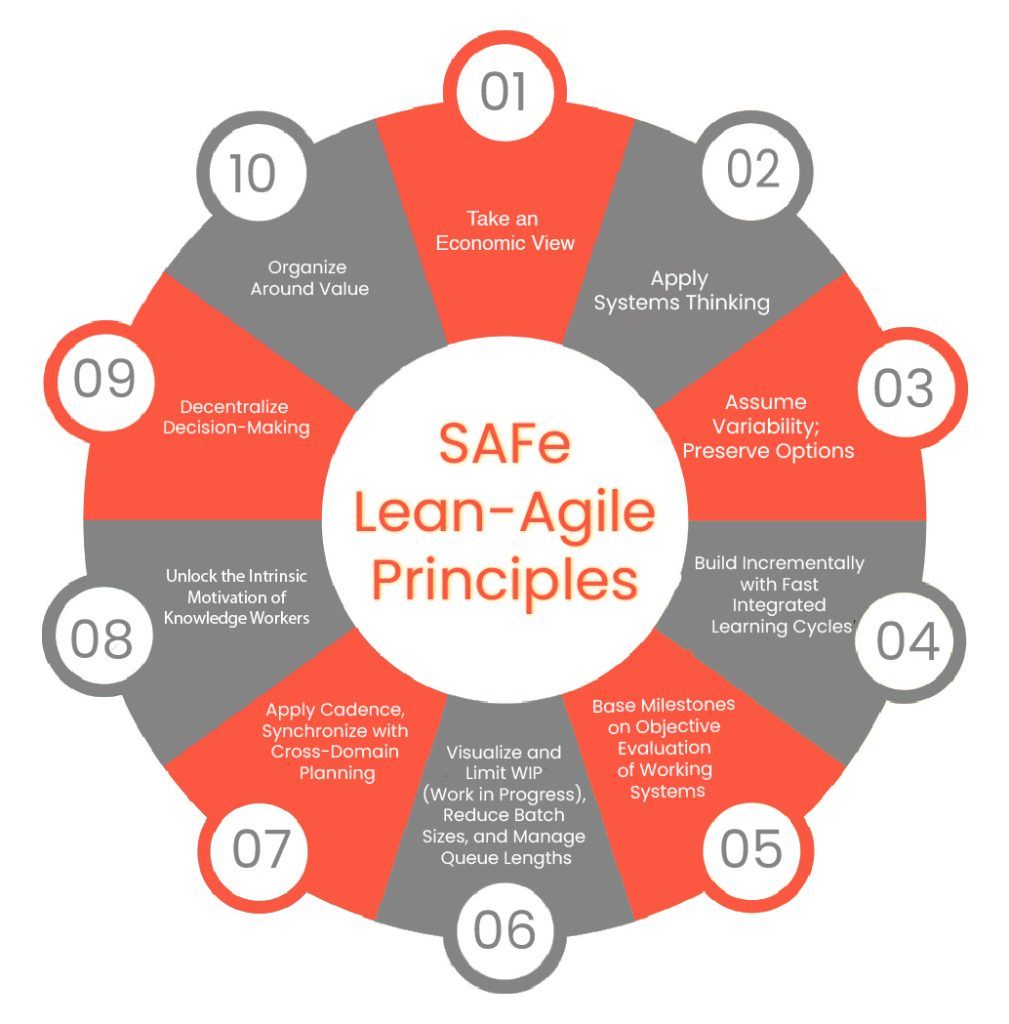
SAFe Lean-Agile Principles
- Take an Economic View: Focus on the economic impact of decisions to maximize value for the customer and optimize the entire value stream.
- Apply Systems Thinking: View the organization as a system of interconnected parts, optimizing the whole rather than just individual teams or departments.
- Assume Variability; Preserve Options: Embrace uncertainty by keeping options open as long as possible, allowing flexibility and adaptation.
- Build Incrementally with Fast Integrated Learning Cycles: Deliver value in small increments with fast learning cycles, enabling rapid feedback and continuous improvement.
- Base Milestones on Objective Evaluation of Working Systems: Set milestones based on working systems’ performance to ensure measurable progress aligned with business goals.
- Visualize and Limit WIP (Work in Progress), Reduce Batch Sizes, and Manage Queue Lengths: Use visual tools to track progress, limit WIP, reduce batch sizes, and manage queues to improve efficiency.
- Apply Cadence, Synchronize with Cross-Domain Planning: Use regular planning, execution, and delivery cycles to synchronize activities across teams and domains, ensuring alignment.
- Unlock the Intrinsic Motivation of Knowledge Workers: Foster autonomy, mastery, and purpose to motivate knowledge workers, driving innovation and higher performance.
- Decentralize Decision-Making: Empower teams to make decisions quickly, increasing agility and responsiveness to changes.
- Organize Around Value: Structure teams and resources around delivering value to the customer, aligning work with customer needs and business outcomes.
Key Pillars of Successful SAFe® Implementation
- Leadership Engagement and Commitment: Leadership involvement is critical for driving successful SAFe® implementation. Executives and senior management must actively champion Agile values and practices, demonstrating unwavering support throughout the transformation journey.
- Comprehensive Training and Education: Equip teams with essential SAFe knowledge and skills through comprehensive training sessions to ensure a shared understanding and consistent implementation of Agile methodologies.
- Cultivating a Lean-Agile Mindset: Shift from traditional command-and-control structures to a Lean-Agile mindset, encouraging adaptability, responsiveness, and a focus on delivering customer value.
- Agile Release Trains (ARTs): Establish ARTs, which are cross-functional teams aligned around a shared mission to deliver value consistently, enabling synchronization and collaboration across multiple teams.
- Embracing Continuous Improvement: Foster a culture of continuous improvement by regularly assessing processes, outcomes, and feedback loops to remain responsive to market changes and enhance productivity.
How to Begin Your SAFe® Transformation Journey
- Clarify the Need for Change: Understand why there is a need for change and articulate a compelling vision for transformation.
- Establish the Change Vision: Root the vision in the Lean-Agile Mindset and SAFe Principles, outlining specific objectives and baseline metrics.
- Assess the Current State: Evaluate existing processes, culture, and capabilities to identify areas for improvement and readiness for an agile transformation.
- Evaluate the Baseline: Create a customized model for assessing maturity and measuring progress.
- Strategize the Key Steps: Collect and analyze baseline data, communicate the target maturity level, and prepare for key categories including organizational readiness, content readiness, logistics, and enablers.
- Educate and Empower Leaders, Stakeholders, and Teams: Ensure leaders and stakeholders understand SAFe® principles and provide training for teams on Agile methodologies and SAFe® practices.
- Create Agile Release Trains (ARTs): Establish ARTs aligned with value streams and business units.
- Start Slow: Implement small, manageable changes to minimize disruption and gradually scale up.
Common Challenges in SAFe® Implementation
- Resistance to Change and Cultural Alignment: Address resistance by fostering a culture of openness and continuous learning.
- Ensuring Alignment Across Teams and Continuous Improvement: Use regular PI planning and synchronization meetings to maintain alignment and promote continuous improvement.
- Training and Skill Development: Provide comprehensive training on Agile methodologies and SAFe® practices.
- Implementing Agile Release Trains (ARTs) and Logistics Planning: Focus on setting up and managing ARTs effectively.
- Balancing Local Optimization with System-wide Impact: Use a systems thinking approach to measure overall business outcomes.
- Scaling Agile Across Complex Organizations and Sustaining Change: Utilize SAFe® scaling frameworks and develop a change management strategy that includes continuous training and regular assessments.
Role of SAFe® Implementation Experts
- Onboarding Stakeholders with Case Studies and Strategic Analysis: Experts bring valuable case studies and strategic analyses to facilitate stakeholder onboarding.
- Collaborative Partnership with Internal Teams for Change Leadership: Experts work with internal teams to establish centers of excellence and empower internal champions.
- Providing Fresh Perspectives for Innovative Solutions: Experts tailor the SAFe® framework to fit the organization’s specific context and needs.
- Tailoring Expertise to Fit Organizational Context: Experts customize implementation strategies and practices to align with organizational goals.
- Bringing Credibility, Authenticity, and Unbiased Guidance: Experts offer credibility and unbiased views through their track record of successful transformations.
- Assessing Critical Paths and Facilitating Strategic Resolution: Experts identify critical paths and potential roadblocks.
- Continuous Development through Training and Mentoring: Experts provide ongoing mentoring and coaching to develop internal competencies in SAFe® practices.
At Skillbook Academy, we specialize in professional development through Agile Training and provide comprehensive solutions for business and product agility. From individual coaching to team development and entire organizational transformation, we address all aspects of agile implementation. Discover how we can help you achieve business agility! Reach out to us today for a personalized agile assessment and transformation strategy.
Conclusion
In the words of Allen Ward, “A strategic inflection point is that moment when technological advancements, market changes, and customer expectations demand a company to either transform radically or face obsolescence.” This resonates profoundly in today’s fast-paced business environment. Traditional organizations now confront immense challenges due to rapid technological changes, dynamic markets, and evolving customer demands.
SAFe® transformation provides a structured approach to tackle these challenges, empowering organizations to foster agility and customer-centricity at every level. By embracing SAFe® principles grounded in Lean, Agile, and DevOps methodologies, businesses can streamline operations, boost collaboration, and expedite value delivery to customers. However, successful adoption hinges on implementing the right strategy and receiving expert guidance, as outlined in this blog. A well-defined strategy ensures that organizations can navigate the complexities of transformation effectively, driving sustainable success and achieving their business objectives.
Related Courses & Certification Training: SAFe® Practice Consultant Certification Training | SAFe® Lean Portfolio Management (LPM) Certification Training | SAFe® Release Train Engineer (RTE) Certification Training
Meet the Author

Sam Martin
Contributing Writer
Sam Martin is a contributing writer at Skillbook Academy covering Agile, SAFe and AI topics.