- Bring leaders, customers, and team reps into the transformation from day one so they become advocates instead of blockers and resistance drops before it can take hold.
- Measure success by business value, not feature count: track time-to-market, customer satisfaction, revenue impact, and quality rather than raw output.
- Push decision-making down to empowered teams and make customer value the primary filter for every call.
- Roll out SAFe incrementally, starting with a single pilot team or value stream with clear scope and success criteria, then scale on the strength of early wins.
- Move fast once direction is set, decisive action and quick, visible wins build the momentum and leadership trust that sustain change.
- Treat Agile and SAFe as a people-centered mindset shift toward continuous improvement, not rigid adherence to a framework.
-
1. Involve Stakeholders Early
Early, active engagement of leaders, customers, and team representatives aligns strategy with execution and reduces resistance. Shared ownership surfaces risks sooner and turns potential blockers into advocates.
-
2. Identify Outcomes to Pursue (Not Just Outputs)
Warns against the common trap of counting delivered features instead of business value created. Teams should define the customer problems being solved and use outcome metrics like time-to-market, satisfaction, and revenue impact.
-
3. Put Teams and Customers at the Center of Decision-Making
Agile works best when teams have autonomy and customer feedback guides decisions, while bureaucracy is minimized. Customer value should serve as the primary decision filter to drive customer-centric innovation.
-
4. Implement Change Incrementally
Effective SAFe transformations start small, with a pilot team, product, or value stream, a defined scope, and measurable success criteria. Incremental adoption enables fast learning, early wins, and smoother scaling.
-
5. Take Action Quickly and Build Momentum
Once direction is clear, decisive action prevents the uncertainty caused by delay. Focusing on high-impact starting points and transparent communication of early value builds trust and sustained momentum.
-
Conclusion: Leading with Agile
Recaps that successful Agile and SAFe adoption is a mindset of continuous improvement, customer focus, and empowered teams rather than rigid framework compliance. Organizations that lead with agility consistently outperform those that resist change.
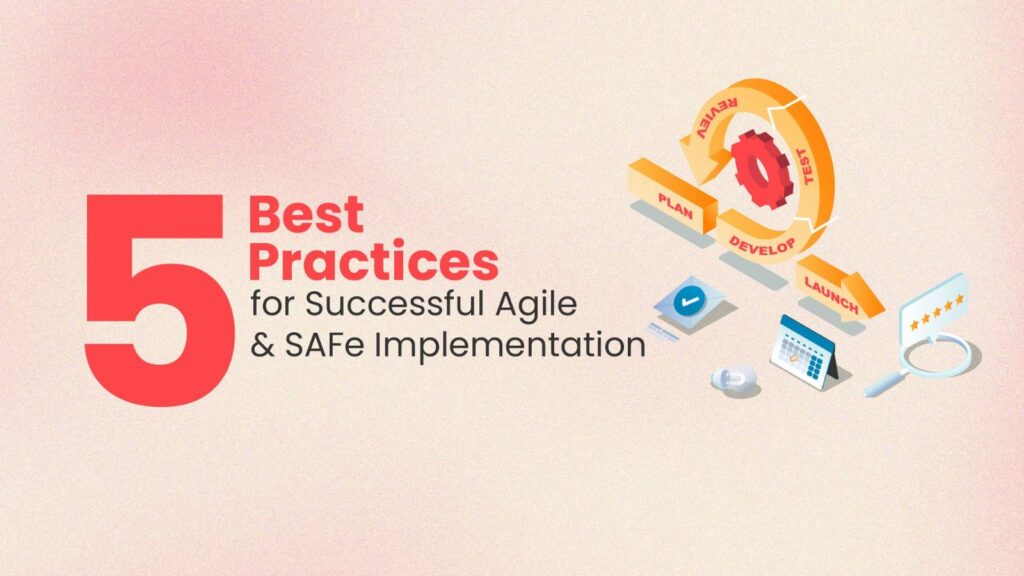
In today’s business environment, agility is no longer a luxury, it is a necessity. Organizations that successfully adopt Agile and SAFe® practices are better equipped to navigate constant change, drive innovation, and maintain a competitive edge. However, successful implementation requires far more than following a framework, it demands a strategic, people-centered transformation.
Drawing from experience working with 100+ organizations over the past decade, here are five proven best practices that enable sustainable and effective Agile and Scaled Agile Framework (SAFe®) adoption.
1. Involve Stakeholders Early
A successful Agile or SAFe® transformation begins with early and active stakeholder involvement. Engaging key stakeholders from the outset ensures alignment between enterprise strategy and execution, while also reducing resistance to change.
When leaders, customers, and team representatives participate early:
- Expectations are clarified
- Risks are surfaced sooner
- Stakeholders become advocates, not blockers
This shared ownership builds trust and creates a strong foundation for transformation.
2. Identify Outcomes to Pursue (Not Just Outputs)
One of the most common pitfalls in Agile and SAFe® adoption is focusing on outputs instead of outcomes. Agile success is not measured by how many features are delivered, but by the business value created.
Before starting your transformation, clearly define:
- What customer problems you are solving
- How success will be measured
- Which outcomes truly matter to the business
Outcome-driven metrics such as time-to-market, customer satisfaction, revenue impact, and quality improvements ensure teams remain aligned with strategic goals.
3. Put Teams and Customers at the Center of Decision-Making
Agile thrives in environments where teams are empowered and customers guide decisions. Excessive bureaucracy slows innovation, while disconnected decision-making leads to misaligned products.
Successful organizations:
- Grant teams autonomy to make fast, informed decisions
- Continuously gather and act on customer feedback
- Treat customer value as the primary decision filter
This approach fosters engagement, creativity, and customer-centric innovation, resulting in better outcomes for both teams and users.
4. Implement Change Incrementally
True agility does not mean changing everything at once. The most effective SAFe® transformations begin incrementally.
Start with:
- A pilot team, product, or value stream
- A clearly defined scope
- Measurable success criteria
Incremental adoption allows organizations to:
- Learn and adapt quickly
- Demonstrate early wins
- Build momentum and confidence
As success becomes visible, scaling across the organization becomes significantly smoother.
5. Take Action Quickly and Build Momentum
Speed matters in Agile transformations. Once direction is clear, decisive action is essential. Delays reduce confidence and create uncertainty.
Focus on:
- High-impact starting points
- Delivering early, visible value
- Communicating progress transparently
Quick wins build trust, energize teams, and reinforce leadership commitment, creating the momentum needed for sustained change.
Conclusion: Leading with Agile
Implementing Agile and SAFe® successfully is not about rigid adherence to a framework, it is about cultivating a mindset of continuous improvement, customer focus, and empowered teams.
By:
- Involving stakeholders early
- Focusing on outcomes
- Empowering teams and customers
- Implementing change incrementally
- Acting decisively
organizations can unlock the true potential of Agile and SAFe®.
In a fast-paced and unpredictable world, organizations that lead with agility will consistently outperform those that resist change, delivering exceptional value and staying ahead of the competition.
Related Courses & Certifications: SAFe® Lean Portfolio Management (LPM) Certification Training | SAFe® Release Train Engineer (RTE) Certification Training | SAFe® Practice Consultant Certification Training | Certified ScrumMaster (CSM) Certification Training | Agile Coaching Skills Certified Facilitator (ACSCF) Certification Training
Meet the Author

Harry Narang
SAFe® Practice Consultant & Agile Coach
Harry Narang is a SAFe® Practice Consultant and Agile Coach based in Toronto.