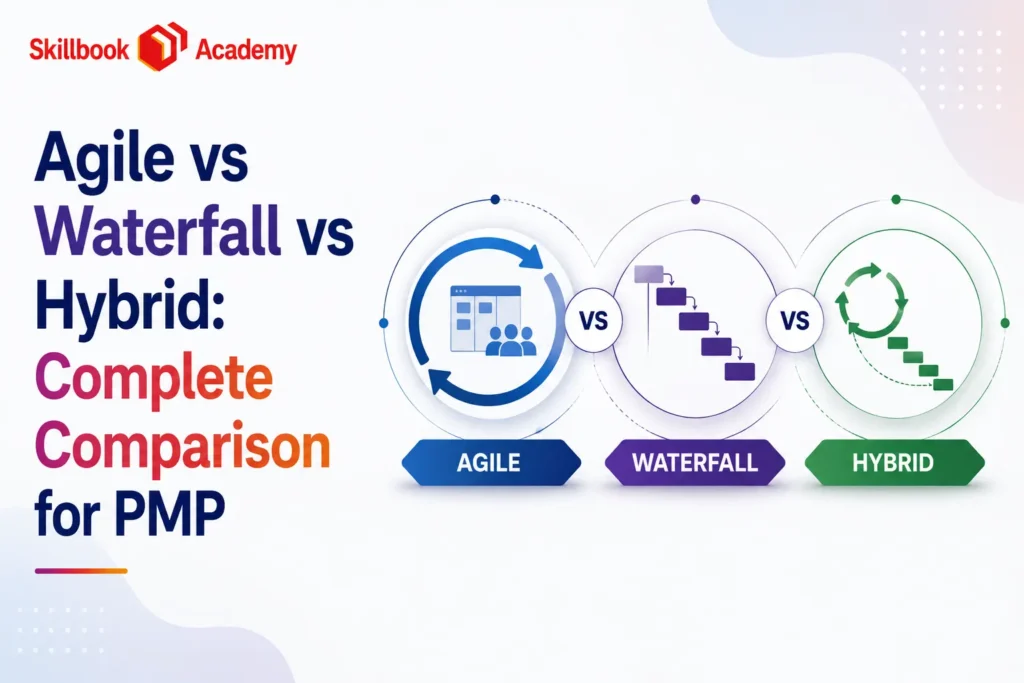
- Agile (adaptive) delivers value incrementally through short iterations and continuous feedback, making it suitable when requirements are uncertain, change is expected, and fast learning is valuable.
- Waterfall (predictive) defines scope, schedule, and budget upfront and uses sequential phases and formal change control, making it appropriate when requirements are stable and the cost of late change is high.
- Hybrid combines predictive governance and milestones with adaptive or iterative execution, making it useful when different parts of a project have different levels of uncertainty, regulation, or delivery requirements.
- For the PMP® exam, the choice is a tailoring decision—not a preference for Agile or Waterfall. PMI expects candidates to select the development approach based on the product, environment, stakeholders, requirements, and project constraints.
- Requirement stability, tolerance for change, regulatory burden, stakeholder availability, product type, team experience, and cost of late change are key factors when selecting a delivery approach.
- Predictive approaches favor stability and formal control, adaptive approaches favor learning and responsiveness, and hybrid approaches balance governance with adaptability.
- Hybrid is a deliberate delivery strategy, not a fallback when a team cannot choose between Agile and Waterfall. It can combine predictive milestones, funding, and regulatory controls with iterative software or product delivery.
- Agile does not mean eliminating planning, documentation, or governance. Agile teams use continuous planning and just-enough documentation while adapting plans based on feedback and changing conditions.
Direct Answer
Agile is an adaptive approach to delivering value. You build small increments and learn fast and adapt based on feedback. Waterfall (predictive) plans the full scope, schedule, and budget up front and moves through sequential phases. Hybrid blends both, typically using predictive governance and milestones with iterative execution inside. For the PMP exam, PMI speaks in terms of predictive, adaptive, and hybrid, and expects you to choose the right approach based on the product, environment, stakeholders, and constraints, a tailoring decision aligned with the PMBOK Guide Seventh Edition.
Why This Topic Matters for PMP Learners and Project Managers
Picking the wrong delivery approach can be one of the costliest mistakes a project manager makes. Run a regulated infrastructure program as fully agile, and it will likely fail an audit. Run a fast-moving consumer software project as waterfall, and you’ll probably miss the market window. The PMP exam tests this judgment heavily because PMI redesigned the credential to assess situational awareness across predictive, adaptive, and hybrid contexts.
For PMP-credentialed managers, this isn’t just exam theory. Most modern programs are hybrid. A typical enterprise initiative has predictive funding and milestones, but an iterative delivery engine inside. Sponsors want both a credible plan and a credible feedback loop at the same time. PMP candidates need a clear mental model of all three approaches, the trade-offs each makes on cost, schedule, scope, quality, risk, and stakeholders, and the criteria PMI uses to recommend one over another.
Core Definitions
What is Waterfall (Predictive) Delivery?
Waterfall, referred to as predictive in PMI terms, plans the project upfront and executes in sequential phases such as initiation, planning, design, build, test, and close. Scope, schedule, and budget are established early, baselined, and managed through formal change control. The PMBOK Guide Seventh Edition relates predictive delivery to stable requirements, known domains, and the high cost of change late in the project. For many construction, engineering, and regulated programs, Waterfall is still the right answer.
What is Agile (Adaptive) Delivery?
Agile, called adaptive in PMI terminology, plans incrementally and delivers in short iterations or continuous flow. Feedback reveals requirements, and the team is optimized for value, not sticking to an upfront plan. The PMI Agile Practice Guide describes agility as a mindset supported by frameworks (Scrum, Kanban, XP, and Lean) and technical practices (CI/CD and TDD). Agile works when you don’t know what you need, you expect change, and timely feedback creates value.
What is Hybrid Delivery?
Hybrid blends predictive and adaptive into a single project or program. Predictive milestones and governance with iterative execution in each phase is a common pattern. Another example of a hybrid approach is to use predictive methods for hardware or regulatory deliverables while applying agile methods for software components. The PMBOK Guide Seventh Edition treats hybrid as a normal, even dominant, mode of modern delivery and emphasizes tailoring to choose the right blend.
Detailed PMP-Focused Explanation
The PMP exam reframes the old “methodology debate” as a tailoring decision. The PMBOK Guide Seventh Edition organizes content around twelve principles and eight performance domains rather than predefined process groups. One of those domains is the development approach and life cycle, which directly maps to predictive, adaptive, and hybrid choices. PMI expects the candidate to evaluate the product, the environment, and the stakeholders before making a selection.
In predictive delivery, change control, baseline management, and earned value management dominate. The manager with the PMP credential protects the baseline, manages variance, and uses formal acceptance to close phases. The manager is focused on backlog, iteration goals, working agreements, and continuous stakeholder engagement in adaptive delivery. The plan is a forecast, not a contract. In hybrid delivery, the manager often holds two artifacts in parallel: a master schedule with milestones and a rolling backlog feeding iterative teams.
Cost, schedule, scope, quality, risk, and stakeholder management each behave differently across approaches. Predictive favors stability; adaptive favors learning; hybrid balances both. PMP exam scenarios typically describe the project context (regulation level, requirement clarity, stakeholder availability, team experience) and ask the candidate to pick or adjust the approach accordingly.
Key Differences
| Dimension | Waterfall (Predictive) | Agile (Adaptive) | Hybrid |
| Meaning | Sequential phases against an upfront baseline | Iterative or continuous delivery driven by feedback | Blend of predictive and adaptive elements |
| Purpose | Stability, predictability, formal control | Value, learning, rapid response | Governance plus responsiveness |
| When it happens | When requirements are stable and change is costly | When requirements evolve and feedback is critical | When parts of the project differ in stability and risk profile |
| Who is responsible | Project manager owns baseline; sponsor approves changes | Product owner, team, scrum master or coach, with PM facilitation | PMP-credentialed manager balances both with PMO support |
| PMP relevance | Process domain, integrated change control, EVM | Process and People domains, agile practice guide concepts | Tailoring principle, development approach domain |
| Example | Highway construction, regulated drug submission | Mobile app, internal SaaS, growth experiments | Banking platform with predictive compliance + agile features |
| Risk if misunderstood | Late discovery of misaligned requirements | Inadequate governance, scope drift | Confused roles, unclear cadence |
Practical Project Examples
Construction (Waterfall): A fully predictive delivery system is employed to construct an extension to an expressway. The detailed engineering, procurement, environmental permitting, and construction phases that follow occur in sequence. Formal change control governs change orders. The PMP project manager reports the earned value to government sponsors.
IT / SaaS (Agile): A scale-up is building a customer success platform in an agile way. The PMP delivery manager prioritizes backlog quality, throughput, and stakeholder feedback over a Gantt chart, while the team works in two-week iterations, engages in continuous discovery with users, and utilizes a CI/CD pipeline.
Banking (Hybrid): A retail bank modernizes core banking. Predictive plans with firm milestones support both regulatory submissions and hardware migrations. Agile teams use CI/CD to deliver features to customers. The PMP program manager oversees a master plan with milestone gates and an aggregated backlog that feeds multiple agile teams.
Healthcare (Hybrid) Hospitals keep electronic health records: They forecast the infrastructure rollout, training plans, and compliance documentation. Feedback can be incorporated into clinical modules in an agile way to configure and adjust. The PMP-credentialed manager is in charge of vendor, clinician, and IT coordination across both rhythms.
Engineering / Aerospace (Predictive w/ Agile pockets) The key objective of aircraft systems development for certification purposes is predictive development. Inside that envelope, cabin systems software development is agile. The hybrid wrapper retains certification artifacts and enables agile responsiveness.
Government (Hybrid): A national tax filing platform uses predictive funding and predictive accreditation while agile teams build the citizen-facing features. The PMP program manager bridges the two cultures, translates between them, and ensures that agile output feeds the predictive evidence trail.
PMP Exam and Certification Insights
The PMP Exam Content Outline groups roughly half its tasks under People, half under Process, and a smaller portion under Business Environment. Predictive content remains strongly tested in Process. Agile and hybrid content is woven across all three domains. The PMP exam mixes scenarios across the three approaches, so candidates must read carefully.
As of the July 2026 update, 40% of exam items are predictive approaches, and the other 60% are evenly split between adaptive/agile and hybrid approaches. These approaches are domain agnostic but distributed over all domains.
Some common traps are
Agile is consistently selected because of its modern connotations. Context fit is more important to PMI than bias.
Treating hybrid as a fallback for indecision. PMI treats hybrid as a deliberate, principled choice.
Confusing tailoring with abandoning governance.
Assuming a fixed-bid contract requires a waterfall. Many fixed-bid programs run agile internally.
Mnemonic for choosing an approach: SCRAP—Stability of requirements, change tolerance, regulatory load, available stakeholders, product type. High stability, low change tolerance, and heavy regulation typically indicate a predictive approach. Opposite indicators point to adaptation. Mixed indicators point to hybrid.
PMI’s framing in the PMBOK Guide Seventh Edition emphasizes that the approach should serve the principles—value, stewardship, quality, and adaptability—not the other way around. PMP candidates should not memorize which framework is “best”; they should articulate why a particular approach fits a given context.
Common Mistakes and Misconceptions
- Believing waterfall is obsolete. Many regulated and infrastructure programs require predictive rigor.
- Assuming agile means no documentation. Agile projects produce focused, just-enough documentation.
- Treating hybrid as “agile with extra meetings.” Hybrid is a tailored design choice, not laziness.
- Choosing an approach based on team preference rather than project context.
- Forgetting that the feasibility is dependent on organizational maturity. The traditional PMO can’t pivot overnight.
- Scrum as Agile. Scrum is one such approach; others include Kanban, XP, and Lean.
- Not recognizing the cultural change necessary to shift from predictive to adaptive.
- Not seeing the importance of contracts. Fixed-price waterfall contracts often dictate the approach.
- Forcing a single approach across a portfolio. PMI encourages tailoring per project.
- Treating PMP as a “waterfall certification.” The current PMP exam is heavily weighted toward agile and hybrid.
How to Apply This in Real Projects
Selection checklist:
- Are requirements stable and well-understood? Lean predictive.
- Is the product evolving with user feedback? Lean adaptive.
- Are some components stable and others evolving? Lean hybrid.
- What is the regulatory burden?
- What is the team’s experience and the organization’s culture?
- What does the contract or funding structure require?
- What is the cost of change late in the project?
Decision rules:
- Heavy regulation, capital-intensive, hardware-driven → predictive.
- High uncertainty, small batch sizes, software-heavy → adaptive.
- Mixed product, mixed regulation, multiple teams → hybrid.
Hybrid design tips:
- Define clear handoffs between the predictive and adaptive pieces.
- Cadences: Governance monthly, iterations biweekly, demos weekly.
- Use a shared roadmap with milestones and a rolling backlog
- Educate sponsors on what each cadence means for them.
Tip for communication:
- Translate agile metrics into steering committee predictive language.
- Translating predictive milestones into iteration goals for delivery teams.
- Maintain a single source of truth for status, regardless of approach.
Frequently Asked Questions
No. The current PMP Exam Content Outline is a test that evaluates predictive, adaptive, and hybrid approaches. By 2026, 60% of questions are in agile or hybrid contexts. The PMBOK Guide alone is not enough for proper preparation, but the PMI Agile Practice Guide is a must.
Waterfall is appropriate when requirements are stable, the cost of change is high late in the project, and the regulatory or contractual situation requires a documented sequential plan. Examples include large construction projects, drug submissions, aerospace programs, and capital infrastructure builds.
Agile works well when requirements are uncertain, fast feedback is valuable, and the cost of change is low. Examples include consumer software, internal SaaS, machine learning experiments, and growth efforts. Agile also requires empowered teams and engaged product owners.
Hybrid programs blend iterative execution with predictive milestones and governance. A common pattern is a master plan with quarterly milestones fed by agile teams running two-week iterations. PMP managers simultaneously possess both these perspectives for sponsors and teams.
No. Agile favors just-enough documentation: backlogs, acceptance criteria, architectural decision records, runbooks, and release notes. Agile also includes substantial multi-horizon planning. The plans are forecasts, not contracts. Agile teams plan continuously, document selectively, and govern transparently.
Utilize the development approach domain of the PMBOK Seventh Edition, which encompasses requirement stability, product, team experience, stakeholders, and regulation. Which components necessitate adaptive learning or predictive control? - Establish cadences and integration points, and revisit the design as conditions change.
Yes. The exam is scenario-based and heavily weighted on situational judgment across predictive, adaptive, and hybrid settings. Choosing the right approach based on context is a core competency of PMI tests.
Meet the Author

Aaron Jebin
Contributing Writer
Aaron Jebin is a contributing writer at Skillbook Academy covering Agile, SAFe and AI topics.