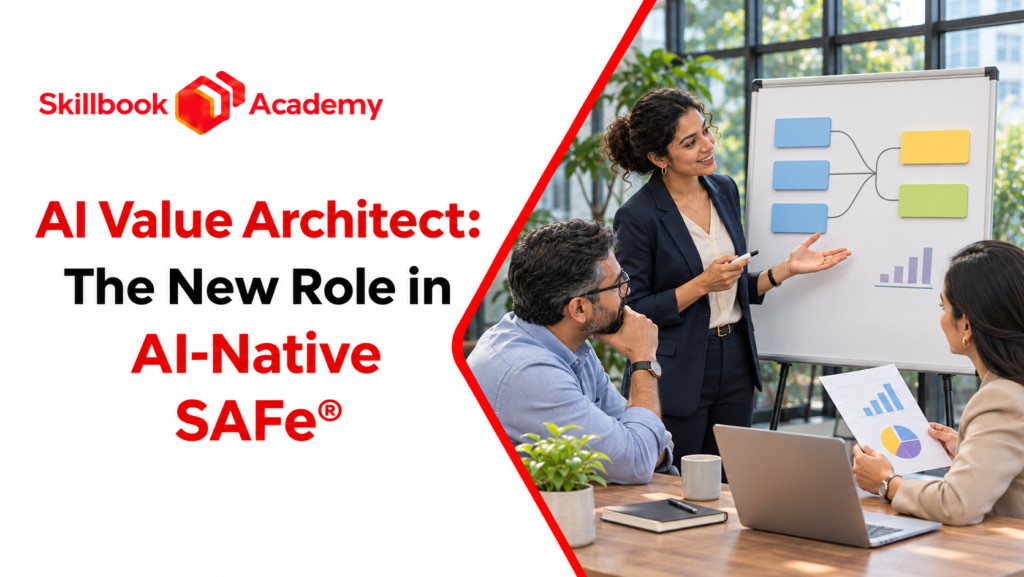
- The AI Value Architect combines AI adoption, workflow design, business goals, technical execution, risk management, and measurable outcomes.
- Today’s guidance describes the role in five responsibilities: coach adoption, unlock workflow and tool value, bridge business and technology, facilitate solution development, and optimize outcomes.
- The role complements existing product, delivery, technical, business, and governance responsibilities; it does not replace them.
- In AI-Native Teams, Product, Builder, Domain Expert, and AI capabilities are combined through Align, Sense, and Respond activities under human supervision.
- AI-Native SAFe® also uses Intent, Specifications, and Context to help teams maintain shared direction while developing AI-enabled products and workflows.
Direct answer
An AI Value Architect helps teams and Agile Release Trains (ARTs) turn AI opportunities into measurable customer and business value. Scaled Agile describes the role as providing a systems view across AI adoption, workflows, business goals, technical execution, risk, and outcomes. The role can support one team, several teams, a specific solution, or an ART more broadly.
What is an AI Value Architect?
Scaled Agile defines the AI Value Architect as a systems-thinking role that can support a single team, multiple teams, a solution, or an entire ART. It’s built for organizations that need to connect business strategy with technical execution while managing AI adoption, risk, and outcomes. Scaled Agile’s role guidance outlines five core areas where the AI Value Architect makes an impact:
- Coach AI adoption.
- Unlock value from AI workflows and tools.
- Bridge business and technology.
- Facilitate AI solution development.
- Optimize outcomes.
These are framework responsibilities rather than a requirement that every organization creates a new standalone job title. Scaled Agile notes that people already supporting the team, ART, or organizational success can be natural candidates for the role. The appropriate staffing model depends on scope, capacity, organizational design, and decision rights.
The AI Value Architect is an AI-Native SAFe® role. It should not be treated as a universal requirement for every organization using Core SAFe® or Agile more broadly.
The guidance also distinguishes this role from adjacent specialties. An AI Value Architect needs business literacy, AI fluency, and facilitation skills—without becoming the business owner, AI developer, or meeting administrator.
Why AI-Native SAFe® introduces the AI Value Architect
AI success requires more than a working model.
AI work often crosses boundaries that are typically managed separately. Product leaders define customer and business needs. Technical specialists develop and deploy solutions. Data specialists assess availability and quality. Operations teams plan how the capabilities will operate. Risk, security, legal, and compliance participants define constraints. Management and users support adoption.
When these concerns stay disconnected, a prototype can look successful while the real workflow isn’t ready for production. The data may be incomplete. Nobody may own the operating process. Users may not trust the output. Review and approval may be undefined. The organization may have no agreed measure for deciding whether to continue, revise, stop, or scale the work.
The AI Value Architect addresses this coordination problem through a systems view. It keeps five concerns visible: the intended outcome, the path to a usable workflow, people and data handoffs, risk controls, and evidence for the next decision.
Scaled Agile describes this challenge as an AI value gap: organizations may adopt AI without realizing the value they expected. Technical success is only one part of closing that gap. The workflow must be usable, the data suitable, the solution operationally supportable, adoption addressed, governance integrated, and outcomes measured. The AI Value Architect helps connect those concerns while leaving final product, technical, investment, legal, and risk decisions with the appropriate accountable roles.
The five responsibilities of an AI Value Architect
The table below breaks down the five core responsibility areas into actionable, real-world guidance. Think of the “Evidence or control” column as a practical lens on how the role shows up in practice and not a one-size-fits-all certification checklist.
| Responsibility | Practical contribution | Evidence or control |
|---|---|---|
| Coach AI adoption | Help teams use AI responsibly and reshape how work actually gets done | Adoption signals, user feedback, observed workflow changes, and records of course corrections |
| Unlock value from AI workflows and tools | Spot where existing AI capabilities can genuinely improve a real-world workflow | Baseline of the current workflow, the redesigned version, and a clear before-and-after outcome comparison |
| Bridge business and technology | Tie together business goals, technical delivery, data, risk, and adoption efforts | Shared intent, specifications, context, clear decision owners, and defined constraints |
| Facilitate AI solution development | Bring hidden assumptions, evaluation gaps, data problems, and operational risks to light | Key review checkpoints, test results, supporting evidence, escalation paths, and documented decisions |
| Optimize outcomes | Keep AI work focused on delivering customer and business results | Outcome metrics, learning cycles, and clear stop, continue, revise, or scale decisions |
Coach AI adoption
Adoption isn’t just about giving people an AI tool and hoping it works out. Even with access, teams might not use it consistently, might use it in ways that go off-track, or might ignore its output altogether because they don’t trust it. The AI Value Architect steps in to help the team figure out where AI truly adds value, where human judgment still needs to lead, and what proof would show that the workflow is actually getting better.
Unlock value from AI workflows and tools
Start with the workflow: its trigger, decisions, data, AI output, human review, and uncertainty handling. Judge the redesigned workflow by its defined outcome, quality, and risk, not by output volume alone.
Bridge business and technology
The AI Value Architect makes sure the right voices are in the room when it matters. Depending on the situation, that could mean bringing together product, delivery, architecture, engineering, data, security, operations, risk, finance, customer success, and even end users. The goal is a shared understanding of the value being pursued, where the solution starts and stops, the context in which it must work, the risks that must be addressed, and who owns which decisions.
Facilitate AI solution development
In this role, facilitation means clarifying the real problem, mapping how work flows, surfacing hidden assumptions, coordinating evaluation, documenting boundaries, and helping the team determine what should happen next. It also means distinguishing between something that is technically possible and something that is genuinely ready to operate in the real world.
The AI Value Architect can guide all of these activities without owning the final call on product, architecture, risk, investment, or legal decisions. But for that to work, the organization needs to be clear about who owns what.
Optimize Outcomes for AI Value Architect
Optimizing outcomes means carefully examining the evidence and being willing to change course when the data doesn’t support the original hypothesis. That review might cover whether the initiative is achieving the intended customer or business outcome, how well the workflow is being adopted, output quality, operational sustainability, risk events, and cost.
Teams might decide to stop, keep going, revise, improve, or scale. Stopping an initiative that lacks sufficient value, evidence, feasibility, or acceptable risk is not automatically failure; it can be a disciplined learning decision.
The role of AI Value Architect in AI-Native Teams and ARTs
Current AI-Native SAFe® guidance paints a clear picture of what an AI-Native Team looks like through four key capabilities:
- Product capability: This is the “why” behind the work. It keeps everything aligned with the product vision and makes sure customer feedback actually shapes what gets built.
- Builder capability: Uses AI to generate outputs and functional systems that support agreed outcomes.
- Domain Expert capability: This brings in the real-world customer and business context that keeps solutions grounded and fit for purpose.
- AI capability: Provides data, automation, analysis, and decision support under human supervision.
The four items above are capabilities, not four mandatory job titles. Different team members and systems can contribute to them depending on the context. AI is a capability within the AI-Native Team model, but it is not a human accountability and does not replace human responsibility for consequential decisions.
What This Means
AI-Native ARTs remain important because multiple teams still need cross-team synchronization, shared learning, product alignment, governance, and system-level decisions. Current Scaled Agile guidance describes AI-Native ARTs as organized around products, outcome-driven, powered by human expertise and judgment, balancing rapid innovation with cadence-based learning, optimized through shared AI workflows and platforms, and governed through AI governance and ethics.
The AI Value Architect contributes to that system view by connecting AI adoption, workflows, technical execution, cross-functional collaboration, risk considerations, and outcome evidence. The role complements rather than replaces existing ART responsibilities.
AI-Native Teams structure their work around three core activities: Align, Sense, and Respond. They align on decisions and outcomes, sense feedback and learning, and respond by adjusting workflows or products based on what they discover.
The AI Value Architect may also plug into the AI Innovation Pipeline outlined in current AI-Native SAFe® guidance. The pipeline moves work through five stages—Discover, Specify, Build, Validate, and Release—and supports four common work-item types: prototypes, experiments, features, and enablers. Its components include AI-Empowered workflows, embedded policies, insights and evidence, and shared platforms.
The whole setup is designed for disciplined learning and delivery, with a key mindset shift: not every prototype needs to become a feature. Some experiments teach you what not to build, and that’s valuable too.
The underlying principle is that teams should use evidence from both delivery and real-world outcomes to decide what to continue, change, stop, or scale.
How AI Value Architect differs from related roles
The AI Value Architect operates across role boundaries, but the goal is to complement existing accountabilities, not blur them.
| Related role | Primary focus | Relationship to AI Value Architect |
|---|---|---|
| Scrum Master | Establishes Scrum and supports Scrum Team effectiveness | May be a strong candidate for the capability, but the AI Value Architect role doesn’t replace Scrum accountability |
| Product Owner or Product Manager | Manages product value, customer needs, product direction, or backlog decisions, depending on the organization’s model | Partners with the product role to connect AI opportunities to outcomes; doesn’t automatically take over product decisions |
| Release Train Engineer | Supports ART flow, coordination, learning, and impediment removal | Collaborates with the AI Value Architect on cross-team AI work, evidence, dependencies, and outcome learning; doesn’t replace the RTE |
| Architect or AI developer | Guides technical decisions or builds, evaluates, integrates, and operates AI capabilities | Brings technical depth; the AI Value Architect connects that work to intent, adoption, risk, and outcomes |
| Business Owner or executive sponsor | Holds organization-specific investment or business decision accountability | Provides sponsorship and key decisions; the AI Value Architect is business-literate without becoming the Business Owner |
The Scrum distinction matters here. The Scrum Guide states that the Scrum Master is accountable for establishing Scrum and for the Scrum Team’s effectiveness. The AI Value Architect has a different focus: helping teams and ARTs connect AI adoption and technical execution to measurable value. One person could potentially perform responsibilities associated with both, but the accountabilities should remain distinct.
Skills and backgrounds that transfer
Scaled Agile specifically identifies people already contributing to team, ART, and organizational success as natural candidates for the AI Value Architect role, including Scrum Masters, Team Coaches, Product Managers, and Architects. The current certification is also relevant to roles such as RTEs, SPCs, System Architects, and Product Owners, depending on the organization and class audience.
An effective AI Value Architect brings a working blend of:
- AI fluency: Enough depth to ask useful questions, spot trade-offs, and challenge assumptions without needing to be the most technical expert in the room.
- Business and customer literacy: Clear understanding of the problem at hand, the value drivers, and who the solution is for.
- Workflow and systems thinking: Ability to map workflows, identify handoffs and dependencies, and understand how AI changes the flow of work.
- Facilitation and cross-functional communication: Ability to align product, engineering, data, security, operations, and governance on a common outcome.
- Intent, Specifications, and Context: Ability to make the “why,” “what,” and “where it must succeed” explicit across people and systems.
- Risk and governance literacy: Understanding boundaries, approvals, evidence requirements, escalation conditions, and when work must stop or be reviewed.
- Evidence-based measurement and decision-making: Driving decisions using adoption, quality, performance, risk, cost, and outcome data.
- Change and adoption capability: Driving behavioral change, workflow redesign, and sustained use.
- Technical collaboration without over-claiming ownership: Knowing when to bring in data, security, MLOps, architecture, or domain expertise and keeping that expertise connected to the intended outcome.
The role is not about being the best specialist in every discipline. It’s about orchestrating the right expertise at the right time and ensuring it stays connected to measurable business or customer value.
Training and Certification: Keep The Terms Separate
A framework role, a job title, a training course, a certification, and real-world capability are not the same thing.
Scaled Agile currently offers the AI-Native Value Architect certification through a two-day instructor-led course followed by a certification exam. The current exam is web-based and closed book, contains 60 multiple-choice questions, allows 120 minutes, and requires an 80% passing score. The first exam attempt is included with the course when taken within 60 days of course completion.
The certification is valid for one year and must be renewed annually. Scaled Agile currently requires 12 Continuing Education Units (CEUs) for AI-Native Value Architect renewal. AI-Native certifications renew separately from standard SAFe certification tiers.
Current public class listings include instructor-led offerings from authorized providers. Delivery format can vary by offering, so candidates should verify whether a specific class is in person, remote, public, or private before enrolling.
Attendance alone is not certification, and holding a certification does not automatically prove someone can perform the role effectively in every organizational context.
Scaled Agile is the credential issuer. Authorized training providers deliver classes under the applicable Scaled Agile authorization; they should not be described as the credential issuer.
A Practical implementation Roadmap for Organizations
Scaled Agile’s AI-Native SAFe® Implementation Roadmap defines five phases for scaling AI in an outcome-driven way. The role-level actions below translate that roadmap into practical steps for an AI Value Architect. They are an editorial interpretation, not a separate or official AI Value Architect certification process.
| Roadmap phase | Practical application for the AI Value Architect |
|---|---|
| 1. Align to Outcomes | Name the customer or business outcome, establish a baseline, identify the sponsor, and define who can stop or continue the work. |
| 2. Set Priorities | Select a bounded opportunity based on value, feasibility, data readiness, workflow fit, and risk. Do not start with a tool alone. |
| 3. Launch AI-Native ARTs | Clarify Product, Builder, Domain Expert, and AI capabilities; define human review, handoffs, policies, and escalation paths across the relevant team or ART. |
| 4. Measure Performance | Inspect adoption, quality, operational performance, risk, cost, and the intended business or customer outcome. Record corrections and update the shared context. |
| 5. Amplify ROI | Scale only what is repeatable and supportable. Share validated workflow improvements through the ART or shared platform while retaining human accountability and governance. |
Before delegating this responsibility, the organization should determine whether the AI Value Architect capability will be dedicated, distributed, or temporary, based on initiative volume and complexity, cross-team coordination requirements, data and operational risk, capacity constraints, and the clarity of decision rights. No universal staffing ratio is established in the reviewed sources.
Keep Intent, Specifications, and Context Visible
AI work becomes harder to coordinate when people and systems operate from different assumptions. Current AI-Native SAFe® guidance addresses these issues with three connected foundations:
- Intent explains why the work matters and what problem or opportunity it addresses.
- Specifications describe what the solution must do and how it must operate, including functional and policy boundaries.
- Context explains where the solution must succeed, covering customer, market, operating, ecosystem, and regulatory conditions.
An AI Value Architect can use this structure to connect product goals, domain knowledge, technical constraints, operating conditions, and governance. The role does not automatically own all three artifacts; ownership is organization-specific.
Intent, Specifications, and Context also help AI-Native Teams detect drift. Current Scaled Agile guidance notes that a significant change in intent, specifications, or context can trigger renewed alignment so teams do not continue executing against outdated assumptions.
The same principle applies to governance. Embedded policies define boundaries, approvals, and stopping rules for both people and AI systems. Teams should ask: what information may the system access, what actions require approval, what evidence must be retained, and when must the workflow stop or escalate?
Conclusion
The AI Value Architect provides AI-Native SAFe® organizations with a structured way to link adoption, workflow design, business and technical alignment, risk, and outcomes. The role can be applied at the level of a team, group of teams, solution, or ART, depending on organizational need. Its effectiveness depends on clear decision rights, human accountability, appropriate technical and domain expertise, and credible evidence of value.
The key question is not whether the organization needs another job title. It is whether someone is explicitly accountable for connecting AI opportunities to responsible, measurable use.
Frequently Asked Questions
An AI Value Architect is a role within AI-Native SAFe® that helps teams and Agile Release Trains (ARTs) connect AI adoption, workflow improvement, business goals, technical execution, risk, and measurable outcomes. Scaled Agile describes AI Value Architects as providing the systems view needed to connect business strategy with effective AI execution.
Yes. Scaled Agile has published an AI Value Architect role definition as part of its AI-Native SAFe® guidance. The role supports AI adoption and value creation across teams, solutions, and ARTs. Whether an organization creates a dedicated position or assigns the responsibilities to existing practitioners depends on its operating model, scale, and decision rights.
The Scrum Master is accountable for establishing Scrum and supporting Scrum Team effectiveness. The AI Value Architect focuses on AI adoption, AI-enabled workflows, business and technology alignment, AI solution development, risk conversations, and outcome optimization. One person may perform responsibilities associated with both, but their primary purposes are different.
No. Current Scaled Agile guidance describes the role as AI-fluent without being the AI developer. The person needs enough technical understanding to ask useful questions, recognize constraints, coordinate specialists, and connect technical work to outcomes. AI developers, architects, data specialists, and operators retain their technical responsibilities.
Yes. Scaled Agile currently offers the AI-Native Value Architect certification. The associated course lasts two days, and the current certification exam contains 60 questions, allows 120 minutes, and requires an 80% passing score. The certification is valid for one year and currently requires 12 CEUs for renewal.