- Write every story in the "As a [user], I want [goal], so that [benefit]" format to keep the focus on user value instead of technical implementation.
- Treat user stories as communication tools that align Product Owners, developers, testers, and stakeholders around a shared, customer-centric goal.
- Estimate effort with Fibonacci-based story points (0, 0.5, 1, 2, 3, 5, 8, 13...) that weigh complexity, risk, and uncertainty rather than raw hours.
- Define clear acceptance criteria before development starts so "done" is unambiguous and rework is minimized.
- Keep stories small, plain-language, and independently estimable to enable incremental delivery and faster feedback.
- Story points support predictable planning through team velocity and shift the conversation from time tracking to value delivery.
-
What are user stories and how do they work?
Defines a user story as a description of functionality from the user's perspective, capturing who the user is, what they want, and why. Introduces the standard "As a [user], I want [goal], so that [benefit]" format with a to-do-list example and explains how teams break stories into smaller, deliverable tasks.
-
Why User Stories Matter in Agile
Frames user stories as communication tools delivering clarity, customer focus, flexibility, incremental delivery, and shared understanding. Covers why story points (using a Fibonacci scale weighing complexity, risk, uncertainty, and effort) beat time-based estimates, and how acceptance criteria define when a story is complete, illustrated with a password-reset example.
-
Best Practices for Writing Effective User Stories
Lists practical guidelines for high-quality stories: focus on user goals, keep stories small, avoid technical jargon, define acceptance criteria, ensure estimability, and stick to the standard format so teams deliver real value with fewer surprises.
-
Let's summarise
Recaps that user stories capture requirements simply and concisely, and reinforces the core best practices—clarity on user goals, small manageable scope, enough detail to estimate, defined acceptance criteria, and consistent use of the standard format. Closes with related Skillbook Scrum, Agile, and SAFe certification courses.
User stories are a popular way to capture requirements for agile development projects.
You’ve probably heard of agile development methodology and user stories before, but do you know how to write them? In this article, we’ll give you a crash course on agile user stories. You’ll learn what they are, why they’re important, how to write them effectively, and how they can benefit your agile project.
What are user stories and how do they work?
User stories are a core practice in Agile software development. They describe functionality from the user’s perspective, focusing on the value the user wants to achieve rather than technical implementation details.
A user story explains:
- Who the user is
- What they want to do
- Why they want to do it
Standard User Story Format
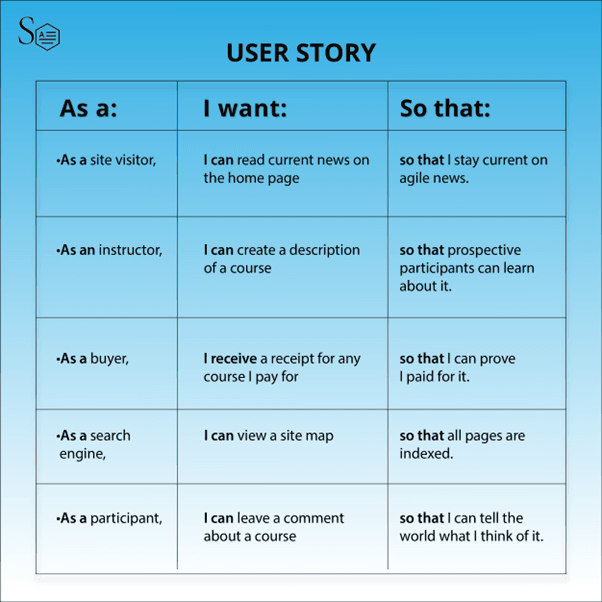
User stories are typically written using a simple structure:
As a [user], I want [goal] so that [benefit].
Example
- As a busy parent, I want to add tasks to a to-do list so that I can keep track of my daily responsibilities.
This format keeps the focus on user value, making stories easy to understand for Product Owners®, Developers, Testers, and Stakeholders.
Agile teams use user stories as the foundation for planning. Each story is broken down into smaller tasks that can be implemented, tested, and delivered incrementally.
Why User Stories Matter in Agile
User stories are not just requirements, they are communication tools that align teams around shared goals.
Key Benefits of User Stories
Clarity and simplicity
User stories are easy to read and understand, even for non-technical stakeholders.
Customer-centric focus
They ensure development work is driven by real user needs.
Flexibility
User stories allow teams to adapt quickly when requirements change.
Incremental delivery
Large features are broken into manageable pieces that can be delivered step by step.
Shared understanding
Everyone works toward the same outcome, reducing misalignment and rework.
User stories also act as a continuous feedback loop, allowing teams to refine solutions based on user input throughout the development process.
Why should agile teams employ user story points?
User story points are used to estimate the relative effort required to complete a user story. Instead of measuring time directly, story points consider:
- Complexity
- Risk
- Uncertainty
- Effort
Fibonacci Sequence for Story Points
Most Agile teams use a Fibonacci-based scale such as:
0, 0.5, 1, 2, 3, 5, 8, 13, 20, 40, 100
The gaps between numbers make it easier to estimate effort without over-precision.
Why Story Points Are Effective
- They are more accurate than hours or lines of code
- They account for complexity and uncertainty
- They help teams prioritize work effectively
- They support predictable planning through team velocity
Story points allow teams to focus on value delivery, not time tracking.
How acceptance criteria play a major role in your agile projects?
Acceptance Criteria (AC) define the conditions under which a user story is considered complete and acceptable to the user. They are unique to each user story and define feature behavior from the perspective of the end user.
They describe expected behavior, not implementation details.
Why Acceptance Criteria Matter
- Prevent misunderstandings
- Define clear boundaries for a story
- Help developers and testers align on expectations
- Ensure the delivered feature meets user needs
Acceptance criteria should be defined before development begins.
Example
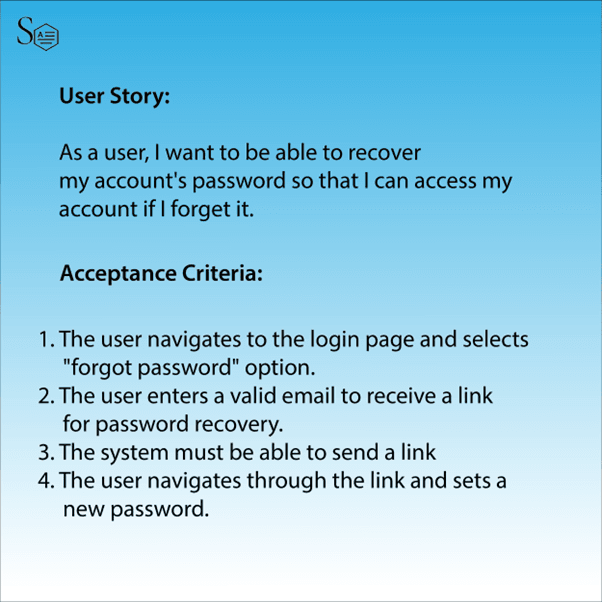
User Story:
- As a user, I want to reset my password so that I can regain access if I forget it.
Acceptance Criteria:
- User can click “Forgot Password” on the login page
- User enters a registered email address
- System sends a password reset link
- User can set a new password using the link
Clear acceptance criteria ensure predictable outcomes and reduce rework.
Best Practices for Writing Effective User Stories
To create high-quality user stories, keep the following guidelines in mind:
- Focus on what the user wants to achieve
- Keep stories small and manageable
- Avoid technical language
- Define clear acceptance criteria
- Ensure stories can be estimated
- Use the standard format:
- As a … I want … so that …
Well-written user stories help teams build software that delivers real value—faster and with fewer surprises.
Let’s summarise
User stories are a fundamental part of agile development. They help to capture the requirements of a project in a way that is simple, concise, and easy to understand. While there is no one right way to write a user story, there are some best practices that can help ensure that your user stories are effective.
Some key things to keep in mind when writing user stories are:
- Be clear about what the user wants to achieve.
- Make sure the story is small and manageable.
- Include enough detail to allow for estimation.
- Think about the acceptance criteria for the story.
- Structure your story using the format: As a [user], I want [goal], so that [benefit].
Keep these tips in mind and you’ll be well on your way to writing great user stories that will help your team build better software!
Related Courses & Certifications Training:
Certified Scrum Master (CSM) Certification Training | Advanced Certified ScrumMaster (ACSM) Certification Training | Agile Coaching Skills Certified Facilitator (ACSCF) Certification Training | SAFe® Practice Consultant Certification Training | SAFe® for Teams (SP) Certification Training
Meet the Author

Harry Narang
SAFe® Practice Consultant & Agile Coach
Harry Narang is a SAFe® Practice Consultant and Agile Coach based in Toronto.