- SAFe turns cross-functional collaboration into structure, not slogans: Agile Release Trains bring developers, testers, UX designers, and business analysts together to deliver continuous customer value.
- Three mechanisms do the heavy lifting: PI Planning aligns teams on shared objectives and surfaces dependencies, CI/CD dissolves dev-test-ops handoffs, and Lean Portfolio Management ties team-level work to business strategy.
- The payoff is concrete: faster time-to-market from fewer handoffs, higher quality and innovation from diverse perspectives, and stronger engagement when people see their impact on the bigger picture.
- Map each common obstacle to a SAFe practice: Inspect & Adapt workshops defuse cultural friction, PI Planning and shared goals break siloed mindsets and align priorities, RTEs plus tools like Jira and Miro manage dependencies, and Continuous Testing kills QA bottlenecks.
- Sustain it with disciplined habits: run regular sync and team-of-teams meetings, invest in transparency tools (Jira, Slack, Miro), and grow T-shaped people through a Continuous Learning Culture.
- Collaboration at scale isn't optional polish; it's the lever that makes a SAFe transformation responsive, accountable, and competitive in fast-moving markets.
-
Key Elements That Enhance Cross-Functional Collaboration in SAFe
Identifies the three foundational SAFe mechanisms for collaboration: PI Planning to align teams and expose dependencies, CI/CD to remove barriers between development, testing, and operations, and Lean Portfolio Management to connect team decisions to business strategy. Together they replace siloed structures with transparent, goal-driven teamwork.
-
Benefits of Cross-Functional Collaboration in SAFe
Lays out three payoffs: faster time-to-market by eliminating handoff delays and shortening cycle times through CI/CD, improved quality and innovation from diverse perspectives reducing defects, and stronger employee engagement driven by purpose and SAFe's Continuous Learning Culture.
-
Challenges and Solutions
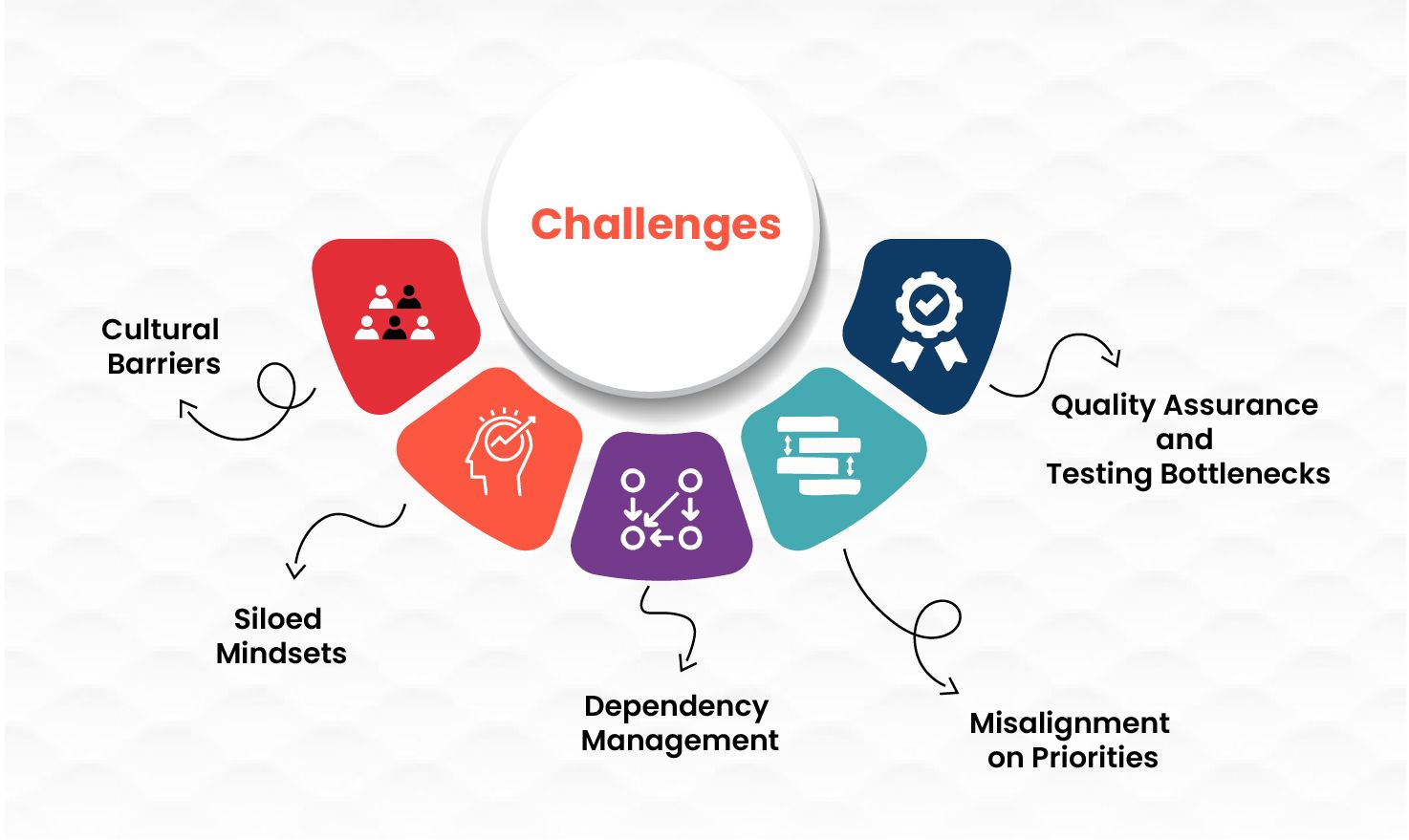
Walks through five obstacles and the SAFe practice that addresses each: cultural barriers (Inspect & Adapt workshops and retrospectives), siloed mindsets (PI Planning and shared goals), dependency management (PI Planning, RTEs, and tools like Jira/Miro), misalignment on priorities (LPM and PI Planning), and QA/testing bottlenecks (Continuous Integration and Continuous Testing).
-
Key Practices to Enhance Cross-Functional Collaboration in SAFe
Recommends three sustaining habits: regular sync and team-of-teams meetings to keep teams aligned, investment in Agile tools (Jira, Slack, Miro) for transparency and real-time updates, and a Continuous Learning Culture that develops T-shaped, more adaptable team members.
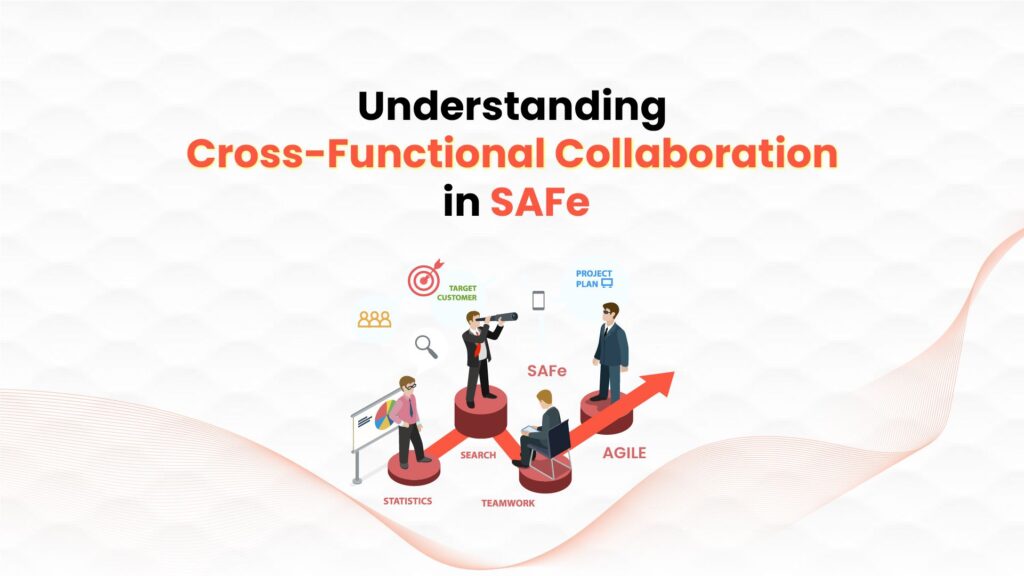
In today’s Agile landscape, cross-functional collaboration has emerged as a cornerstone of effective teamwork and innovation. It’s not just a trend; it’s a strategic approach that unites diverse skill sets and perspectives to drive better decision-making and faster problem-solving. This approach is especially valuable in the Scaled Agile Framework® (SAFe®), where the complexities of scaling Agile principles across large organizations require seamless alignment across teams.
SAFe promotes cross-functional collaboration as a means to accelerate workflows, eliminate silos, and align team efforts with organizational goals. Within SAFe, teams with varied expertise — ranging from development and design to testing and business analysis — come together across Agile Release Trains (ARTs) to deliver continuous value to customers. This collaboration is supported by key SAFe practices, such as Program Increment (PI) Planning and Lean Portfolio Management, which help to coordinate work, address dependencies, and align teams on shared objectives. By fostering a culture of collaboration, SAFe organizations can respond quickly to changing market demands, reduce bottlenecks, and achieve measurable improvements in both productivity and customer satisfaction.
This article delves into the structures and practices SAFe offers to build effective cross-functional teams, addresses common challenges teams face, and explores the tangible business impacts of adopting collaboration at scale. By understanding and implementing these strategies, Agile organizations can harness the power of cross-functional teamwork to unlock efficiency, accelerate innovation, and create a resilient, adaptive enterprise.
Key Elements That Enhance Cross-Functional Collaboration in SAFe
Program Increment (PI) Planning — This collaborative planning event aligns teams with the organization’s vision and goals. During PI Planning, cross-functional teams identify dependencies, synchronize work, and create shared objectives.
Continuous Integration and Continuous Deployment (CI/CD) — SAFe emphasizes automation and integration, which encourage collaboration by removing barriers between development, testing, and operations.
Lean Portfolio Management — By aligning teams with high-level business strategy, SAFe enables teams to make informed, customer-focused decisions.
These SAFe components — PI Planning, CI/CD, and LPM — are foundational for creating a cross-functional, collaborative culture where teams can deliver value to customers efficiently. By emphasizing transparency, frequent feedback, and alignment with strategic priorities, SAFe enables organizations to overcome the challenges of traditional siloed structures and achieve cohesive, goal-driven teamwork across all functions.
Benefits of Cross-Functional Collaboration in SAFe
Faster time to market
Cross-functional collaboration within SAFe helps eliminate handoff delays, a common issue in siloed organizations. By integrating roles and aligning teams under Agile Release Trains (ARTs), SAFe enables faster decision-making and streamlined workflows. In particular, practices like Continuous Integration (CI) and Continuous Deployment (CD) reduce cycle times, ensuring that issues are identified and resolved swiftly, ultimately accelerating the release process.
Improved quality and innovation
Diverse perspectives within cross-functional teams foster creative problem-solving, reduce defect rates, and improve product quality. By bringing together developers, testers, UX designers, and business analysts, teams can consider multiple angles during product development. This diversity of input leads to more robust and innovative solutions that enhance the end-user experience.
Enhanced employee engagement
Working in cross-functional teams gives employees a stronger sense of purpose, as they can see the impact of their work on broader business objectives. The collaborative culture encouraged by SAFe’s Continuous Learning Culture (CLC) also promotes personal growth, empowering employees to develop skills outside their core roles. This leads to higher job satisfaction and retention, as team members feel more valued and connected to the organization’s mission.
Challenges and Solutions
While cross-functional collaboration is highly beneficial, it’s not without challenges. Here’s how SAFe helps organizations address common obstacles:
1. Cultural barriers
Cross-functional teams bring together individuals with diverse expertise, perspectives, and professional backgrounds. While diversity can drive innovation, it can also lead to misunderstandings and conflicts if team members struggle to align their approaches or communicate effectively. This challenge is often intensified in Agile environments, where rapid iterations and continuous feedback are standard practices.
SAFe’s Inspect and Adapt (I&A) workshops play a critical role in addressing cultural challenges. These workshops create a safe space where team members can openly share feedback on processes, challenges, and personal experiences. I&A workshops help foster trust by allowing teams to celebrate wins, identify issues collaboratively, and establish improvement goals. Additional SAFe practices, such as team retrospectives and celebration events, further enhance collaboration by encouraging ongoing dialogue and building a culture of respect and continuous learning.
2. Siloed mindsets
Siloed mindsets can be a significant barrier to effective cross-functional collaboration. Departments often operate independently, focusing solely on their own metrics and goals without a broader view of how their work impacts other areas of the organization. This can lead to conflicting priorities, misaligned goals, and reduced efficiency.
SAFe addresses siloed mindsets through PI Planning and the establishment of shared goals and objectives across teams. PI Planning sessions gather all teams within an ART to align on a shared purpose and map out deliverables for the upcoming increment. To further reduce silos, SAFe encourages leaders to model collaboration and promote a culture of transparency, with regular sync meetings and team-of-teams events keeping teams informed and aligned.
3. Dependency management
Managing dependencies in large organisations can be complex, especially when multiple teams must coordinate their work to meet shared objectives. Dependencies across functions can create bottlenecks, delay timelines, and increase the risk of miscommunication.
SAFe tackles dependency management through Program Increment (PI) Planning, where teams come together to make dependencies visible, identify potential risks, and plan how to address them collaboratively. SAFe’s use of Agile tools such as Jira or Miro supports dependency management by providing real-time visibility into project progress. SAFe’s Release Train Engineers (RTEs) also play an essential role, acting as facilitators who help teams navigate dependencies and mitigate obstacles.
4. Misalignment on priorities
Different teams often have varied interpretations of what constitutes a priority. A development team might prioritize speed, a QA team could focus on stability, and a UX team may prioritize user satisfaction. These differences can lead to conflicts and slowdowns when delivering on shared objectives.
SAFe addresses this through Lean Portfolio Management (LPM) and PI Planning events, which help establish organization-wide priorities aligned with high-level strategy. During PI Planning, each team aligns its individual goals with the broader priorities set by the portfolio and product management teams, ensuring all functions work cohesively toward shared outcomes.
5. Quality assurance and testing bottlenecks
In cross-functional teams, QA and testing are often integrated into the Agile process, but bottlenecks can still arise when testing cycles lag behind development. This issue is especially prevalent in larger teams or ARTs, where dependencies create delays that affect downstream functions.
SAFe’s emphasis on Continuous Integration (CI) and Continuous Testing helps mitigate testing bottlenecks by encouraging regular, incremental testing throughout the development lifecycle. This approach identifies issues early and allows for faster, iterative improvements. PI Planning and sync meetings further align testing schedules with development timelines, reducing last-minute pressures on QA teams.
Key Practices to Enhance Cross-Functional Collaboration in SAFe
Conduct regular sync meetings
Regular sync meetings and team-of-teams events ensure alignment and keep teams focused on shared objectives. These meetings provide an opportunity to track progress, address emerging issues, and adjust priorities as needed. Consistent communication helps team members stay informed, engaged, and aligned, reinforcing a collaborative culture.
Invest in Agile tools
Agile tools like Jira, Slack, and Miro facilitate transparency and real-time updates, allowing cross-functional teams to collaborate effectively regardless of location. Tools that offer shared dashboards, document repositories, and real-time tracking help teams coordinate and adjust workflows, fostering seamless collaboration across departments.
Promote a learning culture
SAFe’s Continuous Learning Culture (CLC) encourages team members to expand their skills beyond their primary roles, creating “T-shaped” individuals who can collaborate more effectively with colleagues from other functions. This adaptability makes teams more resilient and responsive to changing needs, as members can contribute in various capacities, enhancing overall flexibility.
In SAFe, cross-functional collaboration is not just a best practice — it’s a foundational principle that drives the success of Agile transformations. By bringing together diverse roles, including developers, testers, UX designers, and business analysts, SAFe creates Agile Release Trains (ARTs) that break down traditional silos. This integration enables teams to align closely with organizational goals and respond swiftly to changing market demands, enhancing both responsiveness and accountability.
The impact of cross-functional collaboration on business outcomes is substantial. With streamlined workflows, teams achieve faster time-to-market by eliminating bottlenecks and reducing handoffs between departments. By leveraging structured SAFe practices like Program Increment (PI) Planning and Lean Portfolio Management, organizations can unify their cross-functional teams around shared goals, ensuring a seamless flow of information and a cohesive approach to customer value delivery.
Ultimately, building a culture of cross-functional collaboration in SAFe equips organizations with the agility to remain competitive. By implementing SAFe’s practices to address challenges like dependency management, cultural barriers, and resource constraints, organizations not only strengthen their Agile processes but also bridge silos and build a culture of continuous improvement. In today’s fast-paced, competitive market, fostering effective cross-functional collaboration isn’t just beneficial — it’s essential for organizations seeking to deliver exceptional customer value and maintain a competitive edge.
Meet the Author

Disha Jain
Contributing Writer
Disha Jain is a contributing writer at Skillbook Academy covering Agile, SAFe and AI topics.