- Continuous learning is the engine of Agile innovation, letting teams adapt fast to new technology, shifting customer expectations, and volatile markets.
- A learning culture pays off four ways: sharper adaptability, higher engagement, more innovation, and stronger talent attraction and retention.
- Build skills through an experiment-friendly environment, cross-functional collaboration, CI/CD-style flexibility, clear roles, and a focus on team excellence.
- Embed learning into daily work via on-the-job training, peer shadowing, and dedicated skill-development time rather than treating it as a separate task.
- Leadership commitment, personalized learning paths, AI and simulation-based tools, and tight feedback loops are what make continuous learning stick.
- Frameworks alone do not deliver Agile success, the mindset of ongoing capability development is what sustains it.
-
Why Continuous Learning Is Essential in Agile
Establishes the case for continuous learning as the foundation of Agile success, detailing four benefits: increased adaptability to new tech and methods, better employee engagement and morale, encouragement of innovation through curiosity, and stronger talent attraction and retention.
-
What strategies should teams use for skill development and growth?
Lays out the practical strategies for building skills: creating an adaptable, feedback-driven Agile learning environment, plus cross-functional collaboration, engineering flexibility through CI/CD and retrospectives, clearly defined roles and responsibilities, and a focus on team excellence.
-
Implementing Continuous Learning in an Agile Organization
Covers how to operationalize learning in daily workflows through leadership commitment, integrating learning into everyday work, tailored learning paths, AI-powered and immersive learning technology, and ongoing feedback and self-reflection.
-
The Skillbook Impact
Positions Skillbook Academy's expert-led SAFe training and certifications as a way to adopt and sustain Agile practices, with practitioner-grounded curriculum and links to related Agile coaching and Scrum Master certifications.
Innovation is a critical component of Agile workflow management. At its core, innovation enables organizations to respond effectively to constant change while fostering a culture of continuous learning, a necessity for meeting the evolving demands of modern business.
For organizations, the real challenge lies in ensuring teams can continuously adapt to emerging technologies, shifting customer expectations, and dynamic market conditions. In Agile environments, skill development and growth form the foundation of innovation. Businesses design Agile roadmaps not only to deliver value faster, but also to equip teams with the capabilities needed to thrive in uncertainty.
Agile management emphasizes flexibility, speed, and collaboration to help organizations scale efficiently. However, successful Agile adoption requires more than frameworks and tools, it demands a mindset built on ongoing learning and capability development.
In this blog, we explore why continuous learning is essential in Agile, the strategies teams can use to develop skills and grow, and how organizations can effectively implement learning within Agile workflows.
Why Continuous Learning Is Essential in Agile
Before discussing strategies for skill development, it is important to understand why continuous learning is fundamental to Agile success.
What is the need for continuous learning in Agile?
Before we talk about the strategies for skill development and growth, we must understand the need for continuous learning in Agile. In this section, we will discuss the need for continuous learning.
Increased adaptability
Employees who embrace continuous learning can quickly adapt to new technologies and methods, a vital skill in today’s fast-changing markets. This ability to adapt benefits not only their personal career development but also helps the organization stay agile and competitive in a dynamic business environment.
Better employee engagement
When companies prioritize continuous learning, employees feel valued and appreciated. This sense of recognition drives higher engagement, boosting morale and productivity as employees become more invested in their roles and the company’s success.
Encouraging innovation
A culture of continuous learning fosters curiosity and encourages employees to challenge the norm. By equipping them with up-to-date knowledge and inspiring creative thinking, organizations create the perfect environment for innovative ideas and fresh approaches to problem-solving.
Attracting and retaining talent
For businesses that focus on continuous learning, the talent pool is always bright. Whether it is attracting new talent or retaining existing talent, the process of learning plays a crucial role. Professionals prefer working in dynamic environments where they learn new skills and work on exciting projects.
Businesses that focus on providing employees with personal growth and development opportunities are preferred as a holistic workplace in comparison to workplaces that maintain the status quo.
What strategies should teams use for skill development and growth?
When it comes to skill development and growth, these strategies will help you build the right road map for your business. So, let’s discuss the various strategies in the process.
Creating an Agile Learning Environment
An Agile environment thrives on adaptability, transparency, and experimentation. Teams are encouraged to learn from mistakes and continuously refine their approach.
Key characteristics include:
- Open communication and active listening
- A shared commitment to learning and improvement
- Continuous feedback through sprint reviews and retrospectives
By delivering incremental value in each sprint and applying feedback consistently, teams improve both their workflows and outcomes.
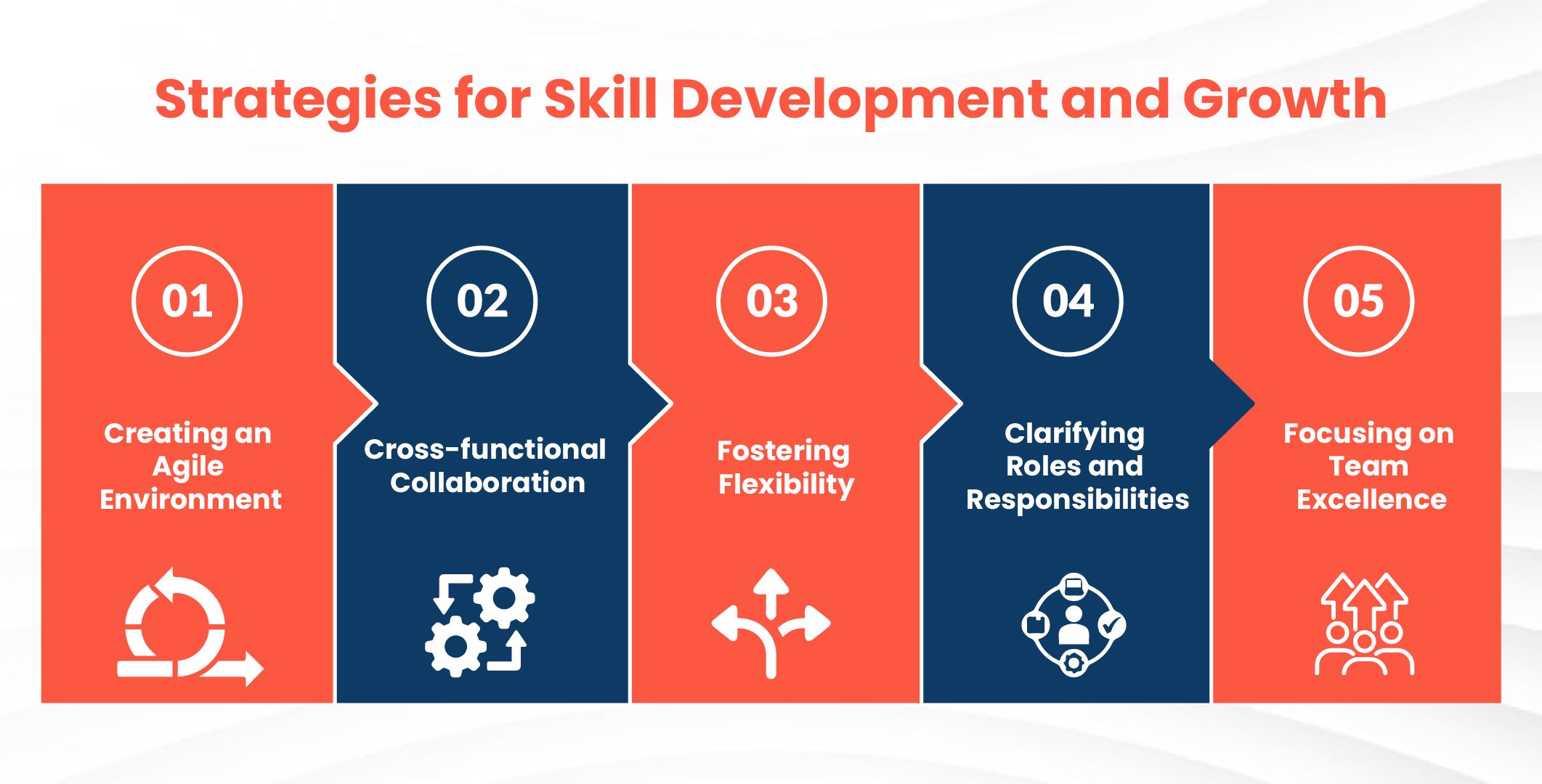
Cross-functional collaboration
Highlighting the value of cross-functional collaboration is essential for the growth of agile teams. When departments work together seamlessly, they bring diverse perspectives to the table, resulting in innovative solutions that address a wide range of customer needs. For instance, when marketing teams collaborate with development teams during a product launch, they ensure the final product aligns with consumer expectations.
To improve collaboration, teams can hold regular retrospectives where they review their performance and identify areas for growth. Additionally, adopting tailored team structures based on the project’s requirements can help by clarifying roles and responsibilities, making collaboration more efficient and focused.
Fostering Flexibility
Flexibility in engineering practices is vital for the growth and development of agile teams. By practicing continuous integration, teams frequently merge code changes into a shared repository, allowing them to catch and resolve integration issues early.
In addition, they focus on continuous delivery, ensuring software can be deployed at any time. By automating testing and deployment, teams maintain high-quality standards while delivering functional software quickly and efficiently.
Agile frameworks like Scrum further support flexibility through regular retrospectives. These sessions encourage teams to reflect on what worked well and what needs improvement, fostering a culture of self-assessment and continuous skill-building.
Clarifying Roles and Responsibilities
Agile teams thrive when roles and responsibilities are clearly defined. This clarity is essential for fostering collaboration and boosting productivity. For example, the product owner is tasked with defining the features to be developed, while the scrum master ensures smooth progress by addressing any roadblocks. Team members focus on delivering high-quality outputs within each sprint. By outlining these responsibilities, everyone understands their contributions, enabling the team to work efficiently toward shared goals.
Focusing on Team Excellence
Prioritizing team excellence is essential for organizations aiming to produce high-quality work. By investing in skill development and fostering growth, teams can refine their processes and consistently deliver outstanding results. This commitment to excellence creates a virtuous cycle of continuous improvement and exceeding expectations. For example, when employees feel supported in their professional development, they are more motivated to contribute meaningfully, driving the team’s overall success.
Implementing Continuous Learning in an Agile Organization
Beyond strategy, organizations must take practical steps to embed learning into daily Agile workflows.
Leadership Commitment
Continuous learning starts at the top. Leaders who actively participate in learning initiatives and promote their value set the tone for the entire organization.
Leadership involvement reinforces learning as a strategic priority, not an optional activity.
Learning as Part of Daily Work
Learning should not feel like a separate task. Instead, it should be integrated into everyday work through:
- On-the-job training
- Peer learning and shadowing
- Dedicated time for skill development
This approach ensures learning remains consistent and relevant.
Tailored Learning Paths
Employees have different strengths, learning styles, and career goals. Personalized learning paths allow individuals to focus on skills that align with their roles while supporting organizational objectives.
Using Technology to Enhance Learning
Technology plays a key role in modern learning environments. AI-powered platforms personalize learning content, while immersive tools such as simulations and virtual environments enable hands-on practice.
These tools make learning more engaging, effective, and scalable.
Feedback and Self-Reflection
Regular feedback loops and self-reflection help employees track progress, adjust goals, and stay aligned with business priorities.
This feedback-driven approach supports both individual growth and organizational agility.
The Skillbook Impact
Skillbook Academy delivers high-quality training and certifications in SAFe®, designed to help organizations achieve operational excellence.
Our programs are led by experienced industry professionals who provide actionable insights grounded in real-world business scenarios. The curriculum emphasizes practical application, enabling organizations to not only adopt Agile principles but sustain them for long-term success.
Organizations can enroll in Skillbook’s training programs or book a consultation to accelerate Agile transformation and continuous learning initiatives.
Related Courses & Certifications: Agile Coaching Skills Certified Facilitator (ACSCF) | Certified Scrum Master (CSM) | Advanced Certified ScrumMaster (ACSM)
Meet the Author

Aaron Jebin
Contributing Writer
Aaron Jebin is a contributing writer at Skillbook Academy covering Agile, SAFe and AI topics.