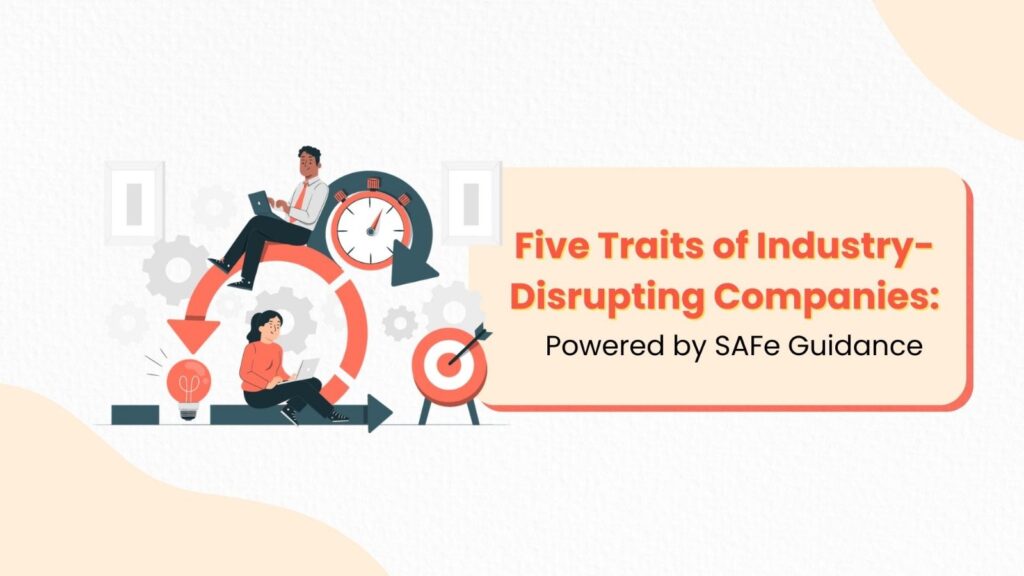
- SAFe gives organizations a structured path to become disruptors rather than the disrupted by building five repeatable traits into how they operate.
- Empowered, self-organizing teams inside Agile Release Trains make autonomous decisions and use tight feedback loops to respond fast to market and tech shifts.
- Disruptors plan for outcomes, not output, running hypothesis-driven product development and validating assumptions against real metrics like revenue, cycle time, and customer satisfaction.
- Strategic alignment from the C-suite to engineering, reinforced through PI planning and ART sync, keeps the whole enterprise moving toward shared goals.
- Balancing intentional long-term roadmaps with emergent, real-time adaptation lets companies stay both directed and flexible.
- Extreme customer focus, fueled by continuous feedback loops and research, separates companies that thrive in disruption from those that fall behind.
-
Empowered, Self-Organizing Teams
Cross-functional, self-organizing teams operating within Agile Release Trains are empowered to work autonomously and deliver value continuously. Guided by coaches and tight feedback loops, this autonomy drives faster responses to challenges and breeds innovation.
-
Outcome-Focused Planning with Continuous Hypothesis Validation
Successful SAFe adopters shift focus from output to outcomes, using Agile Product Management and Lean Portfolio Management to drive a hypothesis-led approach. They continuously test assumptions against measurable metrics like revenue, cycle time, and customer satisfaction to refine strategy in real time.
-
Strategic Alignment Across All Layers
SAFe keeps everyone from the C-suite to engineering aligned on strategic priorities through events like PI planning and ART sync. This shared direction is what lets disruptors respond cohesively to market shifts and seize new opportunities.
-
Balancing Intentionality with Emergence
SAFe helps companies plan for the future while staying agile enough to adapt to the present, blending long-term vision with emergent opportunities. This structured-yet-flexible balance, grounded in Lean principles, positions organizations to lead industry change.
-
Extreme Customer Focus
True disruptors go beyond standard customer-centricity, using continuous feedback loops, market research, user interviews, and hypothesis testing to deeply understand their customers. They adapt offerings to real needs rather than internal assumptions, which is the dividing line between thriving and falling behind.
-
Conclusion: SAFe as the Catalyst for Disruption
The five traits are real-world outcomes of embedding SAFe into a company's DNA: empowered teams, outcome focus, strategic alignment, emergent adaptability, and extreme customer focus. Together they transform organizations into industry disruptors that drive innovation and stay ahead of competitors.
In today’s fast-paced business world, every company, whether a startup or an enterprise, aims to be a disruptor, pioneering change and reshaping their industry landscape. The Scaled Agile Framework (SAFe) offers a strategic blueprint that enables organizations to achieve this ambition. With SAFe as a guide, companies can drive innovation and maintain their competitive edge, ensuring they disrupt instead of being disrupted.
Drawing on the principles of SAFe, businesses can cultivate essential traits that fuel their journey toward industry leadership. These traits don’t just set companies apart; they prepare them to innovate, adapt, and thrive in ever-evolving markets. Below are five critical traits that distinguish organizations effectively leveraging SAFe and position them as leaders in disruption.
1. Empowered, Self-Organizing Teams
At the core of SAFe is the emphasis on cross-functional, self-organizing teams operating within Agile Release Trains (ARTs) to help realize solution focused value streams. These teams are empowered to work autonomously, continuously delivering value to customers and stakeholders. Through tight feedback loops and advanced tools, they can respond swiftly to market demands and technological shifts. Teams are often guided by coaches who keep them aligned with business goals, optimizing their processes and ensuring accountability.
This empowerment breeds innovation—disruptive companies know that when teams have the autonomy to make decisions, they can respond more effectively to both challenges and opportunities.
2. Outcome-Focused Planning with Continuous Hypothesis Validation
In a successful SAFe implementation, the focus shifts from output to outcomes. Agile Product Management and Lean Portfolio Management encourages a hypothesis-driven approach to product development. Disruptors don’t just create solutions—they constantly validate assumptions about customer needs, market trends, and business goals.
By defining hypotheses and testing them against measurable success metrics—such as revenue growth, cycle times, and customer satisfaction—these companies can refine their strategies in real time. This relentless pursuit of outcome-driven validation ensures that businesses are always working toward what matters most: delivering real value, not just ticking boxes.
3. Strategic Alignment Across All Layers
The ability to maintain strategic alignment across the enterprise is one of the hallmarks of a SAFe-driven organization. From the C-suite to engineering teams, everyone must be on the same page, especially as industries rapidly evolve. SAFe promotes clear, top-down communication of strategic priorities (through events like PI planning, ART sync), ensuring everyone is aligned on goals and direction.
This alignment is crucial for long-term success. Disruptors ensure that all parts of the organization are moving together toward common objectives, which becomes particularly valuable when responding to market disruptions or capitalizing on new opportunities.
4. Balancing Intentionality with Emergence
SAFe introduces a delicate balance between intentionality and emergence. It enables companies to plan for the future while staying agile enough to adapt to the present. Successful organizations don’t just create rigid long-term roadmaps—they allow for emergent opportunities, leveraging Lean principles to adjust based on real-time feedback and market shifts.
This balance allows disruptors to innovate in a structured yet flexible manner, aligning medium-to-long-term vision with immediate customer needs. It’s the companies that can strike this balance that often lead the charge in navigating industry change.
5. Extreme Customer Focus
While customer-centricity may seem like a given, true disruptors take it a step further, exhibiting what can only be described as an “extreme” focus on the customer. SAFe promotes continuous customer feedback loops and deep customer understanding through market research, user interviews, and hypothesis testing.
In contrast to organizations that rely on assumptions or internal biases, disruptive companies invest heavily in truly knowing their customers. They are relentless in developing new insights and adapting offerings based on real customer needs, not guesses. This is the difference between companies that thrive in disruption and those that struggle to stay relevant.
Conclusion: SAFe as the Catalyst for Disruption
The traits described above aren’t just theoretical ideals; they are the real-world outcomes of companies that effectively integrate SAFe into their DNA. By fostering empowered teams, staying relentlessly focused on outcomes, aligning strategically, embracing emergent opportunities, and cultivating an extreme customer focus, businesses can transform into industry disruptors.
As someone deeply embedded in the Agile and SAFe community, I have seen firsthand how these traits shape success. Companies that implement these principles consistently are the ones that rise to the forefront of their industries—driving innovation, staying ahead of competitors, and disrupting markets in ways that create lasting impact. Check my transformation demo reel here.
Related Courses & Certification Training:
SAFe® Practice Consultant Certification Training | SAFe® Lean Portfolio Management (LPM) Certification Training | SAFe® Agile Product Management Certification Training | Certified ScrumMaster® (CSM) Certification Training
Meet the Author

Harry Narang
SAFe® Practice Consultant & Agile Coach
Harry Narang is a SAFe® Practice Consultant and Agile Coach based in Toronto.