- SAFe® POPM provides a strong foundation for AI Product Management, with transferable skills in prioritization, stakeholder alignment, value delivery, and cross-functional collaboration.
- The transition to AI Product Manager is a skills upgrade—not a career reset. AI Product Managers add expertise in data thinking, model evaluation, AI product discovery, monitoring, and responsible AI governance.
- A structured 90–180 day roadmap is the fastest path to becoming an AI Product Manager, combining AI fundamentals, portfolio projects, MLOps knowledge, and interview-ready artifacts.
- AI Product Managers are responsible for more than feature delivery. They balance product goals, data quality, model performance, user trust, privacy, bias, and post-launch monitoring throughout the product lifecycle.
- Employers value demonstrated AI product thinking over completed courses. Building AI PRDs, experiment plans, feasibility assessments, and monitoring playbooks provides stronger evidence of AI PM capability than certifications alone.
- AI Product Managers do not need to build machine learning models, but they must understand AI system capabilities, limitations, evaluation metrics, and collaborate effectively with data science, engineering, legal, and design teams.
- Successful AI Product Managers combine business outcomes with responsible AI practices, using continuous evaluation, human oversight, governance, and monitoring to ensure reliable AI-powered products.
- The most accessible transition path for experienced SAFe® POPMs is targeting AI-enabled Product Manager or AI/ML Product Manager roles, where enterprise Agile experience and AI product skills complement each other.
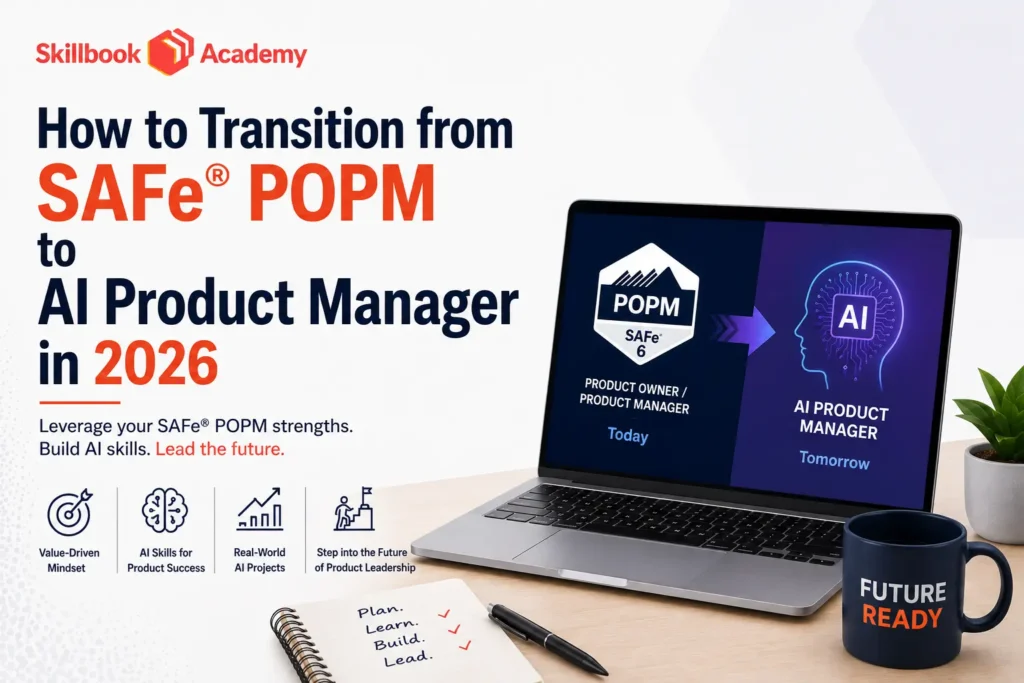
To transform SAFe® POPM into an AI Product Manager in 2026, leverage your strengths in prioritization, value delivery, and stakeholder alignment, and introduce AI-specific data thinking, model evaluation, AI product discovery, monitoring, and responsible AI risk.
The shortest route is a 90180-day plan: translate your POPM experience, learn the basics of the minimum viable AI product, launch 2 AI-related portfolio artifacts, and be able to show ownership of end-to-end AI products in interviews.
Why this transition makes sense in 2026
As a SAFe® POPM, you are already working in complexity. By repeating the steps, you align the stakeholders, make trade-offs, and add value. These capabilities do not vanish in AI product management; they are put to a more effective use.
It is the uncertainty that changes.
In AI products, uncertainty is no longer what to develop or when to deliver. It includes:
- Whether the data is true to reality.
- Consistency of the model.
- Do users trust probabilistic results?
- Risk, bias, and compliance were managed responsibly or not.
Due to this, powerful POPMs tend to change more quickly than anticipated. You are already dealing with ambiguity; AI merely creates new variables. That is why this is a skill bridge – not a career reset.
What you’re moving from vs moving into
On average, experience in SAFe® POPM shows:
- Outcome-oriented prioritization
- Inter-team coordination in Agile.
- Aligned stakeholder enterprise.
- Governance-aware delivery
These are fundamental product leadership skills.
Bridge: What AI Product Managers’ work adds
AI Product Managers continue to own product outcomes- but now:
- Data is a dependency
- Model behavior is part of UX
- Evaluation is continuous
- Risk and trust are turned into product features.
It implies that AI PMs have to conciliate product objectives + data facts + model functionality + risk management into a single system.
Your strength in POPM is delivery and alignment. Your AI PM upgrade is harmonizing data, models, metrics, and risk into one product story.
The roadmap overview (90–180 days)
Rather than learning everything at once, learn in a narrow sequence:
- Migration of the POPM experience to an AI-ready language.
- Minimum knowledge of AI/ML products.
- Introduce AI-specific discovery and feasibility capabilities.
- Construct 2 AI PM portfolio projects.
- Master MLOps and monitoring (PM depth).
- Target the right AI PM roles.
- Revise resume and interview narratives.
Step 1: Reposition the POPM experience for AI PM hiring managers
Why it matters
Most POPMs downplay themselves through SAFe®-heavy language that cannot be translated outside enterprise Agile.
What to do
Restructure work in results, choices, and exchanges.
Instead of: Managed PI planning/backlog.
Use: Possessing prioritization and trade-offs to provide quantifiable results in cross-functional teams.
What to produce (artifact)
- Resume bullet rewrite
- LinkedIn summary focused on results
How to prove it in interviews
Describe what decision you made, what metric moved, and what trade-off you had.
AI PM interviews incentivize the clarity of outcomes, not framework fluency.
Step 2: Learn minimum viable AI/ML knowledge
Why it matters
You do not have to become a data scientist; however, you have to be intelligent about AI systems.
What to do
Focus on:
- AI product lifecycle (data → model → evaluation → monitoring)
- Evaluation mindset (accuracy over time, not “works/doesn’t”)
- Responsible AI principles (risk, bias, privacy, trust)
What to produce
- One-Page AI Product Lifecycle cheat sheet.
Interview proof
Explain the relationship between product objectives, model metrics, and monitoring signals.
You are learning to operate AI products—not to create models.
Step 3: Add AI-specific product discovery skills
Why it matters
The feasibility of AI is diverse. Expensive failures come as a result of poor discovery.
What to do
Before committing to AI, ask:
- In this case, is AI superior to rules-based logic?
- Do we have usable, legal data?
- What’s the cost of errors?
- How will users override or provide feedback?
- What do you need to monitor after launch?
Artifact
- AI Feasibility Checklist
Interview proof
Justify your decisions not to use AI for some problems.
Strong AI PMs lay the groundwork of success—not features.
Step 4: Build an AI PM portfolio (2 projects)
Why it matters
Courses do not demonstrate competence. Artifacts do.
Portfolio Project A vs B
| Project | Purpose | Deliverables | Proof |
| A: AI Feature Spec | AI decision-making | AI PRD one-pager | Product judgment |
| B: Experiment Plan | Iteration & monitoring | Rollout + metrics | Execution thinking |
AI PRD One-Pager
- Problem & users
- AI vs non-AI decision
- Success metrics (business + model)
- Data needs
- UX & error handling
- Risk (bias, privacy, SAFe®ty)
- Monitoring & rollout
A robust portfolio demonstrates that you can deliver, quantify, and govern AI.
Step 5: Learn MLOps + monitoring (AI PM level)
Why it matters
AI systems do not improve in the absence of code modifications.
What to learn
- Online evaluation vs offline evaluation
- Drift detection
- Data quality checks
- Human-in-the-loop
- Rollbacks and guardrails
Artifact
- Post-launch monitoring playbook
Interview proof
Describe how you’d detect failure before users complain.
In AI products, launch is the beginning—not the end.
Step 6: Choose the right target roles
Role types in 2026
- AI-enabled PM: AI improves workflows
- AI/ML PM: Model-driven features
- Platform AI PM: Internal AI platforms & governance
Action: Start with AI-enabled or AI/ML PM roles in your domain—especially in enterprises where SAFe® experience is valued.
Job titles vary; responsibilities matter more.
Step 7: Update resume + interview stories
Resume focus
- Decisions owned
- Metrics moved
- Trade-offs made
- Risk handled
Interview themes (prepare these)
- When AI is the right (or wrong) tool
- Business vs model metrics
- Trust and risk handling
- Cross-functional leadership
- Post-launch iteration
Your edge is responsible, measurable AI leadership.
SAFe® POPM vs AI Product Manager
| Dimension | SAFe® POPM | AI PM |
| Value delivery | Prioritization | Use-case + experiments |
| Metrics | Outcome | Outcome + model |
| Delivery | Iterative | Iterative + monitoring |
| Risk | Program | Bias, privacy, SAFe®ty |
| Stakeholders | Teams | Adds DS, governance |
The long list: 18 skills to build
- AI use-case framing [Upgrade]
- Data requirements thinking [New]
- Outcome metrics [Keep]
- Model metrics awareness [New]
- Error-cost reasoning [New]
- Human-in-the-loop design [New]
- Experiment design [Upgrade]
- Monitoring & drift [New]
- Responsible AI risk [New]
- DS collaboration [Upgrade]
- Data privacy basics [Upgrade]
- GenAI evaluation basics [New]
- Trust storytelling [Upgrade]
- Roadmapping under uncertainty [Upgrade]
- AI change management [Upgrade]
- Tooling familiarity [Upgrade]
- Cost/value trade-offs [Upgrade]
- Continuous iteration mindset [Keep]
90–180 day plan
| Time | Focus |
| 0–30 | Translate POPM + AI basics |
| 31–60 | Portfolio Project A |
| 61–90 | Portfolio Project B |
| 91–180 | Apply + interview |
This plan converts learning into proof.
Is it worth it?
Yes—when you like ambiguity and learning loops and more leveraged decisions.
No—unless you desire certainty before action. AI products demand comfort in probability, iteration, and trust building.
Salary expectations (directional)
The compensation of an AI PM is very different depending on their location, seniority, and type of role. The published U.S. averages (~$150K–$160K) are directional, not guarantees. You should always compare your domain and geography.
Common pitfalls (and how to avoid them)
- Over-learning, under-shipping → Build artifacts.
- Becoming a data scientist → Remain product-oriented.
- Negligence in AI responsibility → Design early.
- None of the monitoring stories → Own post-launch.
- SAFe® overload of jargon → Use outcome language.
Related Courses & Certifications: SAFe® Product Owner/Product Manager (POPM) Certification Training | AI Powered Product Manager / Product Owner | Achieving Responsible AI Micro-Credential Course
Frequently Asked Questions
An AI Product Manager is the owner of the AI-driven products or platform results. They specify use cases, match model objectives to product measures, coordinate data/ML and engineering, and handle monitoring, risk, and post-launch iteration.
The salaries of AI PMs differ greatly depending on the geography, experience, and the type of position. Published averages (in the U.S., approximately, in the mid to high-$150K range) are to be viewed as indicators rather than as assurances.
Begin by mapping your PM or POPM strengths to AI needs, learn AI product fundamentals, create 1-2 portfolio artifacts (AI PRD + experiment plan), and target AI-enabled or AI/ML PM roles in your area.
It can be worth it in case you like ambiguity, learning cycles, and making decisions with greater leverage. AI products demand a feeling of comfort with probabilistic results, ongoing assessment, and trust and risk ownership.
No. AI PMs require technical fluency, not coding proficiency, to learn the constraints, pose the appropriate questions, and make informed trade-offs with the ML and engineering teams.
Prioritization, stakeholder alignment, outcome-based planning, and iterative delivery transfer well. The AI PM roles include the addition of data thinking, model evaluation awareness, monitoring, and accountable AI risk framing.
Add an AI PRD, with quantifiable objectives, data requirements, AI vs Non-AI decision options, risk analysis (bias, privacy, SAFe®ty), rollout plan, and a monitoring plan to demonstrate complete lifecycle ownership.
Meet the Author

Harry Narang
SAFe® Practice Consultant & Agile Coach
Harry Narang is a SAFe® Practice Consultant and Agile Coach based in Toronto.