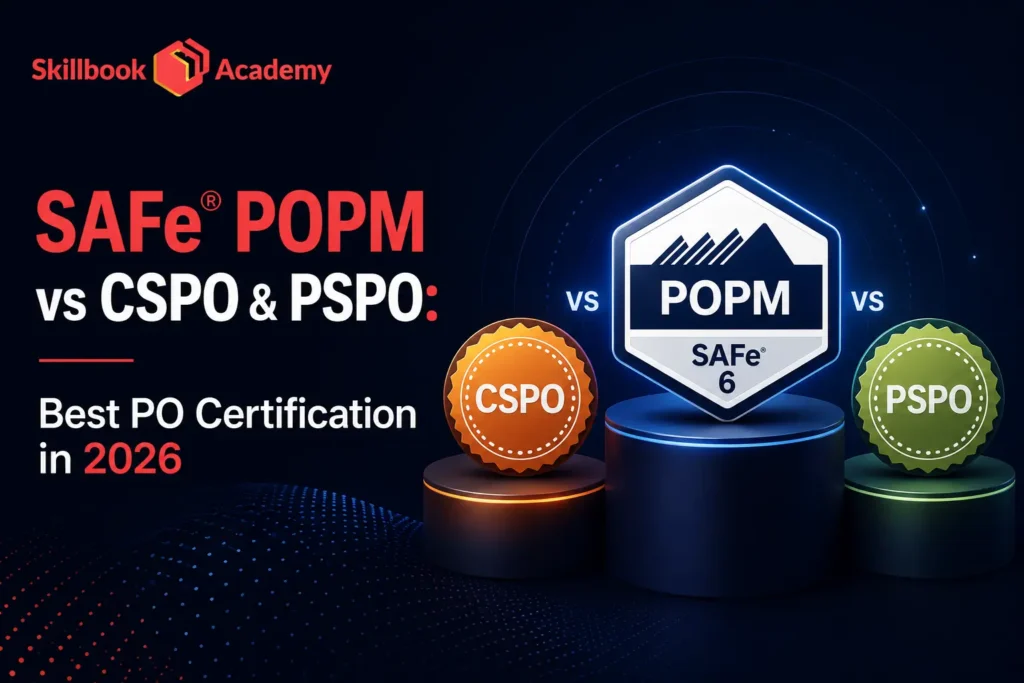
- Choose CSPO or PSPO if you work with a single Scrum team and your primary responsibility is managing one Product Backlog.
- Choose SAFe® POPM if you work across multiple Agile teams, participate in PI Planning, and manage cross-team dependencies within a SAFe enterprise.
- CSPO and PSPO build Scrum fundamentals, while SAFe® POPM focuses on enterprise-scale product delivery, program alignment, and value flow.
- The biggest difference isn't the certification—it's the operating environment. Single-team Scrum and enterprise Agile require different planning, coordination, and decision-making skills.
- SAFe® POPM introduces capabilities that single-team certifications don't cover, including PI Planning, Agile Release Train (ART) collaboration, dependency management, and strategy-to-execution alignment.
- AI-Empowered SAFe® POPM 6.0 extends the role by teaching AI-assisted discovery, backlog refinement, and prioritization while keeping human validation central to product decisions.
- Professionals managing multiple teams, Features instead of stories, or program-level planning typically gain more value from SAFe® POPM than from CSPO or PSPO.
- The best Product Owner certification in 2026 depends on your delivery model—not your job title. Match the certification to the scale, planning cadence, and responsibilities of your organization.
Which Product Owner Certification is best in 2026?
In case you deal with one Scrum team, then select CSPO or PSPO. When you have several teams, PI Planning, and enterprise alignment, then SAFe® POPM is suited. The latest AI-Empowered POPM 6.0 even leaves you ready for AI-powered product processes that are outside the scope of single team certifications.
Why Search Results Blur — The Monday Morning Reality
Type in Product Owner certifications and you’ll find an unending comparison list. All these are similar: backlogs, user stories, stakeholder alignment. However, Monday morning says otherwise.
The same trend is seen in coaching rooms of big companies: it is hardly ever necessary to write more effective stories. It is negotiating dependencies between teams, prioritizing towards strategy, and surviving hundreds of person planning ceremonies.
That is where confusion sets in.
Most professionals who make comparisons between SAFe® POPM and CSPO expect the two to be substitutes. They’re not. They address extremely distinct organizational issues. This guide takes you through those differences so that your selection is based on the work you do—not the title of the job on paper.
Definitions That Actually Matter
Clarify the roles before comparing certifications.
Scrum Product Owner (PO)
According to the Scrum Guide 2020, PO maximises product value by maintaining the Product Backlog of a single Scrum Team. It is tight, tactical, and team-oriented.
Traditional Product Manager (PM)
Usually possesses market strategy, positioning, and roadmap direction. Powerful in discovery and market thinking, frequently excluded from Agile execution mechanisms.
SAFe® Product Owner/Product Manager collaboration
In the Scaled Agile Framework, PO and PM are a system. The PM is concerned with high-level priorities and vision; the PO facilitates team-level implementation in accordance with Program Increment (PI) objectives.
Composite insight: The backlog problem in large enterprises is hardly ever about story writing; it is about dependency negotiation.
What’s Inside This Guide
We will go through the decision in realistic layers:
- In which area does the certification applies
- The Monday-morning environment test
- Advantages and weaknesses of CSPO/PSPO
- Where conventional PM certifications work
- The reasons why SAFe® POPM is dominant at scale
- The 2026 AI shift
- Side-by-side comparison
- Decision framework
- Signals you have outgrown single-team PO certs
- Real-world scenarios
- Exam prep traps
The Monday-Morning Test
Ask yourself one sincere question: What sort of planning meeting predominates your week?
Single Scrum team reality
- Sprint Planning every 1–2 weeks
- One backlog
- Low external dependencies
Start with CSPO or PSPO.
Enterprise SAFe® reality
- PI Planning every 8–12 weeks
- Several teams coming together
- Dependency boards all around
SAFe® POPM is tailored to this environment.
Product-led startup reality
- Roadmaps and market bets
- Less framework rigidity
Conventional PM qualifications can be of use.
Category 1: CSPO & PSPO — Strong Foundations, Clear Limits
Both certifications are great for understanding the basics of Scrum.
What they teach well
- Backlog refinement
- User story writing
- Value ordering
- Teamwork among stakeholders
CSPO focuses on instructor-based learning. PSPO puts a focus on exam rigor and self-study.
Where they struggle at scale
The difference is evident when more than one team is introduced.
Composite coaching insight: Most CSPO-trained POs are confident until their initial PI Planning has 10 teams.
Common friction points:
- None of the formal dependency management
- No ART-level alignment model
- No economic prioritization between teams
- No coordinated planning rhythm
That is the main conflict in SAFe® POPM vs PSPO debates: PSPO is Scrum deep, but not enterprise-ready.
Category 2: Traditional PM Certifications — Strategic but Detached
Conventional product management certifications excel in product discovery and market thinking.
Where they fit
- Product-led companies
- Market strategy roles
- Early product discovery
Why they fall short in SAFe® environments
They typically lack:
- Sprint-to-strategy traceability
- Frameworks of feature-to-story decomposition
- PI Planning mechanics
- Agile Release Train coordination
Composite insight: Most PMs can articulate the roadmap eloquently, but fail to drive strategy in an Agile delivery system.
Category 3: SAFe® POPM — Built for Enterprise Delivery
SAFe® POPM is due to the fact that Agile scaling introduces new modes of failure.
1. PI Planning mastery
SAFe® POPM equips you with 8-12 week Program Increment planning as opposed to isolated sprint planning.
Example: PI Planning moment
- Team A depends on Team C’s API
- The risk is indicated on the program board
- PO negotiates sequencing
- PI Objectives are adjusted
This is the day-to-day reality in big organizations.
2. Strategy → Feature → Story decomposition
Example
- Portfolio theme: Improve digital onboarding
- Epic: Reduce KYC friction
- Feature: On-the-fly document validation
- Stories split across 3 teams
This cross-team slicing is well-tested in the POPM exam.
3. Dependency management across the ART
Flow in SAFe® environments is interrupted at team boundaries.
Composite insight: Performing SAFe® POs writes fewer acceptance criteria, investing more time in the visualization of dependencies.
Your next step if you operate in SAFe®
In case you are already engaged in work associated with PI Planning and the multi-team alignment, the nearest course is the SAFe® AI-Empowered Product Owner/Product Manager (6.0) Certification Training (USD 545).
The 2026 Shift: AI-Empowered SAFe® POPM 6.0
The latest development, AI-Empowered SAFe® POPM 6.0, is an expression of a significant transformation in the work of products.
Product Owners are not being replaced by AI. It is shortening the discovery and backlog preparation time.
Practical daily workflows
Accelerated discovery example
- AI generates thousands of support tickets
- Pain points are clustered into themes
- Suggests persona updates
- Human validates and give priority.
Backlog refinement example
- AI drafts story candidates
- Highlights edge cases
- Recommends acceptance criteria
- PO carries out human validation
Composite insight: When the use of AI in teams is adopted, the backlog cycles can be faster, but only when human validation is still explicit.
Comparison Table (CSPO vs PSPO vs SAFe® POPM)
| Capability | CSPO | PSPO | SAFe® POPM | AI-Empowered POPM 6.0 |
| Ideal environment | Single Scrum team | Single Scrum team | Enterprise / ART | Enterprise with AI workflows |
| Planning cadence | Sprint planning | Sprint planning | PI Planning + sprints | PI Planning + AI-assisted flow |
| Dependency management | Minimal | Minimal | Core responsibility | Advanced + AI support |
| Scope of role | Team backlog | Team backlog | Program + team alignment | Program + AI-driven insights |
| Exam/renewal style | Course-based | Exam-based | 45 Q exam (80%) | Same + AI skills |
| AI integration | Not formalized | Not formalized | Emerging | Built-in workflows |
| SAFe® POPM certification cost | — | — | Varies by provider | Included in training |
Decision Framework: Choosing the Best Product Owner Certification 2026
Ask these three questions.
1. What delivery system are you inside?
- One Scrum team → CSPO/PSPO
- Multiple teams / SAFe® → POPM
- Pure product strategy → PM cert
2. What outcomes define your success?
- Backlog quality → Scrum path
- Market success → PM path
- Cross-team alignment → SAFe® path
3. What must change in the next 60 days?
In case PI Planning and multi-team coordination are already on your agenda, the quickest route will be the SAFe® AI-Empowered Product Owner/Product Manager (6.0) Certification Training (USD 545).
15 Signals You’ve Outgrown Single-Team PO Certifications
- You coordinate on 3+ teams per week.
- Your backlog is based on the delivery of other teams.
- PI Planning shows in your calendar.
- Even Sprint achievement leads to release delays.
- Prioritization is driven by architectural constraints.
- Stakeholders demand program-level visibility.
- You are in charge of Features, not merely stories.
- Your roadmap cuts across several teams.
- Planning is dominated by integration risk.
- You attend ART sync meetings.
- It is an issue of economic prioritization.
- Cross-team negotiation is needed for the release timing.
- Flow is influenced by compliance or governance.
- New uncertainty comes with AI features.
- Your Monday meetings include dependency boards.
POPM should be a better fit, in case 5+ feels familiar.
Real-World Scenarios
Scenario 1: BA → PO in one Scrum team
Context: Single team
Pain: Unclear stories
Best fit: CSPO or PSPO
What changes: Strong backlog discipline
Scenario 2: PM entering a SAFe® enterprise
Context: Strategy strong, execution messy
Pain: Roadmap not translating to delivery
Best fit: SAFe® POPM
What changes: Strategy connects to PI outcomes
Scenario 3: PO in a bank scaling to 10 teams
Context: Regulated environment
Pain: Dependencies derail releases
Best fit: SAFe® POPM
What changes: Predictable program flow
Scenario 4: AI-enabled feature rollout
Context: AI uncertainty, privacy risk
Pain: Hard to slice incremental value
Best fit: AI-Empowered POPM 6.0
What changes: Structured AI delivery workflow
Exam Prep + Common Traps
Official exam snapshot
- 45 questions
- 90 minutes
- 80% passing score
- Closed book
Common traps
Trap 1: Memorizing terminology
The test scores are biased in favor of applied knowledge, particularly decomposition and PI Planning conversations.
Trap 2: Confusing Scrum PO vs SAFe® PO responsibilities
Under SAFe®, Product Management is core.
Trap 3: Ignoring dependency thinking
Most applicants do not prepare adequately for this.
Composite insight: Applicants with program-level thinking are more rapid than those who study glossary words.
Conclusion: SAFe® POPM vs CSPO — The Real Decision
SAFe® POPM vs CSPO is just a matter of choice and depends on the operating environment.
In case you have a single Scrum team, then CSPO or PSPO will work well. When you are working with PI Planning, cross-team dependencies, and enterprise delivery, then SAFe® POPM is the way to go to the future—now that AI is redefining product processes.
The next best step that can be taken by professionals who are already experiencing the pain of the scale is the SAFe® AI-Empowered Product Owner/Product Manager (6.0) Certification Training.
Related Courses & Certifications: SAFe® Product Owner/Product Manager (POPM) Certification Training | Certified ScrumMaster (CSM) Certification Training | AI Powered Product Manager / Product Owner
Related Reads: SAFe® POPM Essential Skills Beyond the Basics | Implementing SAFe® POPM 6.0: Step-by-Step Adoption for Enterprises
Frequently Asked Questions
CSPO focuses on managing one Scrum Team backlog. SAFe® POPM prepares you to coordinate strategy and execution across multiple teams in an enterprise environment.
Yes, especially if your organization is scaling Agile. PSPO builds Scrum depth; POPM builds enterprise delivery capability.
It validates your ability to use AI for discovery, backlog refinement, and edge-case analysis with human oversight.
Experience helps, but is not mandatory. However, familiarity with Scrum concepts will significantly shorten your learning curve.
Can a Scrum Master also be a Product Owner?