- Digital transformation only sticks when execution is tied to enterprise strategy. Lean Portfolio Management (LPM) is the SAFe competency that keeps that link intact.
- LPM rests on three pillars: strategy and investment funding, Agile portfolio operations, and Lean governance that speeds decisions without adding bureaucracy.
- Strategic themes translate enterprise vision into clear investment priorities, so every digital initiative maps back to a measurable business outcome.
- Funding decisions are made on objective criteria, strategic alignment, expected outcomes, and risk, so the highest-impact initiatives get resourced first.
- Portfolios are not set-and-forget. Continuous KPI monitoring lets teams spot bottlenecks, reprioritize funding, and optimize value delivery as conditions change.
- LPM acts as the communication bridge between Agile teams, product and solution management, and business leaders, accelerating cross-functional alignment.
-
What Is Lean Portfolio Management?
Defines LPM as a core SAFe competency that governs and aligns the portfolio, translating enterprise strategy into actionable initiatives delivered through Agile value streams. Lists its core benefits: strategic alignment, informed investment, optimized resource allocation, and continuous performance improvement.
-
Why is there an emphasis on LPM?
Explains why SAFe prioritizes LPM, namely managing complexity without slowing innovation, through three interconnected dimensions: strategy and investment funding, Agile portfolio operations overseeing ARTs and Solution Trains, and Lean governance for fast, low-bureaucracy decision-making.
-
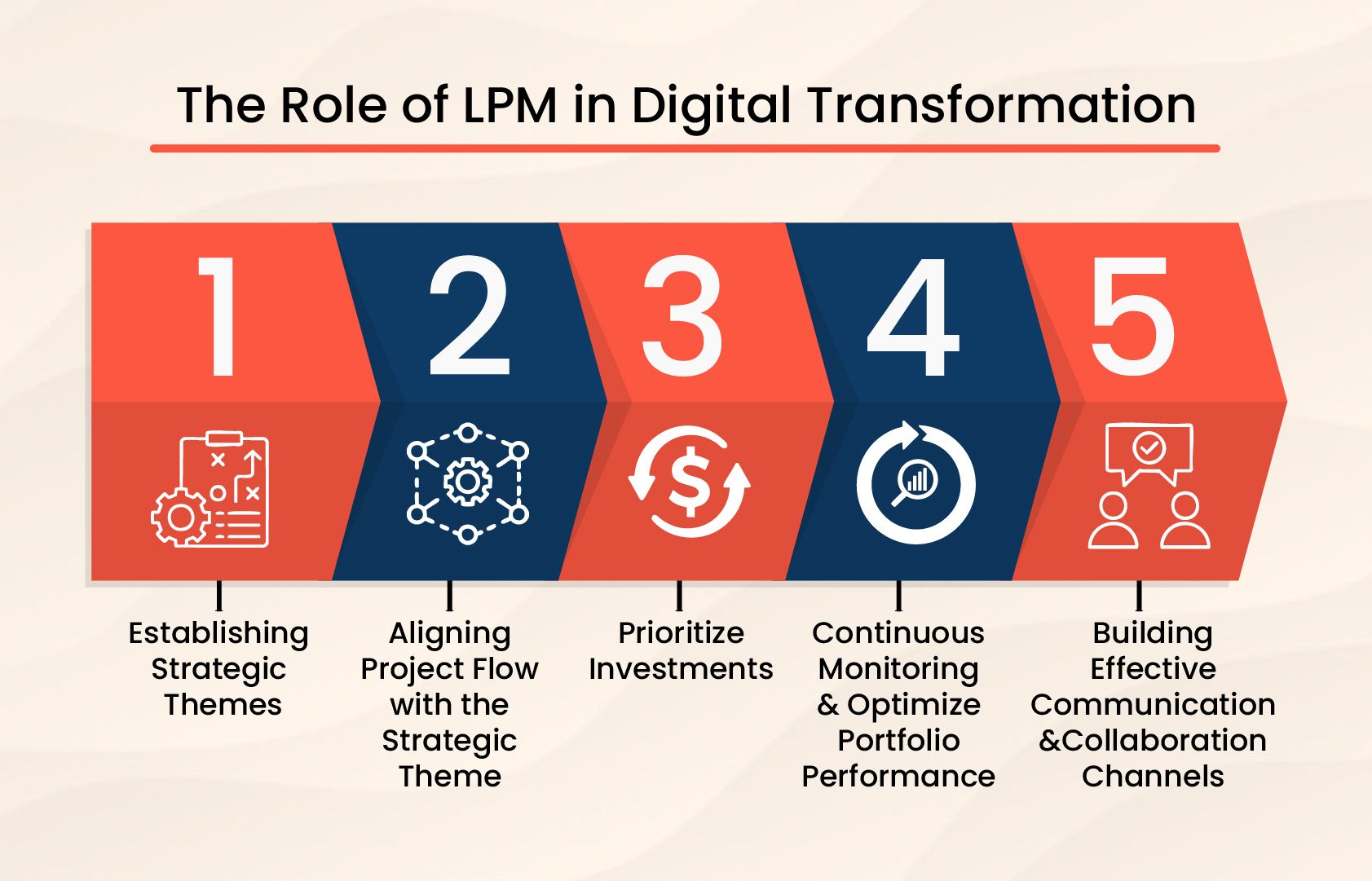
The Role of Lean Portfolio Management in Digital Transformation
Breaks down LPM's transformation responsibilities across five areas: establishing strategic themes, aligning portfolio vision with digital strategy, prioritizing investments by value, continuously monitoring and optimizing the portfolio, and enabling cross-functional collaboration. Uses a financial-services example to show themes like improving customer experience driving aligned digital initiatives.
-
Conclusion
Reinforces that LPM bridges strategic themes and execution to help businesses realize their vision, and points readers to Skillbook Academy's SAFe Lean Portfolio Management certification training and related SAFe courses.
As technology evolves and businesses scale rapidly, organizations face increasing pressure to transform digitally while maintaining strategic clarity. Speed alone is not enough, digital transformation succeeds only when execution is aligned with enterprise strategy.
This is where Lean Portfolio Management (LPM) plays a critical role within the Scaled Agile Framework. LPM ensures that strategic objectives, investments, and execution remain aligned, enabling organizations to achieve meaningful and sustainable transformation.
In this article, we explore the role of Lean Portfolio Management in digital transformation, highlighting how LPM strengthens governance, improves decision-making, and aligns portfolios with enterprise vision.
What Is Lean Portfolio Management?
Lean Portfolio Management (LPM) is a core competency within SAFe® that provides governance, alignment, and execution at the portfolio level. It ensures that enterprise strategy is translated into actionable initiatives and delivered through Agile value streams.
With effective LPM in place, organizations can:
- Align portfolio execution with strategic themes
- Make informed investment decisions
- Optimize resource allocation across value streams
- Continuously monitor and improve portfolio performance
Professionals trained in LPM help enterprises achieve business outcomes while maintaining agility and transparency across the portfolio.
Why is there an emphasis on LPM?
SAFe® places strong emphasis on LPM because it enables enterprises to manage complexity without slowing innovation. LPM focuses on three interconnected dimensions:
- Strategy and investment funding – LPM primarily serves as a bridge and defines the strategic theme and objectives. These are then communicated and aligned with the enterprise strategy. Additionally, the LPM also determines the budget and resource allocation based on the value streams and strategic priorities.
- Agile portfolio operations – LPM comes in with the handy role of overseeing the execution of a portfolio. This is necessary for ensuring that the Agile Release Trains (ART), and Solution Trains continue to deliver value that aligns with the vision and objectives of the enterprise. This is necessary to establish governance, support, and coordination across the entire portfolio.
- Lean governance – By maintaining lean governance, LPM plays a key role in fast decision-making, reducing bureaucracy, and fostering innovation. This builds an environment for continuous improvement and deployment based on the feedback mechanism and learning.
The Role of Lean Portfolio Management in Digital Transformation
Once the foundation of LPM is established, its impact on digital transformation becomes clear. The role of LPM in this context can be understood through the following key responsibilities.
Establishing Strategic Themes
Lean Portfolio Management works closely with leadership and stakeholders to define and communicate strategic themes. These themes represent high-level priorities that guide portfolio investments and decision-making.
Strategic themes are derived from the enterprise vision and provide a clear direction for digital initiatives. For example, a financial services organization undergoing digital transformation may define themes such as:
- Improving customer experience
- Increasing market reach
- Enhancing operational efficiency
LPM ensures these themes are clearly understood and consistently applied across the enterprise.
Aligning Portfolio Vision with Digital Strategy
LPM ensures that the Portfolio Vision aligns with the organization’s digital transformation goals. This creates transparency into how value streams and solutions contribute to enterprise outcomes.
Continuing the financial services example, initiatives such as developing a mobile banking platform, implementing customer feedback systems, or digitizing loan processes are aligned directly with the strategic theme of improving customer experience.
This alignment ensures that digital investments deliver measurable business value.
Prioritizing Investments Based on Value
Lean Portfolio Management guides decisions on where to invest by evaluating initiatives based on:
- Strategic alignment
- Expected business outcomes
- Risk and complexity
LPM uses objective criteria and scoring models to prioritize funding and resource allocation. Initiatives with the highest strategic impact receive priority, ensuring optimal use of enterprise resources.
Continuous Monitoring and Portfolio Optimization
Digital transformation is not static. LPM continuously reviews portfolio performance against strategic objectives and key performance indicators (KPIs).
Using data, analytics, and insights, LPM professionals:
- Identify bottlenecks and dependencies
- Adjust priorities and funding
- Optimize value delivery
Regular portfolio reviews ensure the organization remains aligned with its digital goals while responding to change effectively.
Enabling Communication and Cross-Functional Collaboration
Lean Portfolio Management serves as a communication bridge across the enterprise. It connects:
- Agile teams
- Product and Solution Management
- Business leaders and stakeholders
Through structured portfolio alignment workshops and review sessions, LPM ensures shared understanding of the Portfolio Vision, strategic themes, and transformation goals. This collaboration accelerates decision-making and strengthens alignment across functions.
Conclusion
It is by far evident that SAFe® Lean Portfolio Management plays a critical role in bridging the enterprise’s strategic themes and objectives. When clear strategic themes are established, the portfolio vision gets aligned, investments are prioritized, and portfolio performance is optimized. This eventually helps businesses achieve their visions.
A LPM certification comes in as a necessary requirement that will help your business manage the process with greater ease and certification. This is where the SAFe® Lean Portfolio Management certification training from Skillbook Academy comes in handy.
Related Courses & Certifications Training:
SAFe® Lean Portfolio Management (LPM) | SAFe® Practice Consultant Certification Training | SAFe® Agile Product Management Certification Training | SAFe® Product Owner / Product Manager (POPM) | SAFe® Release Train Engineer (RTE)
Meet the Author

Aaron Jebin
Contributing Writer
Aaron Jebin is a contributing writer at Skillbook Academy covering Agile, SAFe and AI topics.