- AI tools help Product Managers shift from operational execution to strategic leadership by automating documentation, research, meeting management, and routine product workflows.
- Different AI tools solve different stages of the product lifecycle: ChatPRD for documentation, Perplexity for research, Miro AI for discovery, Dovetail for customer insights, Jira Product Discovery for prioritization, Gamma for presentations, and Clockwise for time management.
- The greatest productivity gains come from integrating AI into existing workflows, allowing Product Managers to spend more time on customer discovery, product strategy, and cross-functional decision-making.
- Successful AI adoption starts with solving one high-impact problem at a time. Pilot a single AI tool over two to four sprints, measure business outcomes, and expand adoption based on proven value.
- Enterprise AI adoption requires responsible governance. Product Managers should establish data privacy guidelines, define approved AI tools, and ensure sensitive product information is handled according to organizational security policies.
- The value of AI is measured by business outcomes—not the number of tools used. Track improvements such as faster decision-making, reduced operational overhead, shorter delivery cycles, and improved stakeholder alignment.
- Modern Product Managers combine AI automation with human judgment, using AI to accelerate execution while retaining ownership of prioritization, customer understanding, strategic decisions, and product outcomes.
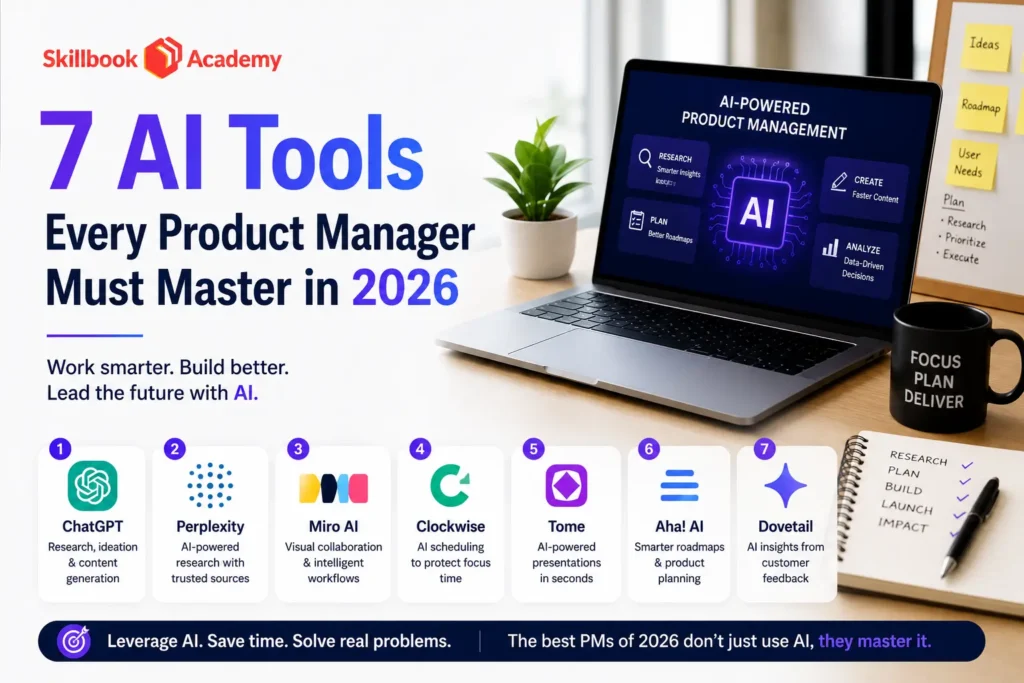
The product management landscape has significantly evolved over the last few years. Today, product leaders are running complex end-to-end workflows using highly specialized platforms like ChatPRD (documentation), Perplexity (market research), and Miro AI (visual collaboration). This technological change is a significant departure from previous generative systems to current tools that can actively execute complex tasks. These platforms handle not only independent backlog refinement but also continuous competitive analysis and team alignment. The following parts extensively highlight 7 AI tools for product managers to excel in 2026. This can help you achieve high-level strategic business goals while reducing operational workload.
Why AI is Mandatory for Product Managers in 2026
The product management discipline has undergone a fundamental shift in 2026. It has moved from project execution to strategic leadership. The focus has shifted from merely generating content to actively executing operational tasks. All routine administrative tasks, such as creating engineering tickets, producing presentations, and setting meeting summaries, are now completely automated. Not using these tools will have professionals spend their week on low-leverage, operational work.
Conversely, professionals who adapt to these systems can dedicate their time entirely to deep customer discovery and strategic market differentiation. The selected platforms are chosen not for their novelty but because they directly resolve the systemic friction points found within modern Agile delivery frameworks. Ultimately, mastering this advanced ecosystem changes your professional responsibilities, shifting your focus away from tracking small deliverables to directly drive broader strategic business outcomes.
The Top 7 AI Tools for Product Managers
| Tool | Best For | Pain Point It Solves | Key AI Feature (2026 Update) | Pricing |
| ChatPRD | Automating user stories and PRDs | Removes writer’s block and hours spent formatting ambiguous technical requirement documents | Converts final requirements into ready-to-use tickets and acceptance criteria. Integrates with Linear and offers a focused writing assistant | Freemium / Pro ($20/mo) |
| Perplexity | Market research & competitor analysis | Eliminates lengthy web searches and scattered browser management by consolidating live-data analysis | Deep Research Mode. Produces structured, fully referenced briefings from live data for strategic decisions | Free / Pro ($20/mo) |
| Miro AI | Visual collaboration & retrospectives | Converts unstructured brainstorming and disorganized ideas into organized PM structures without manual categorization | Sidekicks & Flows. Auto-group notes, summarize sentiment, and turn diagrams into technical flows | Freemium / Business / Enterprise |
| Dovetail | Customer insights & synthesis | Prevents user feedback from getting lost in static sheets; validates reasons for features with multimedia evidence | Magic Cluster. Algorithmically tag and visualize themes from large qualitative transcripts for clear insights | Free / Starter / Team / Enterprise |
| Gamma | Stakeholder presentations | Eliminates time wasted on visual formatting; enables rapid generation of strategic decks after ideation | Remix & Nano Banana Pro. Quickly reformat content for different audiences and generate brand-consistent visuals | Free / Plus / Pro |
| Jira Product Discovery (Atlassian Intelligence) | Roadmap alignment & prioritization | Connects product ideation with code deployment so development aligns with strategic goals | AI Apps Builder. reviews tickets, scores priorities, and links work to strategic goals | Free / Standard |
| Clockwise | Time management & deep work | Mitigates fragmented calendars and meeting overload to protect team flow state | Adaptive Holds. Automatically reshuffles meetings to preserve focus blocks and fit urgent cross-team sessions | Free / Teams / Enterprise |
Pro tip:
- Run a micro-pilot. Pick one tool, one pain point, run it for 2-4 sprints, and see if it actually saves time.
- Integrate, don’t recreate. Bring AI outputs into your existing tools (Jira/Linear, Slack, calendar), so work stays in one place.
Comparison Table: Top PM AI Tools
| Tool | Primary Use Case | 2026 “Killer Feature” | Pricing Model |
| ChatPRD | Documentation | Auto-Drafting Linear Tickets | Freemium |
| Perplexity | Research | Deep Research (Reasoning) | Freemium |
| Miro AI | Visuals | Sidekicks (Auto-Clustering) | Freemium |
| Dovetail | Insights | Magic Cluster Analysis | Paid (Tiered) |
| Gamma | Presentations | Deck “Remixing” | Freemium |
| Jira Product Discovery (Atlassian Intelligence) | Prioritization | Agentic Roadmap Scoring | Free / Standard |
| Clockwise | Time Mgmt | Flexible Meeting Holds | Freemium |
Pro Tip:
- Measure what matters. Track minutes saved, fewer handoffs, faster decisions—not just “we used AI.”
How AI Increases PM Productivity
Decision-Making Velocity: Sophisticated research and insight platforms reduce the internal friction of ideology alignment. When strategic decisions are based directly on synthesized empirical market data and objective customer evidence, organizations are able to rapidly reach consensus.
Lowering operational overhead: Specific automation engines handle the administrative overhead of Agile frameworks, such as documenting requirements and sorting notes. This dedicated support reduces typical backlog refinement time by nearly 50%.
Unified source of truth: Integrated discovery systems reduce communication discrepancies across functional departments. When front-facing teams make promises against standard responsibilities, the engineering teams get operational context right away, removing the usual translation wall between business units.
Pro tip:
- Keep rules simple! No sensitive specs in public tiers; CISO sign-off needed for production data; document who can use which models.
Conclusion
Operational execution versus executive product leadership is, in today’s professional world, a difference mainly of strategic leverage. These specialized AI tools for product managers provide that critical capacity. The transition begins with optimizing existing backlogs through automated documentation engines and enhancing market intelligence through advanced analytical search systems. The endgame isn’t the number of technological tools, but the implementation of precise digital mechanisms that liberate leadership from routine administrative work and enable dedicated attention to long-term strategy.
Ready to reclaim your time and lead with strategy?
Start a two‑sprint pilot with one tool that fixes your biggest daily headache and see the difference!
Suggested Read:
| Revolutionising Agile Workflows: The Power of AI | How Generative AI Is Transforming Agile Product Management |
Related Courses & Certifications: AI Powered Product Manager / Product Owner | SAFe® for Teams Certification Training
Frequently Asked Questions
No. Advanced automated systems primarily absorb repetitive administrative duties, such as documentation drafting and meeting synthesis. This shift fundamentally elevates the human manager, allowing professionals to dedicate their focus entirely to high-value strategic tasks like market positioning and nuanced customer empathy.
Miro AI serves as an exceptional mechanism for structured team collaboration during interactive sessions like retrospectives and sprint planning. Conversely, Jira Product Discovery offers superior utility for the structured tracking and execution of core project management artifacts.
Most enterprise-grade platforms provide rigorous security frameworks. These typically include SOC2 compliance and zero-retention data configurations that explicitly prevent internal proprietary information from training public algorithmic models. However, organizations should always consult their chief information security officer to review data governance protocols before inputting proprietary intellectual property.
Meet the Author

Chris Harrison
Agile Coach & Trainer
Chris Harrison is an Agile coach and certified trainer.