- Agile turns innovation from a one-off project into an ongoing capability by breaking work into small increments and refining solutions against real customer feedback.
- Five principles anchor Agile innovation: customer-centricity, iterative progress, cross-functional collaboration, adaptability, and continuous improvement via retrospectives.
- Psychological safety is non-negotiable — teams that can fail and share ideas without fear out-innovate those that can't.
- Diversity of skills, experience, and background measurably widens the idea pool and sharpens creative problem-solving.
- Scrum and SAFe give innovation structure: Scrum drives iterative feedback, SAFe scales experimentation with Lean thinking.
- Expect friction — balancing creativity against deadlines, overcoming change resistance, and defining innovation metrics (time-to-market, adoption, satisfaction) are the recurring hurdles.
-
Why Innovation Is Essential in an Agile World
Argues that traditional innovation models, built on long planning cycles and hierarchical decisions, can't keep pace with modern complexity. Agile counters this through iterative progress, rapid experimentation, and tight alignment to customer needs.
-
The Role of Agile in Driving Innovation
Positions Agile as a mindset rather than just a project method, fueling innovation through customer-centric feedback loops, cross-functional collaboration, and empowered teams that test and refine ideas early.
-
Core Principles of Agile Innovation
Lays out the five principles that underpin Agile innovation: customer-centricity, iterative progress, cross-functional collaboration, adaptability, and continuous improvement through retrospectives.
-
Strategies for Fostering Creativity and Adaptability in Agile Teams
Covers practical levers for innovative teams: empowering autonomy (citing Google's passion projects), creating psychological safety for failure, encouraging diversity of thought, leveraging Scrum and SAFe, and integrating collaboration and analysis tools. Also flags the core challenges of balancing creativity with deadlines, resistance to change, and measuring innovation outcomes.
-
Agile Innovation in the Future
Looks at emerging trends shaping Agile innovation, notably AI and machine learning for pattern detection and automation, plus the expansion of remote and virtual collaboration enabling global teams to innovate together.
-
Conclusion
Reinforces that Agile innovation unlocks sustained creativity and adaptability, transforming not just how organizations deliver products but how they think, learn, and evolve under uncertainty.
Innovation is no longer a luxury for organizations, it is a necessity. In today’s fast-paced, highly competitive environment, businesses that fail to innovate risk falling behind competitors who can adapt faster and respond more creatively to change. Globalization, rapid technological advancements, and constantly evolving customer expectations have made innovation a critical differentiator.
Agile innovation addresses this challenge by combining Agile methodologies with a mindset focused on experimentation, collaboration, and continuous learning. Rather than relying on rigid plans and long development cycles, Agile empowers teams to respond to change, test ideas quickly, and evolve solutions based on real-world feedback.
In this article, we explore how Agile principles drive innovation, the strategies that foster creativity and adaptability, real-world examples of Agile in action, and emerging trends shaping the future of Agile innovation.
Why Innovation Is Essential in an Agile World
Innovation enables organizations to remain relevant, competitive, and resilient. Traditional innovation models often struggle to keep pace with modern complexity because they rely on long planning cycles, hierarchical decision-making, and delayed feedback.
Agile methodologies excel in dynamic environments by:
- Encouraging iterative progress instead of large, risky launches
- Enabling rapid experimentation and validation
- Aligning innovation closely with customer needs
By breaking work into smaller increments and continuously refining solutions, Agile ensures innovation is not a one-time initiative but an ongoing capability.
The Role of Agile in Driving Innovation
Agile is more than a project management approach, it is a mindset that prioritizes adaptability, collaboration, and learning. Agile innovation thrives because it replaces rigid control structures with empowered teams and feedback-driven execution.
Key ways Agile fuels innovation include:
- Customer-centric development through frequent feedback loops
- Cross-functional collaboration that blends diverse perspectives
- Empowerment of teams to experiment and take ownership
This combination creates an environment where ideas are tested early, refined continuously, and aligned with real customer value.
Core Principles of Agile Innovation
Agile innovation thrives on several key principles that align with Agile methodologies:
- Customer-Centricity: Innovation starts with understanding the needs of customers. Agile practices, such as user stories and customer feedback loops, ensure that innovation efforts are aligned with customer expectations.
- Iterative Progress: Agile encourages breaking down complex problems into smaller, manageable increments. This approach not only reduces risk but also enables faster time-to-market for innovative solutions.
- Cross-Functional Collaboration: Agile teams often comprise members with diverse skills and backgrounds, fostering a culture of creative problem-solving. Cross-functional collaboration encourages the exchange of ideas and perspectives, leading to more innovative outcomes.
- Adaptability: Agile methodologies prioritize responding to change over following a rigid plan. This flexibility is crucial for innovation, as it allows teams to pivot quickly in response to new information or challenges.
- Continuous Improvement: Regular retrospectives in Agile encourage teams to reflect on their processes and outcomes, fostering a mindset of learning and improvement that drives innovation.
Strategies for Fostering Creativity and Adaptability in Agile Teams
Empowering Teams
Teams that feel trusted and autonomous are more likely to think creatively and take ownership of innovation. Leaders can foster empowerment by encouraging experimentation, supporting autonomy, and recognizing innovative contributions.
A well-known example is Google, which has historically encouraged employees to explore passion projects, reinforcing a culture of innovation.
Creating a Safe Environment for Failure
Innovation involves risk, and not every idea will succeed. Agile organizations treat failure as a learning opportunity rather than a setback. Psychological safety, where team members feel comfortable sharing ideas without fear, is essential for creativity.
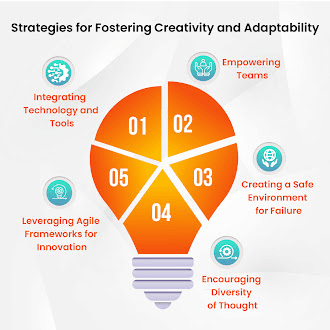
Encouraging Diversity of Thought
Diverse teams generate better ideas. Agile teams benefit from diversity in skills, experiences, and cultural backgrounds, which broadens perspectives and enhances creative problem-solving.
Leveraging Agile Frameworks for Innovation
Structured Agile frameworks provide a foundation for managing innovation effectively.
- Scrum supports iterative delivery and continuous feedback
- SAFe enables innovation at scale by combining Agile principles with Lean thinking and structured experimentation
These frameworks help organizations balance creativity with execution discipline.
Integrating Technology and Tools
Technology enhances Agile innovation by streamlining collaboration and insight generation. Tools for visual collaboration, backlog management, and data analysis help teams innovate more efficiently and make informed decisions.
Challenges in Agile Innovation
Despite its potential, Agile innovation comes with challenges that organizations must navigate:
Balancing Creativity and Deadlines
While Agile promotes flexibility, the need to deliver results within tight timelines can sometimes stifle creativity. Finding the right balance is essential.
Resistance to Change
Introducing Agile methodologies and fostering an innovation culture often require significant organizational change, which can face resistance from teams or leadership.
Measuring Innovation Outcomes
Unlike traditional metrics, measuring the success of innovation can be complex. Organizations must define relevant metrics, such as customer satisfaction, time-to-market, or innovation adoption rates, to assess their efforts effectively.
Agile Innovation in the Future
As organizations continue to navigate a volatile and uncertain world, the need for Agile innovation will only grow. Emerging trends, such as the integration of artificial intelligence (AI) and machine learning into Agile processes, are poised to revolutionize how teams innovate. AI can help identify patterns, predict customer behavior, and automate repetitive tasks, allowing teams to focus on high-value creative work.
Additionally, the rise of remote work and virtual collaboration tools has expanded opportunities for global teams to innovate together. Agile frameworks are evolving to accommodate these changes, ensuring that creativity and adaptability remain at the forefront of organizational priorities.
Conclusion
Agile innovation provides a powerful approach to unlocking creativity and adaptability in teams. By emphasizing collaboration, customer focus, experimentation, and continuous learning, Agile enables organizations to innovate consistently in a changing world.
Organizations that embrace Agile not only improve how they deliver products, they transform how they think, learn, and evolve. In an era defined by uncertainty, Agile innovation is not just a strategy for today, but a vision for the future.
Related Courses & Certifications: Agile Coaching Skills Certified Facilitator (ACSCF) | Certified ScrumMaster® (CSM) | Advanced Certified ScrumMaster® (ACSM)
Meet the Author

Disha Jain
Contributing Writer
Disha Jain is a contributing writer at Skillbook Academy covering Agile, SAFe and AI topics.