- Generative AI augments rather than replaces the PM/PO role: it automates research and repetitive tasks so product leaders can spend more time on strategy, stakeholder alignment, and customer value.
- Use AI for idea generation and scenario planning, mining competitor offerings, market reports, and user feedback to surface feature options teams might otherwise miss.
- Run customer feedback, reviews, and support tickets through sentiment analysis at scale to extract recurring themes and give data-driven justification for what to fix first.
- Speed up early prototyping by generating wireframes and UX concepts from text prompts, cutting the dependency on designers for initial sketches and accelerating stakeholder buy-in.
- Lean on predictive analytics to forecast feature impact on retention and revenue, so roadmap prioritization is backed by data and low-value work gets cut before it's built.
- Tool fluency alone isn't enough: real advantage comes from pairing AI with strategic thinking, ethical awareness, and hands-on application skills built through structured practice.
-
What is an AI-powered Product Manager/ Product owner?
Defines an AI-powered PM/PO as a product professional who uses generative AI to enhance core duties like ideation, customer research, prioritization, prototyping, and documentation. Emphasizes that AI augments rather than replaces human judgment, freeing PMs to focus on strategy and customer value.
-
Why Generative AI Matters in Agile Product Management
Explains how generative AI reinforces Agile principles of speed, adaptability, and continuous feedback by cutting manual research effort, enabling faster iteration, improving collaboration, and supporting data-driven prioritization. Positions AI as a strategic enabler when used responsibly.
-
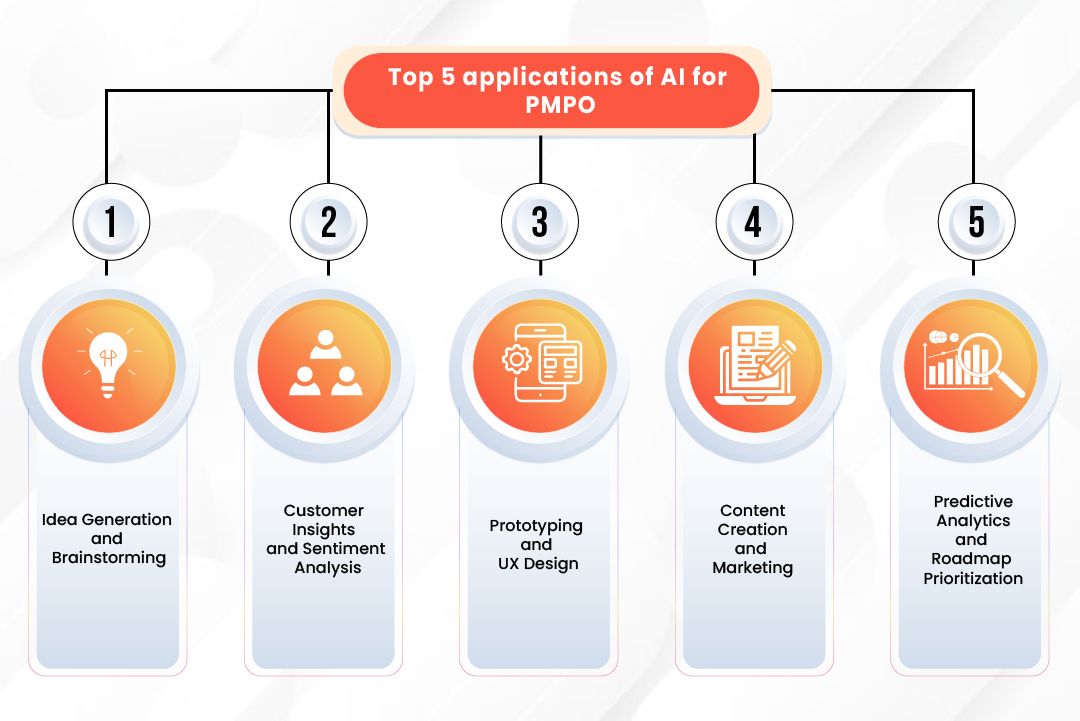
Top 5 Applications of Generative AI for Product Managers & Product Owners
Introduces the article's curated list of the five most effective generative AI applications for product managers and owners, framing the detailed examples that follow.
-
Idea Generation and Brainstorming
Shows how generative AI tools like ChatGPT or Jasper analyze competitor offerings, market reports, and user feedback to suggest new features and run scenario planning. Benefits include faster diverse ideation, out-of-the-box thinking, and starting points for team brainstorming.
-
Customer Insights and Sentiment Analysis
Describes using AI tools such as MonkeyLearn or AWS Comprehend to analyze feedback, reviews, and support tickets at scale, extracting themes and sentiment. Benefits include time savings, focus on critical improvements, and data-driven feature prioritization.
-
Prototyping and UX Design
Covers how generative AI tools like DALL-E, MidJourney, or Figma plugins turn text prompts into wireframes and design templates for rapid early-stage prototyping. Benefits include accelerated prototyping, less reliance on designers, and quick concept visualization.
-
Content Creation and Marketing
Explains using AI tools such as ChatGPT, Writesonic, or Copy.ai to draft user guides, blog posts, press releases, and social campaigns tailored to the product audience. Benefits include consistent professional communication, time savings, and stronger brand presence.
-
Predictive Analytics and Roadmap Prioritization
Details how AI analytics tools like Apty or DataRobot use historical data, market trends, and user behavior to forecast feature impact on retention and revenue. Benefits include data-backed roadmap decisions, reduced risk of low-impact features, and better ROI alignment.
-
How does Skillbook Academy help you?
Promotes Skillbook Academy's AI-powered PM/PO training, covering comprehensive AI instruction, hands-on projects, a 200+ prompt repository, expert-led teaching, community networking, and career future-proofing for the AI-driven product era.
-
The way ahead
Concludes that generative AI is reshaping creativity, execution, and decision-making across the five highlighted use cases, but success requires strategic thinking, ethical awareness, and practical skills built through structured learning. Frames mastering AI as essential for both experienced and aspiring product professionals.
In today’s fast-paced digital landscape, Agile product management demands a careful balance of creativity, precision, and adaptability. As customer expectations rise and product cycles shorten, traditional methods alone are no longer sufficient.
Generative AI is emerging as a transformative technology that enables Product Managers (PMs) and Product Owners (POs) to work smarter, make better decisions, and accelerate innovation. When integrated effectively into Agile practices, generative AI enhances ideation, improves prioritization, and supports faster, data-driven delivery.
This article explores what it means to be an AI-powered Product Manager or Product Owner and highlights five high-impact applications of generative AI in Agile product management.
What is an AI-powered Product Manager/ Product owner?
An AI-powered Product Manager or Product Owner is a product professional who leverages artificial intelligence and generative AI tools to enhance core responsibilities such as:
- Idea generation and validation
- Customer research and insight analysis
- Roadmap prioritization
- UX and prototyping support
- Product communication and documentation
Rather than replacing human judgment, generative AI augments decision-making, automates repetitive tasks, and provides actionable insights at scale. This allows PMs and POs to focus on strategy, stakeholder alignment, and customer value.
Why Generative AI Matters in Agile Product Management
Agile teams thrive on speed, adaptability, and continuous feedback. Generative AI supports these principles by:
- Reducing manual effort in research and analysis
- Enabling faster experimentation and iteration
- Improving collaboration through shared insights
- Supporting data-driven prioritization
When used responsibly, AI becomes a strategic enabler, not just a productivity tool.
Top 5 Applications of Generative AI for Product Managers & Product Owners
Although generative AI can find its applications in a number of various use cases, we have curated the list of 5 most effective applications that stand out as the best applications.
Idea Generation and Brainstorming
Product managers often need to come up with creative solutions to address customer pain points or market demands. Generative AI can analyze competitors’ offerings, market reports, and user feedback to suggest new ideas for products or features. It can also help with scenario planning, such as envisioning how a product could evolve in different market conditions.
AI tools like ChatGPT or Jasper can take prompts like “Suggest features for an AI-powered fitness app” or “Brainstorm ways to improve customer onboarding for a SaaS product.”
Benefits:
- Reduces cognitive load by generating diverse ideas quickly.
- Encourages out-of-the-box thinking by exploring scenarios PMs might not have considered.
- Provides starting points for team brainstorming sessions.
Customer Insights and Sentiment Analysis
Product managers often sift through customer feedback, app reviews, social media comments, and support tickets to understand user sentiment. AI can analyze text data at scale, extracting themes and emotions, and categorizing feedback by priority.
Tools like MonkeyLearn or AWS Comprehend process large volumes of data to identify recurring keywords (e.g., “easy to use,” “frequent crashes”) or sentiments (positive, negative, neutral).
Benefits:
- Saves time compared to manual analysis.
- Helps PMs focus on the most critical areas for improvement.
- Provides data-driven justification for prioritizing certain features or fixes.
Prototyping and UX Design
Early-stage prototypes are crucial for visualizing ideas and getting stakeholder buy-in. AI can generate wireframes or design templates based on user inputs, allowing PMs to quickly iterate on design concepts without requiring deep UX design expertise.
Generative AI tools like DALL·E, MidJourney, or Figma plugins take text prompts (e.g., “Create a modern, minimalist dashboard for an analytics platform”) to produce visual designs.
Benefits:
- Accelerates the prototyping phase.
- Reduces dependency on designers for initial sketches.
- Helps teams visualize concepts quickly during brainstorming.
Content Creation and Marketing
Product managers often need to communicate product updates, create documentation, or contribute to marketing efforts. AI can draft compelling content such as user guides, blog posts, press releases, or social media campaigns, tailored to the product’s audience.
Tools like ChatGPT, Writesonic, or Copy.ai can create content from a few prompts (e.g., “Write a blog post introducing our new AI-powered chatbot”).
Benefits:
- Ensures consistent, professional-quality communication.
- Reduces the time spent on routine content creation.
- Helps maintain a strong brand presence with engaging materials.
Predictive Analytics and Roadmap Prioritization
Product managers face the challenge of deciding which features to build first. AI-powered analytics tools can predict the potential impact of features based on historical data, market trends, and user behavior. For instance, AI can forecast which features might drive user retention or boost revenue.
Tools like Apty or DataRobot analyze past usage patterns, customer demographics, and other data points to simulate outcomes for proposed features.
Benefits:
- Provides data-backed insights for roadmap decisions.
- Reduces the risk of building low-impact features.
- Aligns product strategy with business goals, ensuring optimal ROI.
How does Skillbook Academy help you?
Skillbook Academy comes in as a reputed platform offering AI-powered Product Manager and Product Owner classes. Our curriculum is designed to equip aspiring and current PMs/POs with the skills and knowledge needed to excel in the AI-driven era of product management.
Here’s how Skillbook Academy can help you get a head start in your AI approach for PMPO roles:
- Comprehensive AI Training
Learn how to integrate generative AI into roadmap planning, user research, prioritization, and delivery. - Hands-On Learning
Work on real-world use cases, projects, and workshops that reflect industry scenarios. - 200+ Prompt Repository
Access a curated collection of prompts for PM and PO use cases across the product lifecycle. - Expert-Led Instruction
Learn from experienced professionals with expertise in both AI and product management. - Community & Networking
Connect with forward-thinking PMs and POs to share insights and grow professionally. - Career Future-Proofing
Build skills that position you as a leader in AI-driven product innovation.
The way ahead
Generative AI is reshaping how PMs and POs approach creativity, execution, and decision-making. By applying AI to idea generation, customer insights, UX design, content creation, and predictive analytics, product leaders can stay competitive in an increasingly complex digital environment.
However, success with generative AI requires more than tool familiarity. It demands strategic thinking, ethical awareness, and practical application skills, capabilities that can be developed through structured learning and hands-on experience.
Whether you are an experienced product professional or an aspiring PM or PO, mastering generative AI is no longer optional. With the right training and mindset, you won’t just adapt to the future of product management, you’ll help shape it.
Related Courses & Certifications: AI Powered Product Manager / Product Owner | Achieving Responsible AI Micro-Credential | SAFe® Product Owner/Product Manager (POPM) Certification Training
Meet the Author

Chris Harrison
Agile Coach & Trainer
Chris Harrison is an Agile coach and certified trainer.