- Personalization has shifted from a competitive edge to a baseline expectation, and generative AI is what makes delivering it at scale realistic.
- Unlike rule-based personalization, generative AI creates original outputs in real time, adapting content, recommendations, and even interfaces to each user.
- In practice it sits alongside CDPs, recommendation engines, predictive analytics, and marketing automation rather than replacing them.
- The payoff is higher engagement and conversion, plus the ability to tailor experiences for millions of users without proportional manual effort.
- Adoption hinges on managing real risks: data privacy and GDPR/CCPA compliance, model bias, legacy-system integration, and not letting automation strip out the human touch.
- Retail, healthcare, entertainment, education, and finance already run on it, and hyper-personalization, conversational AI, and AR/VR are the next frontiers.
-
The Growing Need for Personalization
Frames personalization as a business imperative rather than a buzzword, noting customers engage and convert far more when experiences feel relevant. Generative AI meets this by processing large datasets and crafting tailored solutions at scale.
-
Where Generative AI Fits in the AI Ecosystem
Positions generative AI as a subset of AI that creates original outputs rather than just classifying or predicting. It typically works alongside CDPs, recommendation engines, predictive analytics, and marketing automation to enable real-time personalization.
-
How Generative AI Powers Personalization
Breaks down five mechanisms: data analysis and insight discovery, personalized content generation via models like GPT, real-time dynamic recommendations, adaptive user interfaces, and predictive personalization that anticipates customer needs.
-
Benefits of Generative AI in Personalization
Outlines the upside: stronger customer experience and loyalty, higher conversion rates, personalization at massive scale without quality loss, and improved efficiency by automating manual work so teams focus on strategy.
-
Challenges in Implementing AI-Driven Personalization
Covers the key obstacles: data privacy and regulatory compliance (GDPR, CCPA), bias inherited from training data, integrating AI into legacy systems, and balancing automation against authentic human interaction.
-
Real-World Applications of Generative AI in Personalization
Surveys industry use cases across retail (recommendations, dynamic pricing), healthcare (tailored treatment plans), entertainment (content recommendations), education (personalized learning paths), and finance (custom advice and offers).
-
Emerging Trends in AI Powered Personalization
Looks ahead to hyper-personalization, AI-driven creative generation of art and music, voice and conversational AI, and personalized AR/VR environments as the next directions for the technology.
-
Conclusion
Reinforces that generative AI is reshaping personalization at scale and driving stronger relationships and conversions. Warns that realizing its potential depends on addressing privacy, integration, and ethical AI concerns.
-
Frequently Asked Questions
Answers common questions defining generative AI personalization, contrasting it with rule-based methods, addressing data safety through governance, naming the industries that benefit most, and clarifying its reliance on behavioral and contextual data.
In today’s hyper-competitive market, customer expectations are at an all-time high. Businesses no longer succeed by offering generic products or services. Personalization has become a business necessity, not a differentiator.
Generative AI is a class of artificial intelligence designed to create new content, recommendations, and experiences by learning patterns from large datasets. In personalization, generative AI allows organizations to deliver highly tailored product, content, and user experiences at scale, based on individual customer behavior, preferences, and context.
This article explains how generative AI powers personalization, its benefits, challenges, and real-world applications across industries.
The Growing Need for Personalization
Personalization is more than just a buzzword; it’s a business imperative. Studies consistently show that customers are significantly more likely to engage and convert when experiences feel relevant and tailored.
Generative AI rises to the challenge by processing vast amounts of data, identifying patterns, and crafting unique solutions tailored to individual preferences. This ability to deliver real-time, dynamic personalization at scale is reshaping how businesses interact with their customers.
Where Generative AI Fits in the AI Ecosystem
Generative AI is a subset of Artificial Intelligence, closely related to machine learning and deep learning, but distinct in one key way:
it creates original outputs, rather than only classifying or predicting outcomes.
In personalization systems, generative AI typically works alongside:
- Customer Data Platforms (CDPs)
- Recommendation engines
- Predictive analytics systems
- Marketing automation tools
Together, these systems enable real-time personalization across digital touchpoints.
How Generative AI Powers Personalization
Data Analysis and Insights
Generative AI can analyze extensive datasets, including customer behavior, purchase history, and preferences. It identifies trends and patterns, enabling businesses to understand what customers want—even before they know it themselves.
Content Generation
AI models like GPT (Generative Pre-trained Transformer) can create personalized content, such as product descriptions, emails, and recommendations, tailored to individual customers. For example, an e-commerce platform can dynamically generate product suggestions based on a customer’s browsing history.
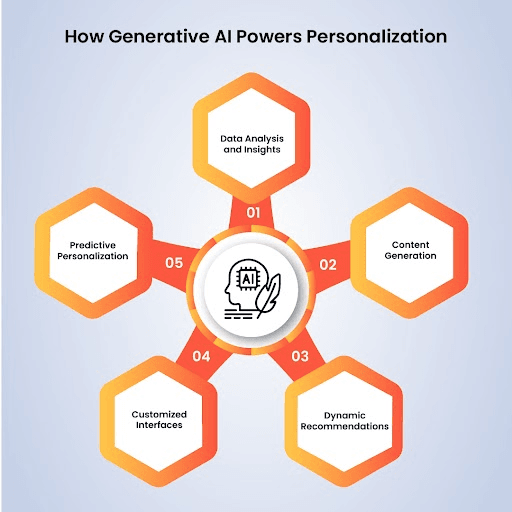
Dynamic Recommendations
Generative AI can power recommendation engines that adapt in real-time. For instance, streaming services like Netflix and Spotify use AI to recommend shows or music tailored to each user’s preferences, enhancing engagement.
Customized Interfaces
Generative AI can create adaptive user interfaces that evolve based on user interactions. These interfaces ensure a seamless and intuitive experience, reducing friction and improving satisfaction.
Predictive Personalization
By leveraging predictive analytics, generative AI can anticipate customer needs. For instance, AI can suggest products customers are likely to need soon, based on lifecycle patterns or past behavior.
Benefits of Generative AI in Personalization
Enhanced Customer Experience
Personalized experiences foster customer loyalty by making users feel valued and understood. AI-driven personalization ensures that customers receive relevant recommendations and communications.
Increased Conversion Rates
Tailored content and product suggestions significantly boost conversion rates. Customers are more likely to engage with brands that resonate with their specific needs.
Scalability
Generative AI enables personalization at scale, making it feasible to offer tailored experiences to millions of users simultaneously without compromising quality.
Improved Efficiency
Automating personalization efforts reduces the manual workload for teams, allowing them to focus on strategic initiatives.
Challenges in Implementing AI-Driven Personalization
Data Privacy Concerns
Collecting and processing vast amounts of user data raises privacy issues. Companies must navigate complex regulations like GDPR and CCPA to ensure compliance.
Bias in AI Models
Generative AI can inadvertently perpetuate biases present in the training data, leading to skewed or unfair personalization outcomes.
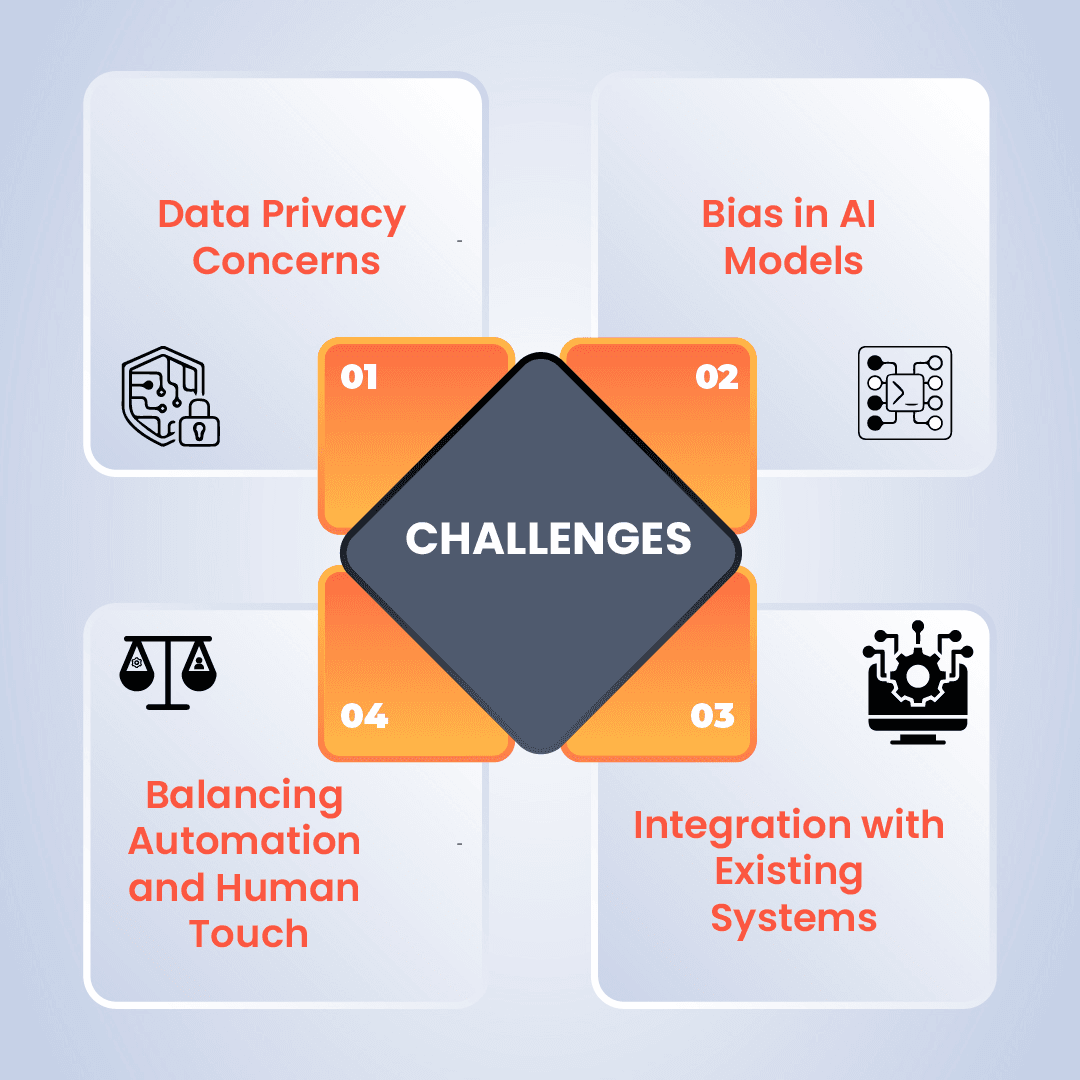
Integration with Existing Systems
Integrating AI tools into legacy systems can be a daunting task, requiring significant investment and technical expertise.
Balancing Automation and Human Touch
While automation is powerful, over-reliance on AI can result in impersonal interactions. Striking the right balance is crucial to maintaining authenticity.
Real-World Applications of Generative AI in Personalization
Retail
Retailers like Amazon use generative AI to analyze customer data and provide personalized product recommendations. Dynamic pricing strategies also leverage AI to offer tailored discounts based on purchasing patterns.
Healthcare
In healthcare, generative AI personalizes patient care by analyzing medical records and suggesting treatment plans tailored to individual needs.
Entertainment
Streaming platforms like Netflix employ generative AI to recommend shows and movies based on user preferences, boosting engagement and retention.
Education
EdTech platforms use AI to create personalized learning paths for students, adapting content and pacing to suit individual learning styles.
Finance
Banks and financial institutions utilize generative AI to offer personalized investment advice, credit offers, and financial planning services.
Emerging Trends in AI Powered Personalization
Hyper-Personalization
With advances in generative AI, businesses are moving towards hyper-personalization, crafting experiences that cater to highly specific individual needs in real time.
AI-Driven Creativity
Generative AI is being used to create personalized art, music, and design, opening new avenues for customization in creative industries.
Voice and Conversational AI
Voice assistants like Alexa and Siri are leveraging generative AI to offer more contextual and personalized interactions.
Augmented Reality (AR) and Virtual Reality (VR)
Generative AI is enhancing AR/VR experiences by creating personalized virtual environments tailored to user preferences.
Conclusion
Generative AI is transforming the landscape of personalization, enabling businesses to deliver unique and engaging experiences at scale. By harnessing the power of AI, organizations can foster stronger customer relationships, drive conversions, and stay ahead in a competitive market. However, to fully realize its potential, companies must address challenges like data privacy, integration, and ethical AI use.
The future of personalization is undoubtedly AI driven. As generative AI continues to evolve, businesses that embrace its capabilities will be better positioned to meet the ever-growing expectations of their customers, creating a sustainable competitive advantage in the process.
Related Courses & Certifications: AI Powered Product Manager / Product Owner | Achieving Responsible AI Micro-Credential | SAFe® Agile Product Management
Frequently Asked Questions
It is the use of generative AI models to create personalized content, recommendations, and experiences based on individual user data.
Traditional personalization uses fixed rules, while generative AI adapts dynamically and generates new outputs in real time.
It can be safe when implemented with strong data governance, transparency, and compliance practices.
Retail, media, healthcare, finance, education, and SaaS benefit significantly.
Limited personalization is possible, but high-quality personalization requires behavioral and contextual data.
Meet the Author

Disha Jain
Contributing Writer
Disha Jain is a contributing writer at Skillbook Academy covering Agile, SAFe and AI topics.