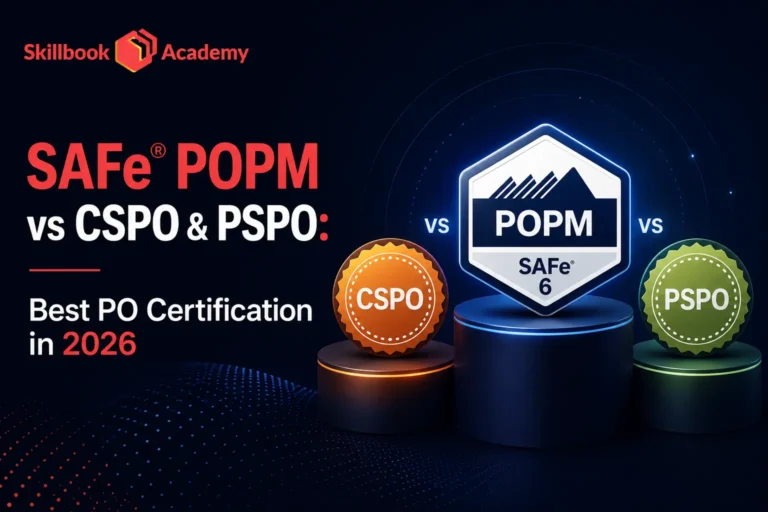
- SAFe POPM 6.0 is the right fit when you operate inside the Scaled Agile Framework, covering PI Planning, Agile Release Trains, value flow, and alignment across multiple teams.
- CSPO (Scrum Alliance) builds a strong single-team Scrum foundation, emphasizing Product Backlog management, stakeholder collaboration, and experiential learning.
- PSPO (Scrum.org) is assessment-driven and rigorously tests deep Scrum Guide knowledge across three escalating levels (PSPO I, II, III).
- General Agile Product Owner certifications offer broader, framework-agnostic value for hybrid or partially-Agile organizations, but vet their recognition carefully.
- Pick based on your organizational context, the frameworks your company uses, your learning style, and your career goals, not on prestige alone.
- Agile Product Management (APM) is the natural next step after POPM, CSPO, or PSPO for those moving toward Product Manager or strategic leadership roles.
-
SAFe POPM 6.0: Tailored for Scaled Agile
Explains how the SAFe POPM 6.0 certification equips Product Owners to manage products and features across multiple Agile teams, with emphasis on PI Planning, the Agile Release Train, value flow, and strategic alignment at enterprise scale.
-
CSPO (Scrum Alliance): Certified Scrum Product Ownership
Covers the CSPO certification's focus on core Scrum and single-team Product Ownership, including backlog management, stakeholder collaboration, and an experiential, course-based learning approach.
-
PSPO (Scrum.org): Deep Dive into the Scrum Guide
Describes PSPO as a rigorous, assessment-based credential grounded in the Scrum Guide, with three progressively harder levels validating both theoretical knowledge and applied Scrum judgment.
-
Agile Product Owner Certification: Beyond Specific Frameworks
Discusses general, framework-agnostic Product Owner certifications that teach universal Agile principles, noting their flexibility for hybrid organizations alongside the need to evaluate curriculum quality and industry recognition.
-
Choosing the Right Certification
Synthesizes the comparison, advising that the best certification depends on organizational context, career aspirations, learning style, and the frameworks in use, and points to Agile Product Management as a logical next step.
In the dynamic world of Agile development, the Product Owner stands as a pivotal role, bridging the gap between the business vision and the development team. As the demand for skilled Product Owners continues to grow, numerous certifications and training programs have emerged to validate and enhance their expertise. Among these, the SAFe Product Owner/Product Manager (POPM) 6.0 certification has gained significant traction, particularly within organizations adopting the Scaled Agile Framework (SAFe).
However, professionals often find themselves navigating a landscape that includes other well-regarded certifications like the Certified Scrum Product Owner (CSPO) from Scrum Alliance and the Professional Scrum Product Owner, as well as more general Agile Product Owner Certification options. This blog post will compare the SAFe POPM 6.0 certification with other prominent Product Owner certifications like CSPO (Scrum Alliance) and PSPO, along with general Agile Product Owner training, to help you determine the best fit for your career goals and organizational context.
SAFe POPM 6.0: Tailored for Scaled Agile
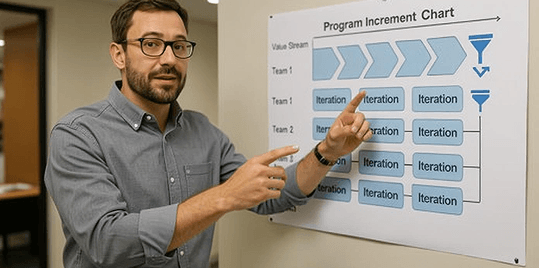
The SAFe Product Owner/Product Manager (POPM) 6.0 certification is specifically designed for individuals operating within or transitioning to organizations that have adopted the Scaled Agile Framework (SAFe). Unlike certifications focused on single-team Scrum, POPM delves into the complexities of managing products and features across multiple Agile teams within a larger program or portfolio. Key learning objectives of the POPM vs. CSPO (Scrum Alliance) and POPM vs. PSPO (Scrum.org) comparison often highlight POPM’s emphasis on understanding the SAFe framework, participating in PI Planning, defining and managing the flow of value through the Agile Release Train (ART), and collaborating with other roles like Release Train Engineers and System Architects.
The certification focuses on strategic alignment, customer centricity at scale, and the economic prioritization of features and benefits within a SAFe environment. For professionals working in large, complex organizations utilizing SAFe, the POPM certification provides a valuable understanding of how the Product Owner role functions effectively within that specific framework.
CSPO (Scrum Alliance): Certified Scrum Product Ownership

The Certified Scrum Product Owner (CSPO) certification offered by Scrum Alliance focuses on the foundational principles of Scrum and the responsibilities of the Product Owner within a single Scrum team. While SAFe builds upon Scrum, CSPO provides a deeper dive into the core Scrum framework, emphasizing techniques for managing the Product Backlog, stakeholder collaboration, and maximizing value delivery within a single team context. A key differentiator when considering POPM vs. CSPO (Scrum Alliance) is the scope.
CSPO primarily equips individuals to excel as Product Owners within a single Scrum team, focusing on the Scrum events, artifacts, and roles. The learning approach often involves experiential exercises and emphasizes collaboration and communication within the Scrum team and with stakeholders. CSPO is particularly well-suited for individuals and teams primarily utilizing the Scrum framework and those looking for a strong foundation in core Scrum Product Ownership principles.
PSPO (Scrum.org): Deep Dive into the Scrum Guide

The Professional Scrum Product Owner (PSPO) certification from Scrum.org distinguishes itself through its rigorous assessment based on the Scrum Guide. Unlike CSPO, which often involves completing a training course, PSPO focuses on validating a deep understanding of the Scrum Guide and its application to the Product Owner role through challenging assessments. There are different levels of PSPO certifications (PSPO I, PSPO II, PSPO III), each requiring a progressively deeper understanding and ability to apply Scrum principles in complex scenarios.
When comparing POPM vs. PSPO (Scrum.org), PSPO often emphasizes a more theoretical and fundamental understanding of Scrum as defined by the Scrum Guide, while POPM focuses on the practical application of the Product Owner role within the specific context of the SAFe framework. PSPO is ideal for individuals seeking a certification that rigorously tests their knowledge of Scrum and their ability to apply it effectively as a Product Owner.
Agile Product Owner Certification: Beyond Specific Frameworks
Beyond the framework-specific certifications like POPM, CSPO, and PSPO, there might be more general Agile Product Owner Certification programs or training that focus on core Agile principles and Product Owner responsibilities applicable across various Agile methodologies. These programs might emphasize understanding user needs, prioritizing features, and collaborating with development teams in a broader Agile context, without being tied to a specific scaling framework like SAFe or the specific practices of Scrum as defined by the Scrum Guide. The benefit of such training could be its broader applicability in organizations using hybrid Agile approaches or those that haven’t fully adopted a specific framework.
However, it’s important to carefully evaluate the curriculum and recognition of such general Agile Product Owner certifications compared to the more widely recognized and framework-specific options.
Choosing the right Product Owner certification is a crucial step in advancing your Agile career. SAFe POPM 6.0 offers specialized knowledge for those working within scaled Agile environments, while CSPO provides a strong foundation in Scrum Product Ownership for single teams. PSPO focuses on a deep understanding and application of the Scrum Guide, and more general Product Owner Training and Certification might offer broader Agile principles.
Ultimately, the best choice depends on your organizational context, career aspirations, learning style, and the specific frameworks your organization utilizes or plans to adopt. We encourage you to delve deeper into the specifics of each certification and select the path that best aligns with your unique circumstances and goals in the exciting field of Agile Product Ownership.
Check Agile Product Management (APM) Course
Frequently Asked Questions
If your organization is using or preparing to adopt the Scaled Agile Framework (SAFe), the SAFe POPM 6.0 certification is the most relevant. It focuses on product ownership at scale, including PI Planning, Agile Release Trains, value flow, and alignment across multiple Agile teams.
CSPO (Scrum Alliance) focuses on the Product Owner role within a single Scrum team, covering backlog ownership, stakeholder collaboration, and prioritization. POPM includes these concepts but expands them for enterprise-level environments where multiple teams and scaled delivery practices operate together.
PSPO is assessment-based and tests deep understanding of the Scrum Guide, with multiple levels (PSPO I, II, III). CSPO is typically training-completion based and more experiential. PSPO is suitable for those who want a more rigorous, exam-validated certification, while CSPO is ideal for building foundational Scrum Product Owner skills.
Yes. If your organization operates in a hybrid model or has not fully adopted a single Agile framework, a general Agile Product Owner Certification can be more flexible. It teaches universal concepts like feature prioritization, user needs, Agile collaboration, and delivery practices that are applicable across varied environments.
For career progression toward Product Manager or strategic leadership roles, Agile Product Management (APM) is the next recommended step. It strengthens capabilities in market research, roadmap planning, value stream thinking, product strategy, and managing lifecycle outcomes beyond day-to-day backlog ownership.
Meet the Author

Akash Saha
Contributing Writer
Akash Saha is a contributing writer at Skillbook Academy covering Agile, SAFe and AI topics.