- The CSM is a servant-leadership credential, not a project-management title: you facilitate Scrum events, remove impediments, and coach teams rather than direct them.
- Certification is gated behind an official 2-day (16-hour) course delivered only by Scrum Alliance-accredited Certified Scrum Trainers, typically costing $500 to $1,500.
- The exam is 50 multiple-choice questions in 60 minutes; you need 37 correct (74%) to pass, and Scrum Alliance grants two free retakes.
- Master the Scrum Guide basics first: the three roles, five events, three artifacts, and five values are the backbone of both the exam and real-world practice.
- The badge is valid for two years and renewed via Scrum Education Units (SEUs) plus a renewal fee, so plan for ongoing learning.
- Treat CSM as a starting point, with A-CSM and CSP-SM as clear next rungs and demonstrated value across IT, marketing, healthcare, and education.
-
Step 1: Understand the Role of a ScrumMaster
Clarifies that a ScrumMaster is a servant leader and facilitator, not a project manager. Core duties include removing impediments, facilitating Scrum events, coaching on Scrum values, and fostering collaboration and continuous improvement.
-
Step 2: Learn the Scrum Framework Fundamentals
Lays out the foundational knowledge needed before training: the three Scrum roles, five events, three artifacts, and five values. Points to the official Scrum Guide as the primary study resource.
-
Step 3: Enroll in a Certified ScrumMaster (CSM) Course
Explains that certification requires an official Scrum Alliance-accredited course taught by a Certified Scrum Trainer. Covers the typical 2-day/16-hour format, instructor-led delivery, content, and $500 to $1,500 cost range.
-
Step 4: Pass the Certified ScrumMaster Exam
Details the online exam: 50 multiple-choice questions, a 60-minute limit, and a 74% passing bar (37 correct). Notes that Scrum Alliance offers two free retakes if you don't pass initially.
-
Step 5: Receive Your Certified ScrumMaster Badge
Describes receiving the digital badge from Scrum Alliance and where to showcase it (LinkedIn, resume, email signatures, profiles). Highlights the two-year validity and renewal via SEUs and a fee.
-
Step 6: Continue Learning and Advancing
Frames CSM as the start of an Agile journey, recommending hands-on experience, advanced certifications like A-CSM and CSP-SM, and active community engagement to sustain growth.
-
Why Earn a Certified ScrumMaster Badge?
Summarizes the professional and organizational payoffs: broader career opportunities, higher earning potential, stronger team outcomes, and cross-industry versatility from IT to healthcare and education.
-
Summary
Recaps the path from understanding the role through training, exam, and continuous improvement. Reinforces that the real value is adopting a mindset of collaboration, adaptability, and ongoing improvement, and links related Skillbook courses.
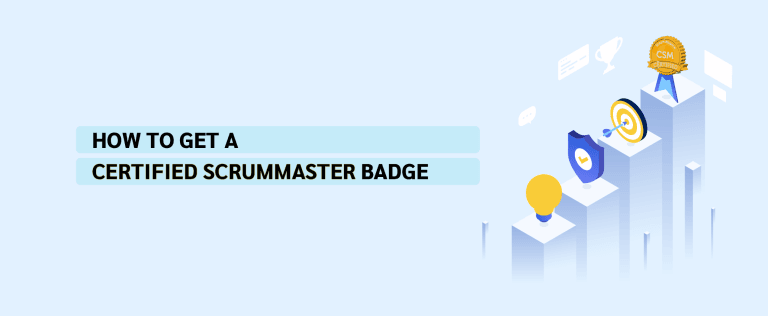
In today’s fast-paced, Agile-driven workplace, becoming a Certified ScrumMaster® (CSM®) is one of the most effective ways to advance your career, strengthen team performance, and build a solid understanding of the Scrum framework.
The CSM® badge validates your ability to guide Scrum teams, facilitate Agile practices, and support successful product delivery. If you’re wondering how to earn this globally recognized certification, this guide walks you through the process step by step.
Step 1: Understand the Role of a ScrumMaster®
Before pursuing certification, it’s important to understand what a ScrumMaster® actually does. Unlike a traditional project manager, a ScrumMaster® acts as a servant leader and facilitator for the Scrum team.
Key responsibilities include:
- Removing impediments that block team progress
- Facilitating Scrum events such as Daily Scrum, Sprint Review, and Sprint Retrospective
- Coaching teams on Scrum values, principles, and best practices
- Encouraging collaboration, transparency, and continuous improvement
By enabling teams rather than directing them, the ScrumMaster® ensures steady value delivery and adaptability to change.
Step 2: Learn the Scrum Framework Fundamentals
A strong grasp of Scrum fundamentals is essential before attending a CSM® course or attempting the exam.
You should be familiar with:
- Scrum roles: Product Owner, ScrumMaster®, Developers
- Scrum events: Sprint, Sprint Planning, Daily Scrum, Sprint Review, Sprint Retrospective
- Scrum artifacts: Product Backlog, Sprint Backlog, Increment
- Scrum values: Commitment, Courage, Focus, Openness, Respect
The official Scrum Guide and Agile learning resources are excellent starting points.
Step 3: Enroll in a Certified ScrumMaster® (CSM®) Course
To earn the CSM® certification, you must complete an official training course accredited by Scrum Alliance. These courses are delivered only by Certified Scrum Trainers® (CSTs®).
What to expect from the course:
- Duration: 2 days (16 hours)
- Content: Scrum theory, roles, events, artifacts, and real-world application
- Format: Instructor-led (online or in-person)
- Cost: Typically ranges from $500 to $1,500, depending on region and trainer
Interactive, scenario-based courses often provide the best preparation for both the exam and real-world Scrum implementation.
Step 4: Pass the Certified ScrumMaster® Exam
After completing the course, you’ll be eligible to take the CSM® exam.
Exam details:
Format: 50 multiple-choice questions
Time limit: 60 minutes
Passing score: 37 correct answers (74%)
Coverage: Scrum roles, responsibilities, values, and practical application
The exam is taken online. If you don’t pass on your first attempt, Scrum Alliance® provides two free retakes.
Step 5: Receive Your Certified ScrumMaster® Badge
Once you pass the exam, you’ll receive your Certified ScrumMaster® digital badge from Scrum Alliance®.
You can showcase it on:
- Your resume
- Email signatures
- Professional profiles
The certification is valid for two years and can be renewed by earning Scrum Education Units® (SEUs®) and paying a renewal fee.
Step 6: Continue Learning and Advancing
The CSM® badge is just the beginning of your Agile journey.
Next steps include:
- Gaining hands-on experience as a ScrumMaster®
- Pursuing advanced certifications such as Advanced Certified ScrumMaster® (A-CSM®) and Certified Scrum Professional® – ScrumMaster (CSP®-SM)
- Engaging with the Scrum community through meetups, conferences, and forums
Continuous learning is essential for long-term success in Agile roles.
Why Earn a Certified ScrumMaster® Badge?
Earning a CSM® certification delivers both professional and organizational benefits:
- Expanded career opportunities as demand for ScrumMasters® continues to grow
- Higher earning potential compared to non-certified professionals
- Stronger team outcomes through better facilitation and collaboration
- Industry versatility, with Scrum used across IT, marketing, healthcare, education, and more
Summary
The Certified ScrumMaster® (CSM®) badge is a powerful credential for professionals looking to lead Agile teams effectively. By understanding the role, completing accredited training, passing the exam, and committing to continuous improvement, you position yourself as a trusted Agile leader.
The journey isn’t just about certification, it’s about adopting a mindset of collaboration, adaptability, and relentless improvement that will serve you throughout your career.
Related Courses & Certifications Training:
Certified Scrum Master (CSM) Certification Training | Advanced Certified ScrumMaster (ACSM) Certification Training | Agile Coaching Skills Certified Facilitator (ACSCF) Certification Training
Meet the Author

Kelly Clarkson
Contributing Writer
Kelly Clarkson is a contributing writer at Skillbook Academy covering Agile, SAFe and AI topics.