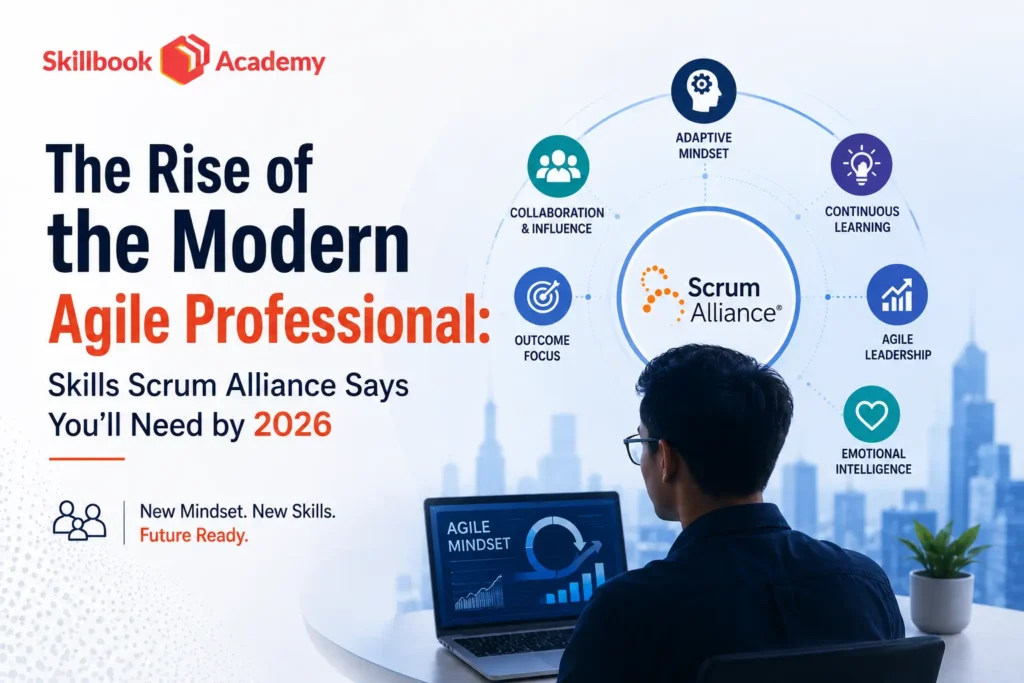
- Agile Expands: Scaling past IT into HR, marketing, finance, and legal.
- PI-Shaped Talent: Top 2026 professionals pair deep agile expertise with a second specialty.
- AI Literacy: AI fluency is now mandatory for Scrum Masters, Product Owners, and leaders.
- Systems Thinking: Solving complex friction requires looking beyond individual teams.
- Adaptive Leadership: Volatile environments demand rapid, flexible situational leadership.
- Drive Outcomes: Professionals must deliver business results, not just facilitate ceremonies.
- Skill Stacking: Combining agile certifications with AI or facilitation accelerates growth.
- Stay Adaptable: Continuous learning is non-negotiable for long-term career resilience.
The Scrum Alliance 2025 report (released on December 19th) emphasises the concept of “Agile for Anyone,” highlighting how Agile practices are increasingly being adopted beyond software development. This broader adoption suggests that Agile skills may become relevant across a wider range of business functions.
In light of the current challenges faced by organizations today with a “triple threat” of rapid adoption of Artificial Intelligence, rapid volatility in the global market, and rapidly increasing complexity within their operations, organizations aren’t looking for specialists having a narrowed definition of the framework types they need to hire for; rather they have an urgent need for “PI-Shaped Professionals”, a term coined by the Scrum Alliance.
What is a PI-Shaped Professional?
While a T-shaped professional will come with a broader skillset with one deep speciality, a PI-shaped professional doubles down with two profound pillars:
- Deep Agile Expertise: Real command of the Scrum Guide, facilitation, and coaching.
- Domain/Technical Literacy: Solid grasp of something extra, like AI, data analytics, or org design.
Core Skill 1: AI-Augmented Facilitation
“In 2026, every Scrum Master and Product Owner will be expected to have AI literacy.”
Research has shown that successful professionals integrate AI with a human-centric approach to agility. As a Scrum Master or Product Owner in the year 2026, you will use AI for several purposes beyond simply facilitating daily scrums:
- Detecting Bottlenecks: By using predictive analytics to identify potential flow issues before they cause a delay in completing a sprint.
- Generating User Stories: By using language models (like LLMs) to prepare initial objects in the product backlog from unfiltered customer input.
- Synthesising Data: By automatically concisely summarising the outputs of a sprint review meeting into actionable real-time insights for stakeholders.
- Providing Coaching Insight: By combining the AI capabilities of recognising “What” (data, shapes & forms, patterns) with the people’s ability to articulate “Why” (empathic reasoning, ethical rationale & strategic rationale), this intersection between what you do as a professional and how you do it is where your value resides.
Core Skill 2: Systems Thinking and Organisational Design
“Focusing on just the ‘Team Level’ will soon cease to be the primary focus.”
A 2025 study reveals a critical shift. The biggest roadblocks to agility no longer live inside your Scrum teams. Instead, they clog up departments like legal, finance, and HR. Master Systems Thinking to secure your spot in the top tier of professionals. This approach demands that you:
- Viewing the organisation as multiple interconnected value streams, instead of discrete departments;
- Coaching leaders on how “command-and-control” style funding models prohibit Sprint innovation;
Assisting the Product Owner when aligning the Product Goal with the overall strategy of the company.
Core Skill 3: Adaptive Leadership (Beyond Servant Leadership)
While the core foundation of Scrum remains on Servant Leadership, the market for 2026 requires adopting an Adaptive Leadership model, which means you lead when you have no idea what direction you should take. The following key components are required for being an Adaptive Leader in 2026:
- Psychological Safety: Create a space such that all Developers feel comfortable trying out their ideas (and failing quickly as a result).
- Conflict Facilitation: Transition from mediating conflict to enabling healthy frictions that enable improvements to product decisions.
- Influence Without Authority: Learn how to leverage corporate politics to eliminate barriers impeding a Scrum Team’s ability to do its job.
The “Agile for Anyone” Shift: Beyond IT
One of the most surprising developments in the Scrum Alliance’s 2025 Research Report is how quickly organisations are adopting Scrum. Marketing, HR, and even Legal departments are becoming some of the fastest-growing agile adopters.
Skills Matrix: The Evolution of the Agilist
| Skill Category | 2024 Benchmark | 2026 Requirement (Modern Professional) |
| Frameworks | Scrum & Kanban basics | Multi-framework fluency (Hybrid, SAFe®, LeSS) |
| Measurement | Velocity & Story Points | Outcome-based Metrics (Business Value, NPS) |
| Tooling | JIRA/Azure DevOps | AI Native Tools & Predictive Analytics |
| Scope | Single Team facilitation | Enterprise-wide Enablement |
| Communication | Technical / Team-focused | Executive Storytelling & Data Visualisation |
The Financial Reality: Why These Skills Matter
Recent industry surveys confirm that specific modern skills command higher salaries. Organisations are actively investing in Resilience Architects. These professionals do not simply execute a static roadmap, but they use it as a framework to drive meaningful business transformation.
2025 Salary Benchmarks (US & India)
| Role Type | Experience | Salary (US – 2025) | Salary (India – 2025) |
| Scrum Master (Certified) | 3-5 Years | $115,000 – $145,000 | ₹12L – ₹22L |
| Modern Agile Lead (AI + Scaling) | 5+ Years | $155,000 – $190,000 | ₹25L – ₹45L |
| Product Owner (CSPO + Data Science) | 3-5 Years | $130,000 – $165,000 | ₹18L – ₹32L |
The Dividend: Professionals with both a foundational certification (CSM®/CSPO®) and at least one Scrum Alliance Microcredential (like Agile Leadership) earn 18-25% more than those with only basic training.
Real-World Scenario: The Pivot of 2025
By early 2025, seasoned Project Manager “Marcus” from a traditional manufacturing firm came to realise the inevitable decline of his company due to the fact that they were attempting to implement an agile methodology under a rigid system. As opposed to just renewing his certificate, he went on to complete a Scrum Alliance Microcredential in Facilitation and was externally certified in AI for Business. When it came time to do Q3 planning, he not only managed the timeline using AI to model anticipated market disruptions but also coached the executive team on Adaptive Budgeting.
By late 2025, his position was redefined as Director of Agile Transformation with responsibility for managing four Scrum Teams and earning 35% more than his previous Project Manager salary; he didn’t get lucky but rather followed the blueprint set out in this report.
Your 2026 Personal Backlog: Practical Steps
You can evolve from a traditional to a Modern Agile Professional by starting with your own “Personal Backlog” and then validating your entry into this area by becoming either a Certified Scrum Master® or Certified Scrum Product Owner® (the Entry Stake). This will enable you to use a common language within the marketplace.
You then want to add a second leg to your process by taking the time to really specialise in an area that is outside of just doing pure Scrum. Some examples would be AI implementations, Data Storytelling or Lean Portfolio Management.
To master facilitation, you must go beyond simply running a meeting. You need to learn how to effectively guide humans through difficult-to-solve problems.
Finally, you want to become familiar with Outcome Mapping, in that you need to stop reporting the number of tasks “Done “and start reporting how much value was provided to the customer.
Conclusion: The Future is Human-Centric
The 2025 Annual Report from Scrum Alliance represents a call to action. Change will be driven by technology (AI), but solutions will remain in the hands of humans. The most successful professionals by 2026 will be the ones who can leverage the speed of AI while exhibiting empathy, leadership, and systems thinking, unlike the capabilities of machines.
“Success tomorrow depends on your ability to learn, unlearn, and lead today.”
Skillbook Academy is here to help you develop the PI-shaped skills that modern organisations value most.
Meet the Author

Harry Narang
SAFe® Practice Consultant & Agile Coach
Harry Narang is a SAFe® Practice Consultant and Agile Coach based in Toronto.