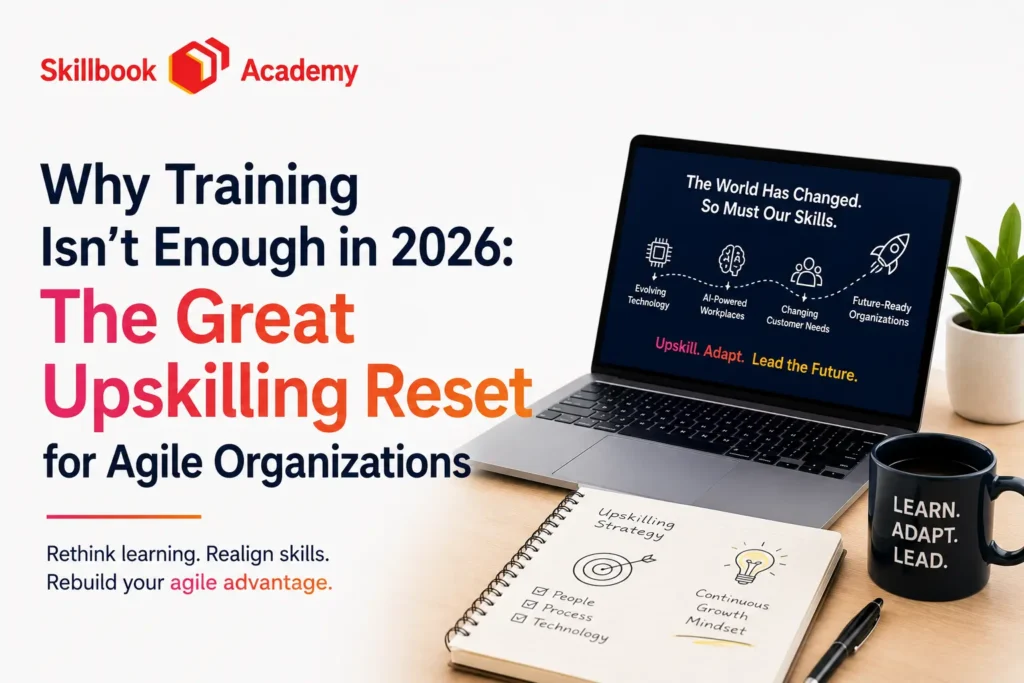
- The Great Upskilling Reset is replacing one-time training with continuous capability building, embedding learning into everyday work so Agile teams can adapt as roles and technologies evolve.
- Traditional training programs cannot keep pace with AI-driven change. Modern Agile organizations require AI-powered learning, real-time coaching, and adaptive skill development integrated into delivery workflows.
- High-performing Agile teams combine AI fluency with durable human skills, including analytical thinking, collaboration, adaptability, resilience, and cross-functional problem-solving.
- Psychological safety is a critical enabler of continuous learning. Teams learn faster when leaders encourage experimentation, normalize skill gaps, and use AI as a coaching tool rather than a surveillance mechanism.
- Organizations should measure upskilling by business outcomes—not course completions. Metrics such as time to proficiency, sprint velocity, reduced supervision, AI adoption, and recovery after change provide a more accurate view of learning effectiveness.
- Building internal talent is often more sustainable than hiring externally. Continuous upskilling reduces hiring costs, accelerates productivity, strengthens retention, and develops the hybrid skills needed for AI-enabled Agile teams.
- The most successful Agile organizations treat learning as infrastructure rather than an event, combining skills intelligence, embedded microlearning, manager coaching, adaptive learning paths, and AI-enabled support into a continuous capability ecosystem.
The Great Upskilling Reset refers to the fundamental shift in 2026 away from one-time training programs toward continuous, embedded capability building. Agile teams need more than training because skill obsolescence is accelerating faster than courses can respond- demanding systems, culture, and AI-powered learning woven into daily work, not scheduled apart from it.
The rules of workforce development have changed. As AI reshapes roles faster than curricula can keep up, organizations running agile teams face a choice: treat upskilling as a program to deploy, or rebuild it as a capability that runs continuously. This article is written for L&D leaders, HR professionals, agile coaches, and engineering managers who must close skill gaps while keeping teams in motion. The stakes in 2026 are not just competitive- they are financial, organizational, and cultural.
What is the Great Upskilling Reset?
The Great Upskilling Reset is the shift away from structured courses, annual reviews, and completion certificates as the primary engine of skill building. Organisations are realizing this model cannot produce the adaptive capability modern agile teams need. It is being replaced by continuous, embedded learning systems that evolve at the speed of work.
Three pressures are forcing this reset to happen now:
- AI has moved from “helpful sidekick” to “autonomous coworker,” changing what humans do next to agents, not just with tools.
- Technology adoption is outpacing human readiness: most companies are increasing AI investment but cite workforce capability as the main blocker.
- According to the World Economic Forum’s Future of Jobs Report, a huge share of skills is expected to change before 2030, making static, role‑based training inherently outdated.
At the same time, tight labor markets and elevated quit rates are pushing companies towards developing talent internally rather than endlessly competing to hire it. The reset isn’t an L&D rebrand; it’s a re‑architecture of how learning is designed, delivered, and measured.
Why Traditional Training Is Letting Agile Teams Down
Standard training fails agile teams because it follows the calendar instead of the sprint board. Agile delivery is iterative and just‑in‑time; static cohorts and quarterly schedules cannot keep pace with sprint‑level skill needs or with AI‑driven role shifts.
Some of the core failure modes:
- Completion rates measure presence, not performance. Finishing a course doesn’t prove someone can do the work under pressure; what matters is time to proficiency, reduced supervision, and faster recovery from disruption.
- One‑time programs lag role evolution. Skills taught in Q1 can already be partially obsolete by Q3 if AI has reshaped that workflow.
- Learning detached from real tasks doesn’t stick. Agile teams learn best when new skills are developed within the actual tasks they’re trying to deliver.
- Static content cannot answer sprint‑level questions. When a sprint stalls because of a capability gap, teams need targeted coaching now – not a link to next month’s webinar.
In short, the old world saw learning as a scheduled event. The new world treats learning as invisible infrastructure embedded into the work itself.
From Courses to Capability: What a Real Ecosystem Looks Like
A capability ecosystem for agile teams is a connected system where skills data, adaptive content, manager coaching, and performance metrics all feed one another in a continuous loop. Instead of standalone programs, you get an always‑on environment that senses gaps and responds in real time.
Key building blocks:
- Skills intelligence: AI‑driven mapping of current team skills against changing role needs so gaps are spotted before they become delivery risks.
- Embedded micro‑learning: Short, targeted content delivered inside tools like Slack, Jira, Teams, or CRM systems, so learning appears exactly when work happens.
- Manager coaching signals: AI insights that explain why a sprint is stuck and which behavior or skill would unblock it, giving managers specific, timely prompts.
- Adaptive learning paths: Journeys that adjust based on role, performance, and behavior, not a single linear curriculum for everyone.
- Performance‑linked checkpoints: Skill checks aligned with real events -client pitches, releases, or new workflows – rather than quarterly cycles.
Leading organisations in 2026 are knitting these pieces into one system, turning the LMS into plumbing rather than a destination. Teams no longer “go to training”; training comes to them.
The Skills Agile Teams Need Most in 2026
Agile teams now need a blend of AI fluency, durable human skills, and cross‑functional technical depth. The exact mix varies by function, but the convergence of human and technical capabilities is becoming table stakes across product, engineering, and business teams.
Priority skill clusters include:
- AI fluency and agent orchestration: Understanding how to prompt, supervise, and collaborate with AI agents, not just “use a tool.” This is rapidly shifting from a specialist skill to a baseline expectation.
- T‑shaped technical depth: Deep expertise in one domain with enough breadth to collaborate across others- engineers who can talk data, security, and product, not just their own stack.
- Human judgment and adaptive thinking: Analytical reasoning, creativity, resilience, and self-awareness – the distinctly human skills future‑of‑work research calls most resilient to automation.
- Soft skills embedded in delivery: Communication and collaboration are directly linked to sprint outcomes; teams with structured soft‑skills support consistently show higher productivity and fewer decision bottlenecks.
- Hybrid “comb‑shaped” profiles: AI‑aware legal and security‑savvy engineers and data‑literate product managers- hybrid roles that are costly and scarce in the external market but can be grown internally.
Across multiple analyses, organisations that double down on internal development see significantly higher income per employee than those relying mainly on external hiring.
Why Psychological Safety Is the Hidden Engine of Upskilling
Psychological safety is not a “nice to have” for agile learning; it is the ground everyone stands on. Without it, nobody will admit they’re stuck, ask questions about AI tools, or experiment in public, and upskilling stalls regardless of how good the platform is.
How it ties directly to learning outcomes:
- In unsafe environments, people choose silence over participation- exactly the opposite of what continuous learning requires.
- Research in 2026 links high psychological safety to stronger performance, innovation, and resilience, making it a core performance driver.
- Policy statements and one‑off workshops rarely change anything; safety grows from consistent leadership behavior over time.
- Agile leaders must balance governance with autonomy, enable distributed decision‑making, and treat experiments as data, not as personal failures.
Practical steps leaders can take include modeling vulnerability in retros, separating skill‑gap conversations from performance ratings, using AI insights as coaching prompts rather than surveillance, and removing process clutter so people have mental space to learn.
Measuring Upskilling Where It Actually Counts
In agile environments, “bums in seats” metrics – completion, attendance, and satisfaction – no longer count as proof that learning works. Leaders now expect measures that connect directly to speed, adaptability, and delivery quality.
A practical measurement lens:
- Time to proficiency: How quickly someone can use a new skill in real work.
- Speed of recovery after change: How fast a team reorients after a tool or role shift.
- Reduced supervision: Whether teams need less hands-on intervention over time.
- Sprint velocity improvements: Whether delivery pace and quality rise after interventions.
- Skill gap recurrence: Whether the same issues keep reappearing across sprints.
- AI utilization per team: Whether AI tools are actually used effectively post-training.
2026 research shows organisations investing seriously in AI-related upskilling report productivity lifts of 30% or more, but only when they track performance-linked metrics rather than activity counts.
The Money Question: Upskill or Hire?
In 2026, the financial case for upskilling existing team members instead of constantly hiring new ones is stark. The market for AI‑fluent, hybrid roles is tight, and chasing external candidates can become an endlessly escalating cost.
Evidence from recent analyses:
- Upskilling an employee into a new role can be dramatically cheaper—often saving 70% or more compared with external hiring when you include recruitment and ramp‑up.
- Replacing specialized talent is expensive and slow, while existing employees already understand systems, customers, and culture.
- A large majority of organisations report that upskilling is more cost‑effective than hiring when total costs are considered.
- Companies that invest heavily in development see higher productivity and profitability, as employees who feel they can grow tend to stay longer and perform better.
For hard‑to‑find hybrid profiles, building from within also reduces culture‑fit risk and shortens the time to full productivity.
Where Leaders Should Start
The Great Upskilling Reset is not something agile organisations can wait out and hope to avoid. The teams that pull ahead will be those that treat capability building as infrastructure – continuous, embedded, AI‑enabled, and woven into their actual delivery systems.
For L&D, HR, and agile leaders, the most important next step is not choosing another platform; it is designing the conditions where learning becomes part of how work works: psychologically safe teams, manager behaviors that normalize growth, data that links learning to performance, and systems that bring the right support into the flow of work.
Related Courses & Certifications: Agile Coaching Skills Certified Facilitator (ACSCF) | Leading SAFe® (SA) Certification Training | AI Powered Product Manager / Product Owner | Achieving Responsible AI Micro-Credential
Frequently Asked Questions
Upskilling strengthens capabilities an agile team member already possesses - for example, a backend developer learning cloud-native architecture. Reskilling prepares employees for entirely new roles, such as a quality analyst moving into automation testing. Agile organizations typically combine both approaches to address immediate delivery needs and future capability gaps simultaneously.
AI has moved beyond personalization to actively orchestrating learning experiences. In agile contexts, AI-powered systems trigger micro-learning interventions at the moment of need - when a team member is navigating a new tool or stalls on a complex task - rather than waiting for a scheduled session. This embeds learning directly into sprint work and reduces disruption to delivery cycles.
Learning in the flow of work means that skill development occurs inside the actual tasks and tools agile teams use every day - Jira tickets, Slack channels, and sprint reviews - rather than in a separate learning management system. The goal is to eliminate the gap between learning context and work context so that skills are immediately applicable and retention improves.
Building a skills-based agile team requires three steps: first, map current team capabilities against evolving role requirements using skills intelligence tools; second, replace static job descriptions with dynamic skills profiles tied to sprint and product needs; third, build continuous learning pathways that evolve as the work evolves. The foundation is a culture where skill gaps are surfaced safely and addressed in real time.
Teams with high psychological safety are more likely to surface skill gaps, admit they need support, and experiment with new tools - all of which are prerequisites for effective upskilling. Teams without it default to silence. Psychological safety is now recognized as a core performance driver, not a well-being perk, and must be built through consistent leadership behavior rather than policy statements.
The most credible metrics for agile upskilling ROI are time to proficiency, sprint velocity change after skill interventions, reduced supervision rates, and speed of recovery after role or tool changes. Completion rates and satisfaction scores do not demonstrate business impact. Organizations investing in AI upskilling specifically report productivity improvements of 30% or more when learning is embedded and measured against performance outcomes.
Yes - and increasingly so. The World Economic Forum identifies analytical thinking, creative thinking, resilience, flexibility, and agility as the most durable future-of-work skills precisely because they cannot be automated. Employees who receive structured soft-skills training show approximately 12% higher productivity than those who do not, with measurable improvements in sprint coordination and cross-functional communication.
The biggest mistake is treating upskilling as a project with a start and end date rather than an ongoing operational capability. One-time programs cannot keep pace with the speed at which agile roles evolve in 2026. Organizations also frequently focus on platform investment while neglecting the leadership behavior and psychological safety required to make learning stick. Infrastructure without culture produces course completions, not capability. (Disprz, 2026)
Meet the Author

Disha Jain
Contributing Writer
Disha Jain is a contributing writer at Skillbook Academy covering Agile, SAFe and AI topics.