- Agile professionals earn higher compensation by delivering business outcomes, not by following Agile ceremonies. Organizations reward practitioners who improve time-to-market, stakeholder alignment, and product value.
- Scrum Alliance certifications strengthen career opportunities by validating Agile knowledge and enterprise-ready skills, while long-term salary growth depends on measurable delivery impact and leadership capability.
- The strongest salary premiums are associated with Product Ownership and advanced Scrum roles, where professionals influence product strategy, organizational change, customer value, and business outcomes.
- AI is increasing the value of human-centered Agile skills. As routine administrative work becomes automated, coaching, facilitation, stakeholder management, negotiation, and empirical decision-making become greater differentiators.
- Organizations increasingly hire for accountability rather than job titles. Professionals who own product value, delivery outcomes, and organizational effectiveness command higher compensation than those performing coordination tasks alone.
- Advanced Scrum Alliance certifications such as A-CSM®, A-CSPO®, CSP-SM®, and CSP-PO® support continued career progression by developing coaching, organizational leadership, enterprise transformation, and strategic product management capabilities.
- The highest-paid Agile professionals combine certification, practical experience, AI fluency, and measurable business results, making continuous learning and demonstrated impact essential for long-term career growth.
Agile professionals are commanding some of the strongest compensation packages in the tech and business sectors heading into 2026 – not because Scrum is trendy, but because organizations facing sustained market volatility have concluded that adaptability is a survival skill worth paying for.
Three converging forces have reshaped the salary landscape since 2024:
Accelerated AI adoption has automated the administrative layer of Agile work – ticket updates, meeting summaries, and status reports. What remains – stakeholder negotiation, team coaching, and empirical decision-making – is irreplaceably human and therefore more valuable.
Persistent market volatility has made long-range planning structurally unreliable. Organizations that can inspect and adapt at the team level are outperforming those that cannot. That capability lives with skilled Scrum practitioners.
Executive fatigue with ceremonial Agile means companies are no longer paying for process compliance. They are paying for outcomes: faster time-to-market, reduced delivery risk, and measurable customer value.
The result is a visible bifurcation. Professionals who treat Scrum as a meeting schedule earn coordinator salaries. Those who apply it as an empirical management framework earn considerably more.
Take it from A Senior Agile Coach: A Conversation that still matters in 2026
Over the last two years, the salary conversation has quietly changed.
For a long time, the golden interview question was, “How many years have you been a project manager?”
In 2026, the question is closer to, “Show me how you navigate complexity when the plan blows up.”
Market data backs this up.
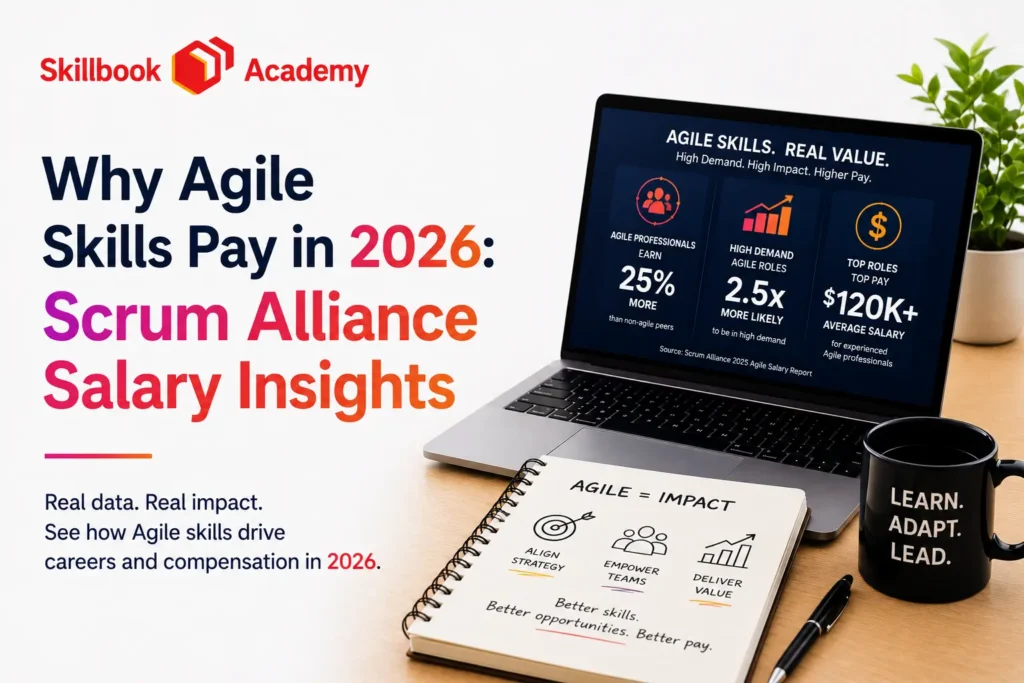
U.S. Scrum Master averages now sit roughly in the low 100,000s USD, with experienced practitioners easily clearing that in the right markets. Guides and aggregators put typical Scrum Master compensation in the 100,000–135,000 USD total range and often higher in tech hubs.
On top of that, certified Scrum professionals regularly earn a 15–25% premium over non-certified peers, especially when they combine credentials with relevant experience.
Three big forces are driving this premium:
- AI is taking over low-value work, spotlighting human skills.
- Market volatility makes adaptability a survival trait.
- Executive fatigue with “Zombie Scrum” that looks Agile but doesn’t move any business needle.
Agile Theater is in the backseat at this point, and velocity charts have only become redundant to one’s career.
As a result, there is a clear divide within the market:
Coordination roles are stagnant, while accountability roles are on the rise.
2026 Salary Landscape: U.S. Benchmarks for Scrum Alliance-Aligned Roles
The following ranges are drawn from aggregated U.S. data reported across Scrum Alliance surveys, PayScale, Glassdoor, and Indeed – mapped to Scrum accountabilities as defined in the Scrum Guide 2020. These represent verified averages for the 2026 fiscal year.
What the Scrum Guide Says You Are – and Why It Matters to your Paycheck
Before analyzing compensation, it’s worth grounding these roles in the definitions that high-paying organizations actually hire against.
The Scrum Master, per the Scrum Guide 2020, is accountable for the effectiveness of the Scrum Team. Not for running meetings. Not for maintaining the backlog tool. Improving team effectiveness compresses time-to-market – that is a business outcome with a measurable dollar value.
The Product Owner is accountable for maximizing the value of the product. This is a profit-and-loss mindset applied to a product backlog. When you own value delivery, you command compensation that reflects that ownership.
Pro-Tip: The market pays for accountability, not job titles.
A Scrum Master who functions as a project coordinator will earn a coordinator’s salary. One who operates as a systemic change agent earns a leader’s salary.
Why the Certification Creates a Salary Multiplier
A two-day CSM course translating to a $20,000 salary differential is counterintuitive until you understand what it signals in a crowded labor market.
Hiring managers in 2026 are explicitly filtering against certain profiles: Scrum Masters who think their job is facilitating the Daily Scrum, Product Owners who cannot say no to stakeholders, and Agile practitioners who optimize Jira configurations instead of human conversations.
Scrum Alliance certifications signal three things that a 30-minute interview cannot reliably assess:
Shared language – the candidate understands empiricism, Sprint Goals, and the role boundaries the Scrum Guide defines. Ethical alignment – familiarity with the Scrum Values (Commitment, Focus, Openness, Respect, Courage)- suggests behavioral expectations, not just process knowledge. Practical exposure – training contexts built around real team dynamics, not conceptual walkthroughs.
The distinction that ultimately separates salary bands, however, is between certificate holders and practitioners. Certification opens the door – it clears applicant tracking systems and signals baseline competence. Sustained salary growth comes from demonstrated outcomes: reduced time-to-market, improved stakeholder trust, and measurable flow efficiency. The certification validates the knowledge. Behavior secures the raise.
Pro Tip: Before your next salary review, document two or three outcomes your facilitation directly influenced- not activities, but results. “Reduced stakeholder escalations by 40% through structured Sprint Review facilitation” is a compensation argument. “Ran 12 Sprint Retrospectives” is a schedule.
The CSPO® Salary Premium: Why Product Ownership Commands Top Rates
The Certified Scrum Product Owner® (CSPO®) consistently commands one of the highest starting salaries across all Scrum Alliance–aligned roles – and the pay gap versus non-certified practitioners is among the widest in the Agile job market.
The Numbers: CSPO® vs. Non-Certified Product Owners
According to U.S. benchmarks aggregated from Scrum Alliance data, PayScale, and Glassdoor:
| Profile | Mid-Level Salary Range | Senior-Level Salary Range |
| CSPO® (Certified Product Owner) | $135,000 – $155,000 | $150,000 – $175,000 |
| Non-Certified Product Owner | $105,000 – $120,000 | $115,000 – $135,000 |
| Certification Premium | ~25–29% | ~25–30% |
That gap- consistent across industries- reflects something structural, not superficial.
Why the CSPO® Commands a Business-Level Premium
The Product Owner’s accountability is, at its core, a P&L function. Per the Scrum Guide 2020, the Product Owner is accountable for maximizing the value of the product – which translates directly to revenue outcomes, cost-of-delay decisions, and customer retention metrics.
Organizations hiring a CSPO® are not hiring a requirements writer or a backlog administrator. They are hiring someone who can:
- Prioritize under constraint –
making explicit trade-off decisions between features, quality, and time, with business impact as the unit of measure.
- Say no with commercial justification –
protecting the team from scope creep while maintaining stakeholder trust.
- Connect Sprint Goals to business strategy –
translating executive objectives into an ordered Product Backlog that the team can execute against.
Non-certified practitioners in equivalent titles often lack the framework to hold this accountability confidently. The result is a role that looks like a Product Owner but functions like a requirements relay – and the market prices that accordingly.
The Expanding CSPO® Market Beyond Tech
Scrum Alliance data shows a significant rise in CSPO® certifications originating outside software – in Financial Services, Healthcare Operations, Marketing, and EdTech. This matters for salary trajectory: a CSPO® who can apply product thinking to a regulatory-driven Healthcare product or a campaign portfolio in Marketing operates in a smaller talent pool with higher leverage. Cross-industry product ownership commands a premium precisely because it is rare.
Pro-Tip: If you hold a CSPO® and are currently operating as a “requirements gatherer,” you are leaving a significant salary on the table. The role that commands $150,000+ is one that owns the definition of “done” commercially- not just functionally. In your next role conversation, frame your value around revenue decisions you influenced, not features you documented.
Three Forces Driving Agile Pay Growth in 2026
Pro-Tip: Replace your next Sprint Review summary with a one-page outcome brief. Sprint Goal → Was it met? → What business metric moved? → What’s the next high-value bet? Executives who see this format once tend to start requesting it. That visibility is the fastest path to a compensation conversation.
A Career Pivot That Illustrates the Pattern
In 2024, a finance-sector Project Manager – call her Sarah – was earning a solid base salary while spending her days chasing status updates and maintaining Gantt charts. Minimal growth. Minimal leverage.
She earned her CSM® certification and, more critically, changed her behavior: she stopped assigning tasks and started facilitating Sprint Planning. She stopped producing status reports and started running Sprint Reviews where stakeholders interacted with the working product directly. She protected the team’s focus from interruption.
By 2026, her Scrum Team had reduced time-to-market by 30%. Stakeholder conflict dropped as transparency increased. She transitioned to a dedicated Scrum Master role at a fintech firm with a base compensation increase of approximately 22%, with bonuses now tied to value delivery rather than hours logged.
This is not an outlier trajectory. It is the consistent pattern for practitioners who fully own the Scrum Master accountability.
The Certification Pathway to Higher Compensation
Salary growth follows impact breadth. A CSM® influences a team. A Certified Scrum Professional influences an organization. The compensation difference between these levels benchmarks at $40,000–$50,000 annually.
Scrum Master Track: CSM® Certification (foundational mindset) → A-CSM (coaching, facilitation, the salary inflection point for most practitioners) → CSP-SM (organizational change, complex adaptive systems)
Product Owner Track: CSPO® (product value and customer focus) → A-CSPO (stakeholder strategy, market alignment) → CSP-PO (assumption validation, ROI accountability)
The A-CSM and A-CSPO levels are where salary premiums typically accelerate — the advanced certifications require demonstrated practice, not just assessment passage, which tightens supply and increases market value.
Start Your Certification Path Today
The salary data is clear. The trajectory is documented. What remains is the decision.
Scrum Alliance certifications are not a guarantee of higher pay – but they are the most consistent, globally recognized signal that separates practitioners who command outcomes from those who coordinate tasks. In a labor market where AI has raised the floor and volatility has raised the ceiling, that signal is worth more than it has ever been.
If you are a Scrum Master looking to move from the $90k–$110k entry range into the $125k–$160k senior band, the A-CSM pathway is your most direct route. The curriculum directly develops the coaching and facilitation depth that hiring managers are paying for.
If you are a Product Owner — or a Business Analyst, Project Manager, or domain expert considering a pivot — the CSPO® offers the fastest entry into a salary band ($135k–$155k at mid-level) that outpaces most adjacent roles. It also gives you the commercial language to negotiate the compensation you are already delivering value for.
Explore the CSM® Certification Path → See the CSPO® Curriculum and Enrollment →
Frequently Asked Questions
Yes. U.S.-based data from PayScale and Glassdoor consistently show certified Scrum Masters and Product Owners earning 15–25% more than non-certified peers. It signals a verified baseline of knowledge that employers trust.
Yes - but the role has evolved. Organizations continue to invest heavily in Scrum Masters who can improve team effectiveness, build stakeholder trust, and ensure delivery outcomes. The "admin" style Scrum Master is disappearing; the "coach" style is thriving.
AI raises the bar. Professionals who combine Scrum expertise with AI-assisted analysis and facilitation earn more. They are viewed as force multipliers who can deliver more with less overhead.
The CSPO® tends to have the highest starting base due to the commercial nature of the role. The highest overall compensation is found in the Advanced and Professional tiers (CSP-SM, CSP-PO, and CST), where the role shifts to enterprise coaching and organizational strategy.
U.S. benchmarks suggest a 25–30% salary premium for CSPO®-certified practitioners versus non-certified peers in equivalent roles - one of the widest certification gaps in the Agile job market.
Meet the Author

Chris Harrison
Agile Coach & Trainer
Chris Harrison is an Agile coach and certified trainer.