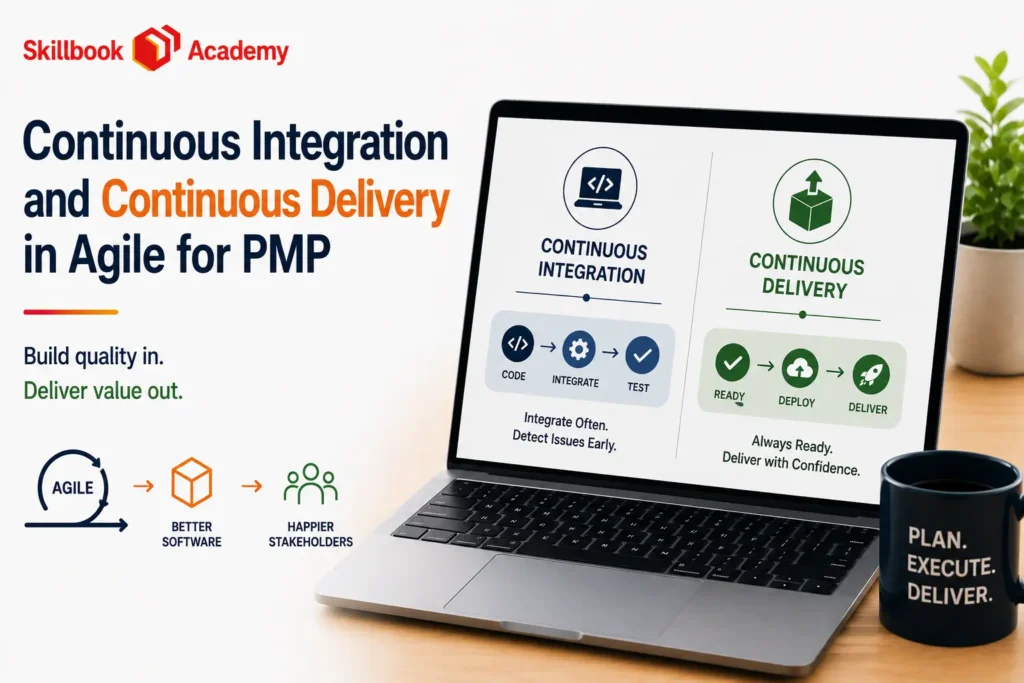
- Continuous Integration (CI) regularly merges code changes into a shared mainline and automatically builds and tests each change, helping teams identify integration problems early.
- Continuous Delivery keeps successfully tested builds ready for production while retaining a human release decision, whereas Continuous Deployment automatically releases every change that passes the pipeline into production.
- CI/CD supports Agile and hybrid project delivery by enabling smaller releases, faster feedback, earlier defect detection, and lower release risk, while maintaining appropriate governance and quality controls.
- For PMP® learners, CI/CD is a project-level delivery capability—not simply a developer practice. Project Managers need to understand its impact on quality, schedule, risk, stakeholder communication, governance, and value delivery.
- A mature CI/CD pipeline includes automated builds, testing, security and compliance scans, staging validation, release controls, production deployment, and post-deployment monitoring.
- Continuous Delivery is generally appropriate when regulatory requirements, approval gates, or a high production blast radius require human authorization, while Continuous Deployment is more suitable when automation, team maturity, and risk controls support automatic production releases.
- CI/CD does not eliminate governance or change control. Traceability, approvals, audit evidence, feature flags, rollback strategies, and compliance controls remain important in controlled delivery environments.
- PMP Project Managers can evaluate CI/CD performance using delivery and reliability metrics such as deployment frequency, lead time for changes, change failure rate, and mean time to recovery.
Direct Answer
‘Continuous integration’ is the method of regularly merging code changes into a shared mainline and using automated build and test procedures to validate each merge. While ‘Continuous Deployment’ goes further by automatically deploying all authorized changes to production, ‘Continuous Delivery’ ensures that the most recently tested build is always ready for deployment. In a PMP setting, CI/CD supports the incremental value delivery paradigm outlined in the PMI Agile Practice Guide as well as quicker delivery, higher quality, and lower risk.
Why This Topic Matters for PMP Learners and Project Managers
A single big-bang release is rarely enough for modern projects to thrive. The PMP exam is based on the PMBOK Guide Seventh Edition and the PMI Agile Practice Guide, which require project managers to manage delivery in environments with frequent, automated releases, closely tied to quality assurance. CI/CD powers that cadence.
In practice, CI/CD affects schedule, quality, risk, and stakeholder communication for PMP-credentialed managers. Rollbacks are controlled events, not catastrophes; releases are normal; and we find defects early. CI/CD preserves the credibility of the predictive plan in hybrid programs, which combine predictive milestones with iterative software delivery, since the iterative side produces verified increments as needed. Production failures, change failures, or chaos on release day are blindsiding project managers who are unaware of CI/CD risk.
Core Definitions
What is Continuous Integration (CI)?
Continuous integration is the practice of integrating code from multiple developers into a common mainline branch many times a day, with each integration triggering an automated build and test suite. The goal is to find integration problems in minutes, not days. In the PMI Agile Practice Guide, CI is a technology practice that reduces integration risk and increases the opportunity for incremental delivery.
What is Continuous Delivery (CD)?
The process of maintaining the codebase so that every successful build can be instantly delivered to production is known as continuous delivery. By including gated approvals, environment configuration as code, and automated deployment to staging environments, it expands continuous integration. While the readiness is automated, humans still make the release decision.
What is Continuous Deployment?
Continuous deployment automates the final step. Every change that makes it through the pipeline is pushed into production without human approval. PMP candidates should differentiate between Continuous Delivery (release ready, manual go) and Continuous Deployment (release automatic). Many regulated companies have adopted Continuous Delivery but have never achieved Continuous Deployment.
Detailed PMP-Focused Explanation
CI/CD appears simultaneously in multiple knowledge domains on a PMP-aligned project. CI/CD operationalizes the build-in-quality concept from the PMBOK Guide Seventh Edition in quality management by offering automated test coverage, static code analysis, and consistent deployments. CI/CD reduces the cycle time between feature ready and feature live in schedule management, enabling the project manager to predict delivery using empirical evidence instead of lengthy planning windows. By making releases small and reversible, CI/CD lowers the risk in risk management.
Additionally, stakeholder management evolves. With CI/CD, change requests can be processed without a heroic release weekend, demos become regular, and feedback is recorded at every iteration. Defects uncovered in CI are less expensive than those found in production, which helps with cost control. Pipeline dashboards create a single source of truth for delivery status, which is advantageous for communication management.
In hybrid delivery, the software side continually performs continuous integration and deployment (CI/CD) in between the project manager’s forecasted milestones for big releases (such as hardware integration windows or regulatory submissions). PMI identifies this approach as the predominant pattern for businesses upgrading their offering without giving up on predictive governance.
PMP exam scenarios assess a candidate’s ability to view continuous integration and deployment (CI/CD) as a project-level competency rather than only a developer habit. Anticipate inquiries when a sponsor requests a quicker release cycle or when production events jeopardize the timeline; strengthening continuous integration (CI), increasing the number of automated tests, or enhancing the deployment pipeline are frequently better solutions than adding more manual review stages.
Key Components of CI/CD
| Component | Purpose | When it happens | Who is responsible | PMP relevance | Example | Risk if misunderstood |
| Source control trigger | Detect new commit | On every push or merge | Developers, DevOps | Configuration management baseline | Pull request opened on main branch | Untracked changes, unclear scope baseline |
| Automated build | Compile and package | Triggered by commit | Build engineers, dev team | Quality assurance, schedule predictability | Container image built and tagged | Manual builds delay release |
| Automated tests | Catch defects early | After every build | Test engineers, dev team | Quality, cost of defect reduction | Unit, integration, regression suites | Late defects, rework cost |
| Security and compliance scan | Enforce non-functional requirements | Each pipeline run | Security, compliance, project manager | Risk, business environment domain | SAST, dependency scan, license check | Compliance risk, audit findings |
| Staging deployment | Pre-production validation | After tests pass | DevOps, QA, product owner | Validate scope, stakeholder demo | Feature deployed to staging URL | Surprises in production |
| Release approval gate (CD) | Human go/no-go decision | Before production push | Product owner, project manager | Change control, governance | Change advisory board sign-off | Skipped governance, audit gaps |
| Production deployment | Make value available | On approval (CD) or auto (CDep) | DevOps, SRE | Delivery cadence, value delivery principle | Blue-green deploy, canary release | Outage, rollback chaos |
| Monitoring and feedback | Validate in real conditions | Continuous post-deploy | SRE, product owner, project manager | Benefits realization, lessons learned | SLO dashboard, error budget | Silent failures, eroded trust |
Practical Project Examples
IT/SaaS (Customer support platform): Within 12 minutes, a SaaS team pushes builds to staging after running 4,000 automated tests on each commit. Before production, Continuous Delivery needs the consent of the product owner. The PMP-credentialed program manager forecasts quarterly release obligations to the sponsor using pipeline metrics, such as change failure rate and change lead time.
Healthcare (Electronic Health Record module): The team uses Continuous Delivery rather than Continuous Deployment due to regulatory restrictions. Clinical sign-off and FDA-aligned documents are required before each candidate is released. Every commit still undergoes CI, including data masking tests that are pertinent to HIPAA. Predictive validation milestones are planned by the PMP project manager around iterative CI builds.
Finance (Trading platform risk module): A bank uses a rigorous change advisory board to manage CI/CD. Outside of market hours, production deployments are prohibited. CI incorporates licensing compliance, regulator-defined controls, and static analysis for OWASP. Executive risk committees are informed by the project manager about the frequency of releases and the average recovery time.
Manufacturing (updates to IoT firmware): Firmware is transmitted over the air to devices in the field. CI uses simulators to do hardware-in-the-loop tests. CD starts with a 1% fleet, monitors for irregularities, and then grows. This is handled by the PMP manager as a phased release based on a CI/CD pipeline.
Government (Citizen service portal): Accessibility, security accreditation, and bilingual content checks are integrated into a government application that uses continuous integration (CI) on each commit. Formal authority-to-operate paperwork serves as a gate for releases. The PMP-credentialed program manager connects Agile teams and the anticipated certification timetable.
PMP Exam and Certification Insights
The PMP Exam Content Outline groups topics under the headings of People, Process, and Business Environment. Most often, CI/CD is viewed through a business lens (compliance, governance, business value) and a process lens (delivery, quality, risk). The People domain comes into view when the project manager has to mentor teams without experience in automation or to resolve a conflict between speed of development and security review.
Typical pitfalls: Confusion between Continuous Deployment and Continuous Delivery. On the test, they are treated differently. More manual reviews as a way to improve quality is a less effective solution aligned with PMI than increasing automation. CI/CD should be a developer-only thing. PMI considers this a delivery capability. Not considering CI/CD in hybrid scenarios. The PMP exam requires candidates to bring CI/CD into hybrid release strategies.
Mnemotic: CD – Click to Deploy CI – Catch Issues. Think “no click” for Continuous Deployment.
PMI frames CI/CD within the framework of tailoring conversations in the PMBOK Guide’s Seventh Edition choose the right level of automation for the situation. CI/CD supports values of stewardship, quality, and value delivery, and candidates should discuss how this is done.
Common Mistakes and Misconceptions
- Using CI only as a building tool. CI is more than simply a Jenkins or GitHub Actions setup; it’s a discipline of modest, regular integrations.
- Distinguishing between continuous deployment and continuous delivery.
- thinking that CI/CD equates to no governance. PMP-aligned CI/CD incorporates traceability, approvals, and audit trails.
- ignoring pipeline non-functional testing and then being taken aback by security or performance flaws.
- CI/CD is only used in development settings; production deploys are still hazardous and done by hand.
- Disregarding rollback tactics. Pipelines must support fast revert.
- Trust is damaged by flaky tests until the team disables them.
- As part of release control, feature flags are being forgotten.
- Reporting solely on success rates rather than DORA-aligned metrics such as mean recovery time, lead time, deployment frequency, and change failure rate.
- Assuming that controlled industries cannot use CI/CD. In government, finance, and healthcare, continuous delivery with solid evidence trails is well-established.
How to Apply This in Real Projects
Checklist for project managers: Verify that CI is present in every code repository on each commit. Make sure that the pipeline includes unit, integration, security, and accessibility tests. Clearly define the responsibilities involved in release approval for continuous delivery. For dangerous updates, use feature flags. Monitor DORA metrics within your status reports. Plan rollback exercises regularly, similar to fire drills. Early on, align CI/CD evidence with audit and compliance requirements.
Delivery model decision rule: Highly regulated, big blast radius. Continuous delivery with express consent. Reduced regulations, a reduced blast radius, an experienced staff, and continuous deployment. Predictive gates surround hardware in a hybrid program with hardware milestones and software-side CI/CD.
Translate pipeline metrics into corporate terminology as a communication rule. Risk and predictability are more important to sponsors than test numbers.
Final Takeaway
Continuous integration and continuous delivery are not only technical practices, but also delivery capabilities that are essential for modern PMP professionals. Used wisely, they help teams deliver value faster, catch problems earlier, reduce release risk, and keep stronger control in Agile and hybrid environments.
The real lesson for PMP learners and project managers is simple: CI/CD supports quality, governance, and adaptability without compromising predictability. The more you understand about how these pipelines work, the better you can lead teams, manage stakeholder expectations, and make release decisions with confidence.
Related Courses & Certifications: Strengthen your project management and Agile quality skills with our Project Management Professional (PMP)® Certification Training, AI Powered Project Manager, Leading SAFe® Agilist (SA) Certification Training, and SAFe® Scrum Master (SSM) Certification Training.
FAQs / People Also Ask
What is the difference between Continuous Delivery and Continuous Deployment?
Continuous delivery keeps every successful build release-ready, but only a person approves the push to production. That last stage is automated through continuous deployment, which pushes each new change to production. Both depend on continuous integration. PMI sees the decision as a matter of customization.
Is CI/CD only relevant to software projects?
While CI/CD is most mature in software, the principles also apply to firmware, machine learning, infrastructure as code, and content publishing. PMP managers in manufacturing, healthcare, and government employ predictive methods and utilize CI/CD on the digital components of hybrid programs.
How does CI/CD support PMP exam concepts?
CI/CD puts the PMBOK Seventh Edition principles of: build quality in, offer value constantly, optimize risk, and embrace adaptability into practice. It also demonstrates personalization. In test situations, automation enhancement is often more desirable than manual review addition.
Can CI/CD work in regulated industries?
Yes, you find continuous delivery often in government, healthcare, and finance. The pipeline is the audit trail, with traceable builds, tests, scans, and approvals. PMP managers usually work with feature flags and canary releases and also maintain a manual of release approvals.
What metrics should a PMP project manager track for CI/CD?
Watch for the following DORA metrics: average recovery time, change failure rate, lead time for changes, and deployment frequency. In addition to cost, schedule, and scope variance, you need to track defect escape rate, pipeline reliability, and percent automated tests for sponsor reporting.
How does CI/CD interact with change control?
Change control remains, but it is replaced by automated evidence-based validation. Pipeline policy preapproves standard low-risk changes. Normal modifications require a lighter clearance. Changes made in an emergency are faster.
Meet the Author

Chris Harrison
Agile Coach & Trainer
Chris Harrison is an Agile coach and certified trainer.