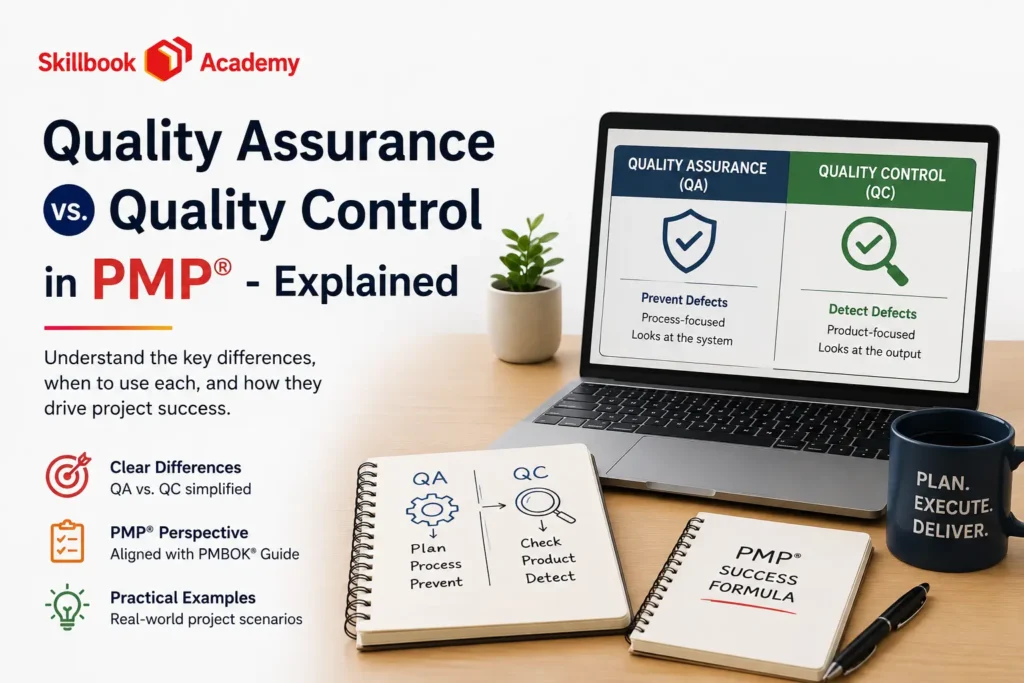
- Quality Assurance (QA) is process-focused and prevents defects, while Quality Control (QC) is product-focused and detects defects in project deliverables.
- QA aligns with the PMBOK® Manage Quality process, while QC aligns with the Control Quality process.
- QA includes process audits, training, standards, root cause analysis, and process improvement, while QC includes inspections, testing, sampling, control charts, and acceptance criteria validation.
- The key PMP® exam rule is: Process problem → QA; Product defect → QC. Recurring defects despite extensive testing indicate a process problem that requires QA rather than more inspection.
- QA and QC are complementary, not interchangeable. QA improves how the team works to prevent defects, while QC verifies whether the resulting deliverables meet specifications and acceptance criteria.
- In Agile environments, QA is built into practices such as Definition of Done, peer reviews, working agreements, and retrospectives, while QC occurs through automated testing, sprint reviews, and acceptance testing.
- Investing in prevention through QA can reduce the higher costs associated with internal and external quality failures, making prevention an important part of project quality management.
- For PMP® questions, remember three simple rules: “QA audits; QC counts,” “QA prevents; QC inspects,” and “Process problem → QA; Product defect → QC.”
Your team is running full regression testing before every release. Defects keep escaping anyway. Adding more testing won’t fix this – fixing the process will. That’s the difference between QA and QC, and it’s one of the most precisely tested distinctions on the PMP exam.
(Direct Answer)
Quality assurance is process-oriented – it ensures the team follows the right methods to prevent defects and answers, “Are we doing things correctly?” Quality control is product-oriented – it inspects deliverables to verify they meet specifications and answers, “Are things done right?” In PMBOK, QA maps to the Manage Quality process and QC maps to Control Quality. Both sit inside the project quality management knowledge area but serve different purposes at different times.
QA looks at the process. QC looks at the product.
The core PMI distinction – and the one the exam tests hardest.
Definitions side-to-side
| Quality Assurance PMBOK: Manage Quality process | Quality Control (QC)PMBOK: Control Quality process |
|---|---|
| Planned and systematic activities that ensure the project follows the right processes to prevent defects from occurring in the first place. | Operational techniques and activities that inspect and verify project deliverables to confirm they conform to specifications and acceptance criteria. |
| Process audits and design reviewsTraining and standards adoptionDefinition of done and working agreementsRoot cause analysis on recurring defectsBenchmarking against quality standards | Inspections, testing, and samplingControl charts and run chartsAcceptance criteria validationAutomated test suite resultsUser acceptance testing (UAT) |
ASQ definitions are used throughout – PMI’s quality knowledge area aligns conceptually with ASQ’s body of knowledge.
Head-to-Head Comparison
| DIMENSION | QUALITY ASSURANCE | QUALITY CONTROL (QC) |
|---|---|---|
| Orientation | Process-focused | Product-focused |
| Purpose | Prevent defects by improving how the team works | Detect defects by verifying what the team produces |
| Timing | Throughout the project, proactively | At deliverable checkpoints, reactive |
| Who Owns It | PM, team, quality function, org policy | PM, testers, inspectors, customer |
| PMBOK Process | Manage Quality | Control Quality |
| Output | Process improvements, audit findings | Verified deliverables, quality measurements |
| Example | Auditing whether code reviews happen before merge | Running automated tests against release acceptance criteria |
| Risk If Confused | Treating QA as inspection leads to high rework costs | Treating QC as auditing leaves deliverables unverified |
The PMBOK Quality Management Framework
Project quality management in PMBOK comprises three sequential but interconnected processes. Plan Quality Management establishes how the team will define, achieve, and verify quality. Manage Quality (QA) executes the plan, audits adherence to processes, and drives continuous improvement. Control Quality (QC) verifies that deliverables meet specifications and that quality measurements fall within acceptable tolerances.
The PMI quality philosophy draws on classical quality thinking: Deming’s continual process improvement, Juran’s quality trilogy of planning, control, and improvement, and Crosby’s principle that prevention is less expensive than the cost of failure. All three schools ground PMI’s view that quality is planned, not inspected, into a deliverable after the fact.
| A common exam trap: a question describes a team with recurring defects despite extensive testing, then asks what the PM should do first. The PMI answer is a process audit – QA – not more testing. Chronic defects signal a broken process, not insufficient inspection. |
|---|
In predictive projects
QA and QC are both formalized: documented quality plans, gate-review audits, formal inspection phases, and test execution against baselined specifications. Quality metrics are tracked throughout execution and reported to the sponsor.
In agile environments
QA is built into team working agreements – definition of ready, definition of done, peer code review, and retrospective-driven improvement. QC runs continuously through automated tests, sprint reviews, and acceptance criteria validation each iteration. The PMI Agile Practice Guide emphasizes that quality is everyone’s responsibility and is engineered into the iteration cadence rather than appended at the end.
In hybrid projects
Predictive quality processes apply to fixed-scope contractual deliverables while agile quality practices apply to iteratively delivered features. A quality management plan must account for both modes, with clearly defined QA and QC activities for each delivery stream.
Cost of quality: why QA is the better investment
The cost-of-quality framework provides the economic case for prioritizing QA. Total quality cost has two sides: costs of conformance (investments to prevent and detect defects) and costs of non-conformance (what you pay when quality fails).
| Simple decision log | |
|---|---|
| Costs of Conformance | Costs of Non-Conformance |
| Prevention – training, audits, process design, QA activities | Internal failure – rework, scrap, re-testing before delivery |
| Appraisal – inspections, testing, control charts, QC activities | External failure – recalls, warranty claims, regulatory penalties, lost reputation |
| The PMI Implication: Investing in prevention (QA) reduces appraisal costs and – far more importantly – dramatically reduces the much larger internal and external failure costs. Crosby’s principle: quality is free when measured against the cost of not having it. |
|---|
Project examples across industries
IT / fintech
Fintech platform build
| QA – audit code review checklist compliance | QC – automated regression tests before release |
|---|
When a defect escapes into production, QA asks, “What process gap allowed this?” and QC asks, “How did our tests miss it?” Both questions belong in the post-incident review – neither replaces the other.
Construction
Commercial tower
| QA – audit welding procedure spec adherence | QC – non-destructive weld tests and cube tests |
|---|
A failed weld test (QC) should trigger a process audit (QA) of the welding crew’s training records. The product failure leads back to a process gap – which is how most quality failures begin.
Healthcare/pharma
Medical device Manufacturers
| QA – audit code review checklist compliance | QC – automated regression tests before release |
|---|
Medical device manufacturer
A regulatory finding almost always traces back to a QA gap even when the symptom is a QC failure. Regulators audit the process – they assume the product reflects it.
Finance
Core banking modernization
| QA – audit code review checklist compliance | QC – automated regression tests before release |
|---|
Both run in parallel during the parallel-run phase. QA ensures the migration methodology is sound; QC verifies that the data that moved is accurate.
Manufacturing
Automotive supplier
| QA – audit code review checklist compliance | QC – automated regression tests before release |
|---|
The QA program ensures the QC checks are well-designed. Without process audits confirming the SPC methodology, control charts may be present but poorly calibrated.
| Catching defects is QC’s job. Preventing them is QA’s mission. The difference matters most at 2 am when a critical defect hits production, and the post-mortem asks how it got there. |
|---|
PMP exam guidance
PMI’s PMP exam covers quality across the process domain. Situational questions typically test two scenarios. First, chronic defects despite extensive testing – the PMI-aligned answer is a process audit (QA), not more inspection. Second, a deliverable is rejected due to a specification mismatch – the answer is control quality. The exam tests whether you understand the directionality: process problems need QA, and product defects need QC.
Three mnemonics worth memorizing before the exam:
T1. “QA audits; QC counts.” – Auditing is a process activity; measuring and inspecting is a product activity.
2. “QA prevents; QC inspects.” – Prevention belongs to the process; inspection belongs to the deliverable.
3. “Process problem → QA. Product defect → QC. Both need each other.”
For agile-flavored exam questions, the definition of done is a QA artifact that establishes the processes a story must follow to be accepted. Acceptance testing is a QC artifact, verifying the product meets the stated criteria. Both appear in agile and hybrid questions.
Common mistakes PMP candidates make
- Equating QA with testing. Testing is a QC activity. QA includes audits, training, and process design — not inspection of outputs.
- Treating QC as the only quality investment needed. Without QA, QC catches the same defects repeatedly because the underlying process never improves.
- Assuming a dedicated QA team owns quality alone. PMI assigns quality responsibility across the project team, PM, and stakeholders. No single function owns it.
- Skipping cost-of-quality analysis. Without it, organizations chronically underinvest in prevention and overspend on failure costs.
- Believing agile teams don’t need QA. “Definition of done,” “peer review,” “retrospectives,” and “continuous integration” are all QA practices. Agile teams practice QA constantly, even without calling it that.
- Confusing audits with inspections. Audits assess processes; inspections assess products. These are different activities with different inputs and outputs.
- Treating quality as a phase-end gate only. Both QA and QC are ongoing throughout the project lifecycle, not checkpoints at the end.
- Assuming “more testing” solves chronic quality issues. It often doesn’t. Process improvement is the answer when the same defect type recurs.
- Ignoring lessons learned for quality. Every defect should refine both the QA process design and the QC test coverage for the next iteration.
- Confusing the quality management plan with quality metrics. The plan governs the approach; metrics measure whether the approach is working.
6 questions to determine whether an action is QA or QC
QUICK DIAGNOSTIC
- Is the action examining a process or a product?
Process → QA. Product → QC.
- Is it designed to prevent defects or detect them?
Prevent → QA. Detect → QC.
- Is it an audit or an inspection?
Audit → QA. Inspection → QC.
- Does the output improve how the team works or verify what they produced?
How → QA. What → QC.
- Which PMBOK process does it belong to?
Manage Quality → QA. Control Quality → QC.
- Is it triggered by a recurring defect pattern or a specific deliverable handoff?
Pattern → QA process audit. Handoff → QC inspection.
Related Courses & Certifications: Strengthen your project management and Agile quality skills with our Project Management Professional (PMP)® Certification Training, AI Powered Project Manager, Leading SAFe® Agilist (SA) Certification Training, and SAFe® Scrum Master (SSM) Certification Training
Frequently Asked Questions
Closely aligned but not identical. Manage Quality incorporates organizational quality policies, audits process adherence, and identifies improvements. QA is the broader prevention philosophy that informs Manage Quality, drawing on ASQ definitions and organizational quality systems.
QC verifies that deliverables meet internal specifications. Validate Scope is the formal customer or sponsor acceptance process. A deliverable can pass QC but still require Validate Scope. Both are monitoring and controlling activities, answering different questions.
Yes, especially on smaller or agile projects where cross-functional members handle process design and testing. The distinction is conceptual, not organizational. Larger projects may use dedicated functions, but PMI does not require formal separation.
QA is built into working agreements: definition of done, peer review, continuous integration, and retrospectives. QC runs continuously through automated tests, sprint reviews, and acceptance criteria validation. Quality is engineered into iterations, not appended at the end.
Cost of quality is the total cost of achieving quality plus the cost of failure- prevention, appraisal, internal failure, and external failure. PMI uses the framework to justify investing in prevention. It is directly testable on the PMP exam in quality management questions.
Process audits, design reviews, benchmarking, training programs, root cause analysis (fishbone diagram, 5 Whys), and process checklists. These are distinct from QC tools like control charts, acceptance sampling, and inspection checklists.
The PM is accountable for quality outcomes but does not personally conduct inspections. Testing and inspection are performed by team members, dedicated quality roles, or the customer. The PM ensures QC is planned, resourced, executed, and acted upon.
ASQ provides foundational definitions for QA, QC, and many quality terms used in PMI materials. PMI's quality knowledge area aligns conceptually with ASQ's body of knowledge, and PMP exam prep commonly references ASQ definitions for precision.
Meet the Author

Chris Harrison
Agile Coach & Trainer
Chris Harrison is an Agile coach and certified trainer.