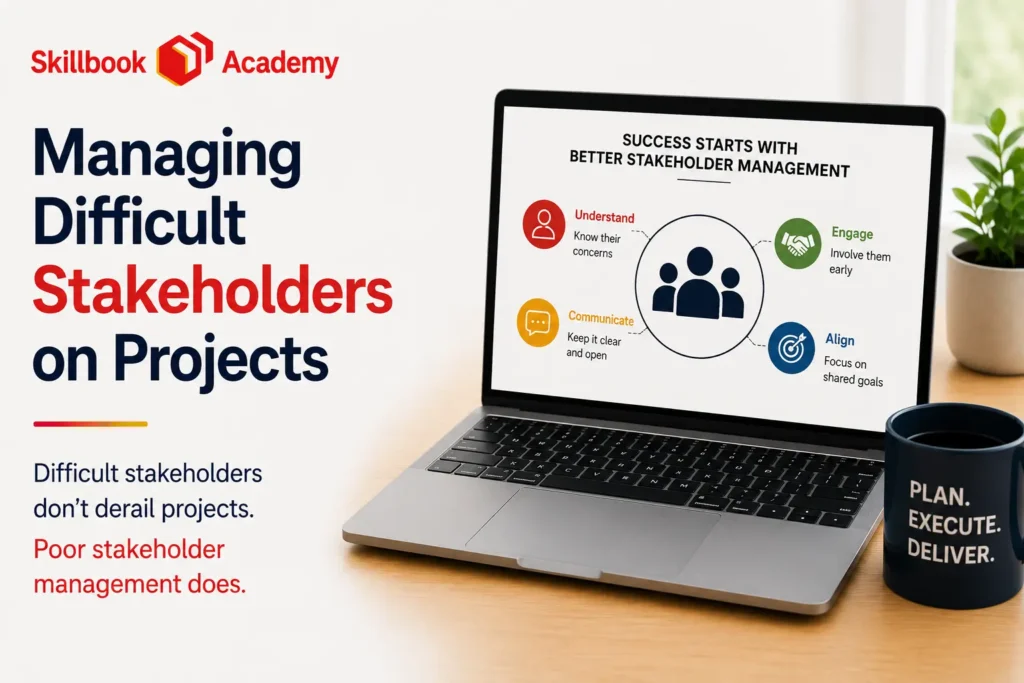
- Managing difficult stakeholders starts with understanding their power, interest, expectations, and current level of engagement, rather than labeling them as simply “difficult.”
- Effective stakeholder management follows four core activities: identify stakeholders, plan stakeholder engagement, manage stakeholder engagement, and monitor stakeholder engagement.
- Stakeholder analysis tools help determine the right engagement strategy. The power/interest grid maps stakeholders by power and interest, while the salience model adds urgency and legitimacy to the analysis.
- The appropriate response to stakeholder conflict is to understand the underlying issue, listen actively, and tailor the engagement approach rather than immediately avoiding, forcing, or escalating the situation.
- Collaboration and problem-solving are generally preferred by PMI when resolving stakeholder conflicts, while avoiding, accommodating, compromising, and forcing may be appropriate depending on the situation.
- Stakeholder engagement is dynamic and must be continuously monitored and adjusted. A stakeholder who is resistant today may become supportive when their concerns are addressed effectively.
- Emotional intelligence, active listening, negotiation, political awareness, and cultural awareness are essential project management skills for handling difficult stakeholders.
- Escalation should occur when an issue exceeds the project manager’s authority, threatens project objectives, or requires action for ethical reasons—after appropriate direct engagement has been attempted.
Direct Answer
Dealing with difficult stakeholders requires transitioning from firefighting to intelligent management. That is, identify who has power, what they care about, and where you can find common ground before disagreements derail the project. Rather than trying to guess your way through tough conversations, you can leverage structured tools, such as power grids or engagement matrices, to anticipate reactions and develop a clear plan of action. It’s not about eliminating friction; it’s about converting that friction into real, productive conversations to keep your project on track.
Why This Topic Matters for PMP Learners and Project Managers
Technical risks are more predictable in real projects. Stakeholder risks aren’t. Situations that turn well-planned projects into political minefields include a senior executive who changes priorities every month, a regulator who delays approvals, an end-user community that resists change, and a sponsor who promises support but does not show up. PMI’s Pulse of the Profession reports consistently identify stakeholder engagement as a key factor in project success or failure, and surveys repeatedly find that poor stakeholder management is associated with significant budget loss on at-risk projects.
For PMP candidates, stakeholder management is one of the largest and most heavily tested areas of the exam, especially under the People domain. The situational questions aim to check if candidates are able to accurately identify stakeholders, gauge their influence, plan appropriate ways to involve them, manage conflicts, and escalate issues in a constructive way. The exam is as much a test of servant leadership, emotional intelligence, and active listening as it is of PMBOK process knowledge.
Core Definitions
Who Counts as a Stakeholder?
In PMBOK, a stakeholder is defined as an individual, organization, or group who may affect, be affected by, or perceive itself to be affected by a decision, activity, or outcome of a project. This very broad term includes sponsors, consumers, end users, team members, suppliers, regulators, communities, executives, and even the media. PMI’s knowledge area on stakeholder management consists of four procedures: Stakeholder engagement, which includes identification, planning, management, and monitoring.
What Makes a Stakeholder Difficult?
“Difficult” stakeholders are those whose involvement does not align with the project’s requirements. They may be openly negative (resistant to the change, antagonistic in meetings, undermining the team), under-engaged when their contribution is required (avoiding choices, delaying approvals, hiding information), or over-engaged in detrimental ways (micromanaging, impeding progress, altering priorities). Instead of classifying people as “difficult,” PMI treats stakeholder involvement levels on a spectrum that includes unaware, resistant, neutral, supportive, and leading. The plan is based on the difference between the desired and actual levels of involvement as determined by the stakeholder engagement evaluation matrix.
Detailed PMP-Focused Explanation
According to PMBOK, effective stakeholder management is a four-process discipline.
Determine the stakeholders: This task goes beyond simply compiling a list of names. The project team records roles, contact details, influence, demands, expectations, project attitude, and relationships with other stakeholders. The result is a stakeholder registration that is updated during the project. PMI places a strong emphasis on early identification because one of the main reasons for project interruption is the late discovery of a strong, resistant stakeholder.
Make a plan for engaging stakeholders: This results in the stakeholder engagement plan, which outlines methods for effectively including stakeholders. The plan takes into account each stakeholder’s communication preferences, decision-making rights, existing and desired degree of engagement, and the management strategy for those whose engagement is not in line with project requirements.
Control the involvement of stakeholders: This includes carrying out the plan through dialogue, compromise, addressing issues, fostering support, settling disputes, and modifying engagement tactics in response to evolving circumstances. Here, PMI places a strong emphasis on interpersonal skills, including political acumen, dispute resolution, emotional intelligence, cultural awareness, and active listening.
Monitor stakeholder participation: The team monitors the effectiveness of the engagement plan and suggests modifications. Engagement is dynamic; when priorities change, supportive stakeholders may become resistant, and when their concerns are addressed, resistant stakeholders may become supportive.
PMI offers several analysis tools: The power/interest grid creates four quadrants with different engagement tactics (manage closely, keep satisfied, keep informed, monitor) by mapping stakeholders along two dimensions: their influence on project decisions and their interest in the outcome. The influence/impact grid and the power/influence grid also provide similar two-by-two viewpoints. The salience model creates seven categories of stakeholders (dormant, discretionary, demanding, dominant, dangerous, reliant, definitive) by adding a third dimension, urgency, to power and legitimacy. The stakeholder cube is a three-dimensional representation of power, interest, and influence.
Steering committees, written charters, and organized communication plans frequently formalize stakeholder engagement in predictive (waterfall) projects.
Engagement is usually more frequent and informal in agile environments: sprint reviews and demos serve as regular touchpoints for the larger stakeholder community, while product owners bear a large share of the responsibility for managing stakeholders. Formal governance and iterative interaction rhythms coexist in hybrid systems.
All stakeholder management is based on PMI’s Code of Ethics and Professional Conduct: Even when stakeholders act badly, integrity, equity, respect, and accountability are still applicable. The PMP exam frequently tests situations in which one of these values is violated by the technically appealing response (avoid the stakeholder, escalate right away, or comply silently); the right response demonstrates principled engagement.
Key Components of Difficult Stakeholder Management
| Component | What It Covers | Tools and Techniques | PMP Process |
| Identification | Who is affected, who has influence, who has interest | Stakeholder register, stakeholder analysis | Identify Stakeholders |
| Analysis | Power, interest, urgency, legitimacy, attitude | Power/interest grid, salience model, engagement matrix | Identify Stakeholders, Plan Stakeholder Engagement |
| Planning | Tailored engagement and communication strategy per stakeholder | Stakeholder engagement plan, communications management plan | Plan Stakeholder Engagement |
| Execution | Conversations, negotiations, conflict resolution, expectation management | Active listening, emotional intelligence, facilitation, negotiation | Manage Stakeholder Engagement |
| Monitoring | Tracking engagement levels and adjusting | Engagement assessment matrix, feedback mechanisms | Monitor Stakeholder Engagement |
| Escalation | Surfacing issues that exceed PM authority | Escalation paths, sponsor involvement, steering committee | Across all processes |
Practical Project Examples
Software development and IT: A chief risk officer frequently opposes releases with new restrictions at the last minute as part of a bank’s digital transformation. The project manager’s stakeholder survey reveals that the CRO has a lot of power and interest, but their current level of engagement is “resistant.” This includes clear risk acceptance sign-offs, early release scope visibility, and weekly walkthroughs with the CRO team. The CRO goes “supportive” in two cycles because the team identified risks early and recorded decisions. Bad behavior meant you had old information, not bad intentions.
Construction: A neighborhood association concerned about traffic and noise has consistently opposed a highway expansion project. They are classified by the salience model as “demanding” (urgent, legitimate, lesser power) and tend to be “definitive” as media coverage increases. The project manager works with the public relations team to hold community meetings, communicate mitigation strategies, and establish a community liaison position. While the engagement has become more formalized and the project retains its social license, the association remains opposed to the initiative.
Healthcare: A senior physician at a hospital is openly negative about the new electronic health record system and doesn’t want to go to training. She falls within the high power, high interest quadrant of the power/interest matrix and is classified as resistant. The CIO and CMO meet with her one-on-one in a targeted fashion to address her specific clinical workflow grievances and ask her to become her department’s clinical champion. Her next endorsement leads to a much higher adoption rate in her department. She gains her status by resisting the urge to be supportive.
Public Sector & Government: A privacy advocacy group raises critical concerns about a city’s deployment of smart meters. Stakeholder analysis categorizes the group as dependent, having urgency and legitimacy but limited independent power, and notes that they could become definitive stakeholders through political or media coalitions. To proactively manage the situation, the project manager and project sponsor proactively engage the group by sharing the data privacy framework and embedding two of their core recommendations in the engagement plan. As a result, public opposition rapidly diminishes.
Manufacturing: Union representatives are resisting the launch of a new production line due to concerns about job displacement. To alleviate this friction, the project manager collaborates with HR and operations leadership to transparently communicate plans for workforce transition, co-design robust retraining programs, and involve union leaders early in the process. This proactive approach transforms a very challenging stakeholder dynamic into a collaborative partnership.
Consulting services: A management consulting team supporting a CEO’s transition faces an extreme C-suite divide, as the COO calls for growth investments and the CFO demands aggressive cost cuts. The consultant project manager leverages the CEO’s sponsorship to facilitate a structured executive workshop to analyze trade-offs and align strategic objectives. Finally, the deadlock is reframed not as a failure of stakeholder management but of critical leadership alignment.
PMP Exam and Certification Insights
The PMI PMP exam content outline indicates that stakeholder management is primarily covered in the People domain (approximately 42% of the exam), with a good deal of overlap in the Process domain as well. These elements include typical situational circumstances:
- A stakeholder is bypassing the PM and going directly to the executives. The PMI-aligned way is to directly talk to the stakeholder, understand the problem, and use the correct communication channels instead of fighting back.
- There is an open conflict between a stakeholder and a team member. But rather than avoiding, smoothing, or prematurely compromising, the PMI-aligned answer is to encourage a confrontational/problem-solving dialogue.
- A stakeholder is not subject to change. The PMI-aligned approach is about understanding the root cause and then tailoring interaction, not avoiding them.
The PMI’s focus is conflict resolution, emotional intelligence, and servant leadership. The five conflict resolution styles are avoiding, accommodating, compromising, forcing, and cooperating/problem-solving. They are helpful frameworks for PMP candidates. Collaborating is generally the PMI-preferred default. They often test for cultural knowledge, empathy, and active listening. “It’s a useful acronym. Identify, plan, manage stakeholder involvement, then monitor. I-PAM.” The other is the ‘Power, Interest, Urgency’ of the salience model. The third principle is to “attack the problem, not the person.”
PMI does not release exam questions verbatim. Candidates should focus on the following principles: 1. Think first
2. Customise the interaction for the stakeholder
3. Escalate appropriately
4. Safeguard the integrity of the project and adhere to ethical duty.
Common Mistakes and Misconceptions
- The definition of “stakeholder” in PMBOK is much broader than that of “sponsor.”
- Make a stakeholder registry and then forget about it. Stakeholders evolve through a project.
- Use only the interest/power network. It is just one tool among many; layered analysis is useful for complex tasks.
- avoiding difficult parties. PMI expects engagement, not avoidance.
- Rising before attempting to seek a straight resolution. Early escalation destroys relationships and credibility.
- Handling each dispute in the same way is ineffective. Conflict styles should be appropriate for the situation.
- not putting agreements in writing. Verbal contracts are void if the situation changes.
- ignoring the silence. Silence does not equal consent, and under-engagement can be as harmful as over-engagement.
- confusing stakeholder management with communication management. One tool for engagement is communication.
- Responses are based on the feelings of the individual. The PMI highlights the importance of acting honorably and professionally when under pressure.
How to Apply This in Real Projects
A valuable stakeholder governance practice for the project manager involves:
- Identifying a wide range of stakeholders at the outset, including silent and indirect influencers.
- Creating a register of stakeholders that includes their role, influence, interest, attitude, and preferred level of interaction.
- For high-stakes initiatives, use at least two analytical techniques (power/interest plus salience, for example).
- Keeping track of each stakeholder’s ideal degree of engagement and contrast it with the present level.
- Instead of employing a single default strategy, customize communication and engagement tactics for each stakeholder.
- Setting up regular one-on-one meetings with important sponsors and challenging stakeholders.
- Employing organized conflict resolution: address the issue, actively listen, comprehend the interests that underlie stances, and look for cooperative solutions.
- When the problem is above your power, escalate it openly and let the stakeholder know before doing so.
- Using an engagement evaluation matrix to track involvement weekly, refresh it following significant occurrences.
- Do not treat the stakeholder engagement plan as static; instead, update it as the project moves forward.
- For upcoming initiatives, record the lessons you’ve learned about stakeholder dynamics. A valuable stakeholder governance practice for the project manager:
- Identifying a wide range of stakeholders at the outset, including silent and indirect influencers.
Related Courses & Certifications: Strengthen your stakeholder management, leadership, and Agile project management skills with our Project Management Professional (PMP)® Certification Training, Agile Coaching Skills Certified Facilitator (ACSCF) Certification Training, Certified Agile Leader 1 (CAL 1) Certification Training, and SAFe® Product Owner/Product Manager (POPM) Certification Training.
Frequently Asked Questions
Hold stakeholder analysis meetings with the sponsor and team to generate ideas for all parties involved, including indirect parties such as downstream users, community organizations, regulators, and nearby leaders. Go over the lessons you've already learned. Dependencies are mapped in the value stream and organization structure.
The grid creates four engagement techniques by mapping stakeholders along power and interest. The salience model creates seven categories by adding urgency, power, and legitimacy. The grid works well for most projects; in politically complex situations, salience provides dimension.
Escalate the situation when an issue surpasses your authority, direct interaction has been tried, the issue jeopardizes goals, or ethical considerations necessitate action. PMI places a strong emphasis on transparent escalation: stay focused on the issue and notify the stakeholder in advance.
Agile teams rely on the product owner to prioritize the backlog, handle stakeholder management, and protect the team. Sprint reviews provide structured touchpoints. The team uses methods such as stakeholder workshops, impact mapping, and story mapping. Frequent, candid engagement helps counter difficulties.
Because it targets underlying interests and generates long-lasting solutions, PMI typically favors collaboration (problem-solving). The other approaches are situational and include avoiding, accommodating, compromising, and forcing. The PMP exam tests your ability to select the appropriate style for the situation.
They are live records. Update at least on a regular basis and if a major project event (phase gate, scope change, or or leadership change) takes place. Since dynamics can alter overnight, major external events frequently call for an instant refresh.
No, PMs are unable to cut ties with stakeholders that have a legitimate interest or influence. The sponsor must carefully engage challenging stakeholders. Respect, justice, and integrity in all interactions are mandated under PMI's Code of Ethics.
Self-awareness, self-control, motivation, empathy, and social skills are all fundamental components of emotional intelligence. In the People domain, PMI highlights it as a crucial PM capability. The PMP exam uses situational questions that prioritize comprehension over reaction to assess this capability.
Meet the Author

Chris Harrison
Agile Coach & Trainer
Chris Harrison is an Agile coach and certified trainer.