- A Statement of Work (SOW) defines the specific products, services, or results to be delivered under a commercial contract, including scope, deliverables, acceptance criteria, timelines, and performance requirements.
- A Terms of Reference (TOR) defines the purpose, scope, deliverables, roles, responsibilities, and governance of an initiative, and is commonly used for government, nonprofit, consulting, institutional, and internal engagements.
- The key PMP distinction is context: SOW is primarily a procurement and buyer-seller document, while TOR is primarily a scope and governance document for an engagement or initiative.
- In PMBOK® procurement management, the SOW is a key procurement document used in Plan Procurement Management and Conduct Procurements and can become part of the executed contract.
- An SOW can define performance, functional, or design requirements, depending on whether the buyer needs to specify what the product must achieve, its required functionality, or how the work must be performed.
- SOW and TOR are not interchangeable. Confusing them can create unclear scope, weak governance, contract disputes, and mismatched expectations between stakeholders.
- For PMP exam questions, remember: when the scenario involves a commercial procurement or buyer-seller contract, think SOW; when it focuses on institutional scope, governance, a working group, or a consulting engagement, consider TOR.
- In Agile and hybrid environments, SOWs can be adapted into master agreements with iterative work orders, while TORs can establish program-level goals and governance as detailed scope evolves through backlog refinement.
Direct Answer
Commonly used in commercial procurement, a Statement of Work (SOW) is a detailed narrative that specifies the products, services, or results to be provided under a contract or agreement. Conversely, a Terms of Reference (TOR) is a document that sets out the purpose, scope, deliverables, roles, and governance for a project, study, or working group and is more commonly used in nonprofits, governments, consulting engagements, and internal initiatives. Both instruments clarify project boundaries; they target distinct professional environments and legal frameworks.
Why This Topic Matters for PMP Learners and Project Managers
Ambiguous scope at contract or kickoff is one of the most common root causes of disagreements, change orders, and failed engagements on actual projects. The SOW and TOR spell out “exactly what we are doing, for whom, by when, and to what standard.” Commercial procurement scenarios, such as those used by project managers, employ SOWs within the contract package. Project managers working in non-profit organizations, governmental organizations, multilateral organizations, and consultancy businesses are more likely to use TORs. For projects that bridge sectors and bring the two together, both audiences need to know about each other.
SOW is specifically cited in PMBOK procurement management for PMP candidates as one of the key procurement documents and as an input to Plan Procurement Management and Conduct Procurements. The TOR is referred to in PMI literature on consulting engagements, working groups, and internal scope assignments, but not explicitly stated. But when people confuse the two in a test or in real life, they create misplaced expectations, unenforceable agreements, and needless arguments.
Core Definitions
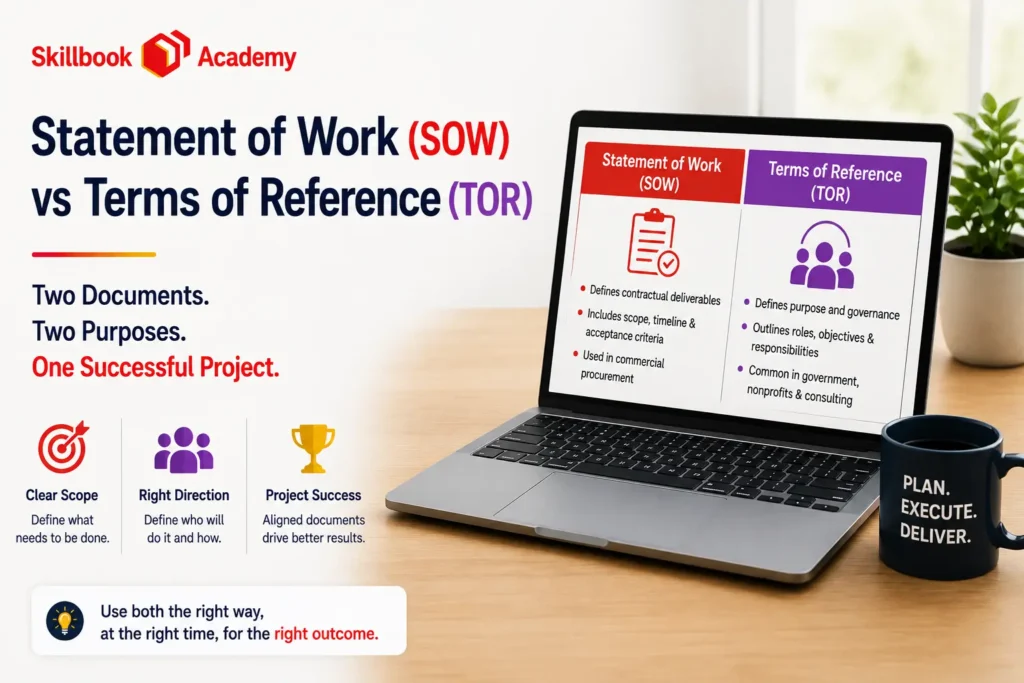
Know the Difference
Statement of Work (SOW)
- Defines contractual deliverables
- Includes scope, timeline & acceptance criteria
- Used in commercial procurement
Terms of Reference (TOR)
- Defines purpose and governance
- Outlines roles, objectives & responsibilities
- Common in government, nonprofits & consulting
What Is a Statement of Work (SOW)?
A Statement of Work (SOW) serves as the official record of the specific goods, services, or outcomes promised by the seller to the buyer. According to the PMBOK, the procurement statement of work is a document created from the project scope baseline that specifies only the part of the project scope that is covered by the associated contract. Prospective sellers can ascertain whether they can do the job and at what cost thanks to the SOW’s sufficient level of detail.
PMI recognizes several typical SOW kinds in procurement, including design SOW (which specifies exactly how the work must be done, including procedures and materials), performance SOW (which explains what the end product must do), and functional SOW (which specifies the general purpose and required functionality). The SOW becomes legally enforceable when it is connected to or referenced by the contract. The SOW specifies deliverables, acceptance criteria, performance standards, timeline milestones, location, and any unique requirements.
What Is a Terms of Reference (TOR)?
A Terms of Reference is a document that outlines the purpose, scope, deliverables, roles, governance, timeline, and resources for a project, study, working group, committee, evaluation, or consulting engagement. While the SOW is most associated with commercial procurement contracts, the TOR is widely used in nonprofits, multilateral institutions (the World Bank, United Nations agencies, and the European Union), government agencies, consulting engagements, internal task forces, and academic research projects.
TOR usually includes background and context, objectives, scope of work, deliverables and milestones, methodology, roles and responsibilities, governance arrangements, reporting requirements, qualifications expected of the team, timeline, budget envelope, and evaluation criteria. Depending on context, the TOR may or may not be contractually binding. For example, when the TOR procures consulting services, it is often part of the request for proposal and the resulting contract.
Detailed PMP-Focused Explanation
The procurement management in the PMBOK involves three processes: Plan Procurement Management, Conduct Procurements, and Control Procurements. The SOW is a primary deliverable of Plan Procurement Management. It is shared with prospective sellers during solicitation, becomes part of the bid documentation, and is incorporated by reference in the executed contract. Sellers price and submit proposals against the SOW; buyers evaluate proposals against the SOW; and during control procurements, both parties measure performance against the SOW.
The TOR has a wider institutional context. PMI refers to TOR-type documents in literature on consulting engagements, project sponsorship, and steering committee charters. In organizations that do not employ formal procurement contracts—for example, an internal cross-functional initiative or a nonprofit working group—the TOR serves as the scope-defining document. When a nonprofit hires a consultant, it may include the TOR as part of a call for proposals. The agreement that results may be a contract that references the TOR.
For forecasting (waterfall) projects, SOW and TOR are typically detailed up front. Changes are handled through formal contract amendments (for SOW) or governance approvals (for TOR).
SOWs and TORs are flexible in agile and hybrid environments. The agile SOW often follows a pattern: a master agreement that defines the team composition, rates, and governance, and then has iterative SOW addenda or work orders for each product release or increment. In agile environments, TORs can define program-level goals, and a detailed scope is developed via backlog refinement. The PMI Agile Practice Guide deals with this adaptation in procurement and engagement design.
It is common for PMP candidates to confuse SOW and TOR, as both describe work. The exam-relevant distinction SOW is most often a procurement artifact in a buyer-seller commercial contract. The TOR most often serves as a scope-defining document in non-commercial, internal, or institutional contexts, as well as in consulting engagements where the institutional language differs.
PMP exam questions that have a procurement flavor tend to use “SOW.” Those working in international development, government, or consulting should be able to recognize TOR equivalents and translate them into PMI procurement language as appropriate.
Key Differences
| Dimension | Statement of Work (SOW) | Terms of Reference (TOR) |
| Meaning | Narrative scope of work for a contract | Scope, governance, and roles for an engagement or initiative |
| Purpose | Define seller’s deliverables under a contract | Define the purpose and structure of a project, study, or group |
| When it happens | During Plan Procurement Management and Conduct Procurements | At engagement initiation, often pre-contract or pre-charter |
| Who is responsible | Buyer’s project and procurement teams; legal review | Sponsoring organization, project owner, sometimes funder |
| PMP relevance | Procurement management knowledge area, key procurement document | Scope and stakeholder management; appears in consulting and institutional contexts |
| Example | SOW for a software vendor delivering a CRM implementation | TOR for a UN-funded evaluation of a public health program |
| Risk if misunderstood | Ambiguous SOW leads to scope disputes and change orders | Vague TOR leads to misaligned expectations, weak governance |
Practical Project Examples
IT / Software Development: RFP for global e-commerce replatforming from a multinational retailer. The procurement SOW outlines deliverables (architecture documents, configured platform, migrated data, performance SLAs), acceptance criteria, milestone payments, change order procedures, and IP ownership. Three vendors bid. One is picked. The SOW is incorporated into the executed master services agreement and into the SOWs for each release. Conversely, the same retailer’s internal “future of retail” working group operates under a TOR that defines purpose, membership, decision rights, meeting cadence, and deliverables—but no commercial contract.
Building: For example, a municipality puts out a tender for road construction. They attach a detailed SOW of performance with quantities, specs, schedule, and unit rates. A nonprofit funding a rural water access program issues a TOR to a consulting firm to evaluate the program’s effectiveness; the TOR specifies the evaluation methodology, deliverables, qualifications, and timeline.
Healthcare: A hospital system has a contract with a clinical software vendor via an SOW that details implementation deliverables and warranties. The TOR specifies the mandate, sponsorship, membership, and reporting line for the hospital’s task force for quality improvement.
International Development: The World Bank finances a feasibility study through a TOR that details background, objectives, scope, deliverables, qualifications, and budget envelope. The selected consulting firm signs a contract including the TOR. In this domain, the dominant institutional vocabulary is “TOR,” and SOW is sometimes used interchangeably.
Consulting: The engagement letter of a management consulting firm is built around what is essentially an SOW: scope, deliverables, fees, timing, and procedures for change. In response to a public-sector RFP, the same firm may be given a TOR by the buyer and may respond with a proposal that reproduces the TOR.
Government: A federal agency buys IT services and issues an SOW under a contract vehicle. The interagency policy committee of the same agency operates under a TOR that defines its scope, authority, and members.
PMP Exam and Certification Insights
The PMP exam content outline by the PMI includes procurement in the Process and Business Environment domains. The SOW is specifically referenced as a procurement document and appears in situational questions concerning vendor management, scope disputes, and contract performance. Typical mistakes are:
- Select “renegotiate contract” when the first step is to look at the SOW to see what was originally agreed upon.
- “issue change order” without first determining if the work is already covered in the SOW.
- PMI considers the absence or vagueness of an SOW a major risk, not a minor point.
The TOR is less often explicitly mentioned on the PMP exam but shows up in questions about consulting engagements, internal initiatives, and stakeholder governance conceptually. If you’re a candidate working in international development, the public sector, or consulting, you should know that a TOR can sometimes be the same as a project charter and sometimes be the same as a SOW.
A handy mnemonic: “SOW signs the contract; TOR sets the table.” Another: “When money is transferred externally, anticipate a SOW. Expect a TOR when governance is the focus.” A third: “SOW defines the TOR scopes.”
If you’re looking for agile-flavored questions, look for “master agreement plus work orders”—that’s the agile SOW pattern. When you see terms such as “evaluation framework” or “study design” in the context of institutional questions, they often indicate a TOR.
PMI does not publish exam questions word-for-word. What candidates should do first is to think about the principles. The SOW is the scope description that binds the contract from the procurement standpoint. TOR is the broader scope-and-governance document from an institutional or non-commercial standpoint.
Common Mistakes and Misconceptions
- Equating SOW with TOR. They overlap but are not the same.
- It’s always non-binding to believe TOR. If a TOR is included in a contract, it has the force of law.
- Not specifying detailed acceptance criteria in the SOW. Conflicting standards for “done” trace to vague criteria.
- Assuming SOW only applies to outside vendors. Cross-organization chargebacks also have internal SOWs.
- Treating TOR as a mere project charter. TORs usually cover more methodology, governance, qualifications, and evaluation.
- Thinking that SOWs aren’t needed on agile projects. Agile vendor relationships typically involve master SOWs and iterative work orders.
- The SOW is not aligned with the project scope baseline. The SOW is an extension of scope, as explicitly stated in the PMBOK.
- Not following the change procedure in the SOW. In the absence of a well-defined change clause, each change becomes a point of contention.
- Functional & Design SOWs Mixing Performance. There is a particular use for each one; if you choose the wrong type, you will be misallocating risk.
- Creating SOWs without subject matter or legal review. SOWs are technical and legal hybrids that require both lenses.
How to Apply This in Real Projects
A usable SOW/TOR routine for the project manager:
- Choose the document type depending on the early definition of the type of engagement—commercial procurement, internal initiative, consulting study, or working group.
- Create the SOW from the project scope baseline for commercial procurement, not separately.
- Each SOW shall contain scope description, deliverables, acceptance criteria, schedule, performance standards, location, and change procedure.
- For institutional or consulting engagements, use a TOR with background, objectives, scope, deliverables, methodology, roles, governance, qualifications, timeline, and budget envelope.
- Select the right SOW type — performance, functional, or design — based on the level of detail the buyer needs.
- Review SOW with procurement, legal, and technical teams before issuance.
- Create a clear baseline so you can measure the change from the original document.
- Ambiguous terms in either document should be considered a risk to be resolved before contract signing, not after.
- For long-term agile vendor relationships, structure a master agreement with iterative work orders.
- Keep a change log against both SOW and TOR to support governance and audit.
Related Courses & Certifications: Strengthen your project management and procurement skills with our Project Management Professional (PMP)® Certification Training, AI Powered Project Manager, and Leading SAFe® Agilist (SA) Certification Training.
Frequently Asked Questions
A TOR is not binding per se. Enforceability is a function of use. It becomes enforceable in a contractual sense when part of a signed contract. Governance is an internal working group that you define. Legal counsel should always be consulted regarding status.
Yes. Internal SOWs are common with department chargebacks, IT shared services, and matrix orgs. They are not externally enforceable, but they do provide governance clarity, scope discipline, and a foundation for performance discussions, whether used internally or externally.
A performance SOW describes what the product must do. A working SOW will describe the general purpose and required functionality. A design SOW explains how the work has to be done. Risk allocation is different: design favors the seller, performance favors the buyer
Yes. The exam may include questions about the differences between performance, functional, and design SOWs, when a SOW is developed, and how it relates to the scope baseline. The SOW is a product of Plan Procurement Management.
A charter formally authorizes the project and the authority of the PM. A TOR is more common in institutional contexts and broader in scope defining detail. Some organizations use the TOR as a full-scope document and charter.
Yes. Acceptance criteria are important as they define when the seller’s work is considered complete and ready for payment. Without clear criteria, “done” disputes are probable. Criteria should be measurable and time-bound.
Meet the Author

Harry Narang
SAFe® Practice Consultant & Agile Coach
Harry Narang is a SAFe® Practice Consultant and Agile Coach based in Toronto.