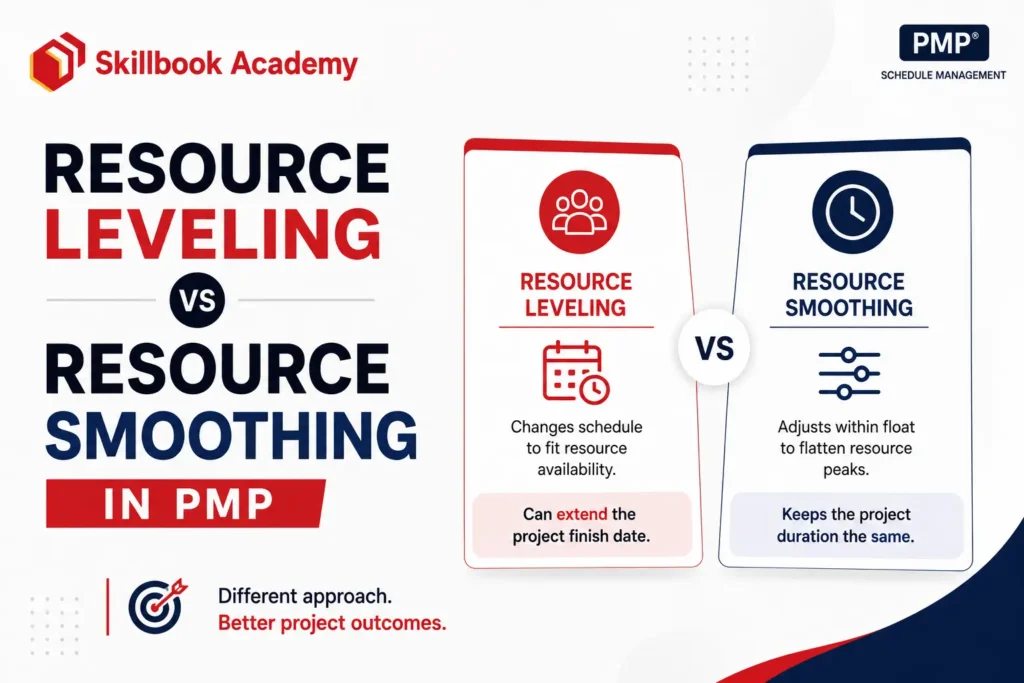
- Resource Leveling and Resource Smoothing are both PMBOK® resource optimization techniques, but they solve resource constraints using different scheduling approaches.
- Resource Leveling adjusts the project schedule to match resource availability, which can change the critical path and extend the project's finish date when resource constraints cannot be resolved otherwise.
- Resource Smoothing optimizes resource utilization without changing the critical path or project completion date, by shifting only activities that have available free float or total float.
- The deciding factor is float. If resource conflicts can be resolved within available float, use Resource Smoothing. If the conflict exceeds available float, Resource Leveling becomes necessary.
- For the PMP® exam, remember the core rule: smooth first when the project deadline is fixed; level only when resource constraints cannot be resolved without changing the schedule.
- Resource histograms, resource calendars, and critical path analysis are essential scheduling tools for identifying over-allocation, evaluating resource conflicts, and selecting the appropriate optimization technique.
- The biggest mistake is treating Resource Leveling and Resource Smoothing as interchangeable. Resource Smoothing preserves the project deadline, while Resource Leveling prioritizes resource feasibility even if the project completion date changes.
Resource leveling changes the schedule to fit resource availability, and it can push out the project finish date and alter the critical path. Resource smoothing only moves activities inside their existing float, so the critical path and the end date stay intact. Both sit inside PMBOK’s resource optimization techniques, but a project manager reaches for them under different conditions and with different consequences for the schedule.
Smoothing respects the critical path. Leveling reshapes it.
Why the Distinction Matters
Every scheduling tool eventually produces a Gantt chart that no team can actually staff. A single lead engineer is booked on two activities at once. A subcontractor is double-booked across sites. A specialist’s calendar caps out at 30 hours a week. The math on the chart says one thing; the resource pool says another. PMI built two techniques to close that gap, and they are not interchangeable.
For PMP candidates, this is one of the most exacting distinctions in the schedule management knowledge area. Exam writers use it to test whether a candidate understands that leveling can move the finish date and smoothing cannot. Missing that boundary produces wrong answers on the exam, and on live projects, it produces schedules that quietly overpromise or that waste float sitting unused.
Core Definitions
What Is Resource Leveling?
Resource Leveling is a resource optimization technique that adjusts activity start and finish dates to match resource constraints, balancing demand against actual supply. PMI defines it as the technique to use when a shared or critical resource is available only at set times, in a limited quantity, or has been over-allocated across activities. Leveling can, and frequently does, change the original critical path – sometimes extending it – and it typically leaves the project longer than the unconstrained version of the schedule would have been.
Leveling gets triggered by things like an over-allocated specialist, a hard ceiling on labor hours per period, or a resource pool that a contract has fixed in size. The technique treats resource feasibility as the priority, even at the expense of the original schedule commitment.
What Is Resource Smoothing?
Resource smoothing adjusts activities so that resource demand stays under a defined limit, without touching the critical path or delaying the completion date. The technique works only inside the boundaries of free float and total float – the slack already built into non-critical activities. If a resource conflict exceeds the available float, smoothing cannot absorb it, and the project manager must resort to leveling or another corrective action instead.
Think of smoothing as the finer instrument of the two: it flattens spikes in a resource histogram without renegotiating anything the project has already promised.
Comparison at a Glance
| Dimension | Resource Leveling | Resource Smoothing |
|---|---|---|
| Meaning | Adjusts schedule based on resource constraints | Adjust activities within the float to flatten resource peaks |
| Purpose | Resolve over-allocation when resources are limited. | Reduce demand spikes without affecting the end date |
| When It Happens | When resource availability is the binding constraint | When a float exists, and demand peaks need flattening |
| Who is Responsible | Project manager and scheduler with resource managers | Project manager and scheduler |
| PMP Relevance | Develop Schedule, Control Schedule, resource optimization | Develop Schedule, Control Schedule, and resource optimization |
| Example | Extending duration because one welder is shared across three crews | Re-sequencing two non-critical tasks to avoid a Friday demand spike |
| Risk if Misunderstood | Treating leveling as harmless flattening breaks end-date commitment | Forcing smoothing when float is insufficient; it creates resource over-allocation |
How Float Draws the Line
Leveling and smoothing both live inside the Develop Schedule and Control Schedule processes, grouped under resource optimization techniques alongside schedule compression tools like crashing and fast-tracking and alongside what-if scenario analysis. What separates leveling from smoothing is float.
Total float is how long an activity can slip without moving the project finish date. Free float is how long it can slip without delaying the early start of its successor. Smoothing stays inside those two boundaries by definition. Leveling has no such ceiling – once a resource constraint is severe enough, leveling will consume all of an activity’s total float and keep going, extending the schedule as needed.
In predictive, waterfall-style projects, planners typically run both techniques during Develop Schedule and then revisit them throughout execution as actual resource availability shifts. A Resource Histogram, a bar chart of demand over time per resource, is the usual diagnostic: after smoothing, the peaks should flatten; after leveling, the project end date may have shifted along with them.
Agile delivery reduces some of this friction because dedicated, cross-functional teams are committed to one product full-time. But shared specialists – a single security architect or a single UX researcher pulled across several teams – still create the same kind of conflict. Agile teams manage it through capacity-based sprint planning and program-level visibility, which functions much like smoothing does inside a fixed sprint cadence.
In hybrid delivery, the predictive portions of the plan use leveling and smoothing directly, while the agile portions lean on team capacity planning. PMP candidates should expect situational questions that span all three delivery models, so the underlying rule is worth memorizing either way: if a fix stays inside total float and protects the end date, it is smoothing; if it can move the critical path or the finish date, it is leveling.
Practical Project Examples
Construction.
On a high-rise project, steel erection, formwork, and rebar installation all overlap in week 14, and the site has only two qualified crane operators. Leveling delays formwork by five days and pushes the completion date out by three days, because the steel-rebar-formwork sequence sits on the critical path. Landscaping, on the same project, has two weeks of float and its own labor spike; the scheduler smooths it by spreading two activities across those two weeks, killing the peak without touching the critical path.
IT and Software Development.
A digital transformation program needs its own principal architect on both the data platform stream and the integration stream in the same sprint window. Leveling delays the integration stream by two weeks and pushes go-live out by ten business days. Documentation and training tasks, which carry a float, get smoothed instead – shifted later to flatten the load on the technical writing team without any effect on the critical path.
Healthcare.
A hospital expansion needs a single biomedical engineer to sign off on commissioning activities. Leveling sequences those activities one after another instead of running them in parallel, and the opening date moves out by two weeks. Non-critical training and orientation sessions for nursing staff get smoothed later, spread across open time slots without touching opening day.
Manufacturing.
A new product introduction shares one CNC machining center across prototype builds. Leveling pushes the prototype iterations into a sequential pattern, extending the timeline. Documentation and supplier qualification tasks, which carry float, get smoothed to keep engineering staff demand under the headcount cap.
Government and Public Sector.
A rural broadband rollout depends on a single regional permitting officer. There is no float-based fix available; smoothing cannot resolve a true single-resource bottleneck. Leveling extends the schedule by six weeks, and the project manager has to carry that number to the sponsor directly.
When float runs out, leveling takes over. There is no shortcut.
What the PMP Exam Tests
PMI’s exam content outline places resource optimization under the Process domain. A typical situational prompt reads something like, “A project has a key resource over-allocated in week 6. Which technique should the project manager apply first if the project end date is firm?” The correct choice is smoothing, precisely because it cannot disturb the critical path. Only when smoothing runs out of float does leveling become the next move, and at that point, the end date is genuinely at risk.
The most common trap is assuming leveling and smoothing are two names for the same idea. PMI treats them as distinct: one is bounded by a float, the other is not.
A few memory aids: “Smooth stays in the lane; level changes the road.” “Smoothing protects the deadline; leveling negotiates a new one.” “Float fed equals smoothing; float starved equals leveling.”
Agile-flavored exam questions tend to signal themselves with language about cross-team resource sharing or sustainable pace. The correct response leans on capacity planning and, for the predictive portion of a hybrid schedule, on smoothing or leveling as the situation calls for.
PMI does not release verbatim exam questions, so the useful preparation is principle-level: protect float, respect the critical path, and treat leveling as the fallback once smoothing is exhausted.
Common Mistakes and Misconceptions
- Assuming smoothing can absorb any over-allocation, it is limited strictly to available float.
- Treating leveling as a rare, edge-case technique when resource-constrained projects use it routinely.
- Believing the critical path is untouchable – leveling can change it outright.
- Mixing up leveling with crashing. Crashing adds resources to shorten duration; leveling redistributes the resources already on the project.
- Mixing up smoothing with fast-tracking. Fast-tracking overlaps activities that were sequential; smoothing shifts activities within existing float.
- Skipping the resource histogram, which turns optimization into guesswork.
- Leveling the schedule and forgetting to recommunicate the new baseline to stakeholders.
- Smoothing without recalculating float first, even though float shifts as the project progresses.
- Ignoring resource calendars – holidays, shift patterns, and time off- affects both techniques.
- Treating leveling as something only the project manager needs to know about, when sponsors and resource managers need to hear about a moved end date too.
Applying This on a Real Schedule
- Build a baseline schedule with the critical path method, ignoring resource constraints at first.
- Build a resource histogram per resource type to see where peaks and over-allocations sit.
- Identify which activities carry float and how much.
- Smooth first: shift the float-rich activities to flatten demand while the critical path stays fixed.
- Rerun the histogram to confirm the over-allocation is gone.
- If it is not gone, move to leveling: adjust the constrained activities’ dates even if that shifts the critical path or the finish date.
- Take any end-date impact to the sponsor and run it through integrated change control before updating the baseline.
- Check resource calendars so the plan reflects real availability, not assumed availability.
- Revisit the optimization as execution produces actuals, since conditions will not stay static.
- Log every optimization decision in the schedule management plan for a later audit and lessons learned.
Checklist – before choosing leveling or smoothing, ask:
- Is the finish date firm, or is there room to negotiate it?
- Does the affected activity carry free float, total float, or neither?
- Will the proposed fix touch the critical path?
- Has the resource histogram been rerun after the change?
- Who needs to know if the finish date moves?
- Is the resource constraint temporary, or is it structural to the whole project?
Related Courses & Certifications: If you’re looking to strengthen your project management, Agile planning, and resource optimization skills, explore our AI Powered Project Manager, Leading SAFe® Agilist (SA) Certification Training, SAFe® Release Train Engineer (RTE) Certification Training, and SAFe® Lean Portfolio Management (LPM) Certification Training to gain practical expertise in enterprise Agile delivery and effective resource management.
Frequently Asked Questions
Not always. If leveling only shifts non-critical activities that still have float left, duration holds. When float runs out, leveling reshapes the schedule around resource availability instead, and duration typically grows.
No. Smoothing works only inside free and total float, and the critical path has zero or negative float by definition. If a fix changes the critical path, it was leveling, not smoothing.
When the end date is fixed, the critical path needs to stay intact, and the conflict involves activities that still have float. The general rule: smooth first, and only level once smoothing can't absorb the conflict.
No. Compression covers crashing (adding resources) and fast-tracking (running sequential activities in parallel) to shorten duration. Leveling adjusts the schedule to match resource availability and often extends it - PMBOK keeps the two categories separate.
Microsoft Project, Primavera P6, and Smartsheet all support both techniques, though naming conventions vary by tool. Resource histograms, resource breakdown structures, and resource calendars remain the underlying analysis regardless of software. PMI does not endorse any particular vendor.
Dedicated, cross-functional teams remove most shared-resource friction by design. Where a specialist is still shared across teams, capacity-based sprint planning and program-level dependency management fill the gap - conceptually close to smoothing, just applied at the team-capacity level.
They turn resource demand into a stacked bar chart over time, making over-allocation visible immediately. Comparing the histogram before and after a change shows whether the fix flattened demand (smoothing) or reallocated it at the cost of dates (leveling).
Almost always as a situational question with an over-allocated resource. The exam is checking whether the candidate knows that smoothing comes first when the end date is firm and that leveling is the technique that's actually allowed to move that date.
Meet the Author

Aaron Jebin
Contributing Writer
Aaron Jebin is a contributing writer at Skillbook Academy covering Agile, SAFe and AI topics.