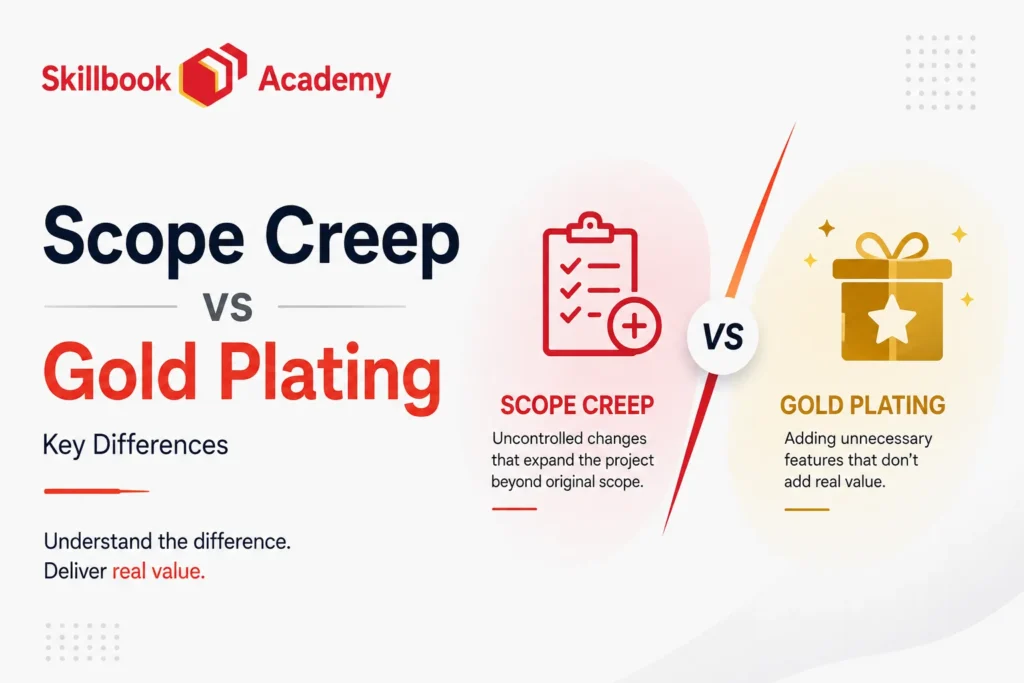
- Scope creep is the unapproved change led by stakeholders, while gold plating is the unapproved addition led by the team.
- Bypass integrated change control. Endanger cost, schedule, and risk.
- Combat remedy creep by using stronger stakeholder change processes and formal change requests.
- Enforce acceptance criteria and audit against the requirements traceability matrix to prevent scope creep.
- PMP exam cue: Route changes through change control or backlog refinement; don't implement or ignore outright.
- Practically, maintain a clean scope baseline, require all changes to be requested in writing, and conduct weekly reviews to identify unauthorized work.
Direct Answer
Usually initiated by clients or stakeholders, “Scope creep” refers to unauthorized changes or additions to a project’s objectives after the initial plan has been locked in. These changes do not involve any changes to the budget, timeline, or staffing, and so they directly threaten the success of the project.
“Gold plating” occurs when a project team adds features, functionalities, or quality to the specified scope baseline without approval. The two are entirely different in source and intent. Although framed differently in the PMP exam, both questions bypass the integrated change control process and test the triple constraint.
Why This Topic Matters for PMP Learners and Project Managers
Deliverables periodically deviate from the approved scope baseline, as communicated to the project managers.
“The customer “only wants one more dashboard.”
A developer “just adds” a slick animation that no one needed.”
When the project is done, the team has gone over budget, missed timelines, and delivered something other than what the sponsor signed off on. Scope discipline is crucial, PMI argues, because every cost, schedule, and risk decision is predicated on a stable, baselined scope.
PMP candidates in the Process and Business Environment domains will often encounter scope creep and gold plating. These are situational questions, and you will nearly always tie the answer to the integrated change control process or refer back to the scope management strategy. Confusing them, or worse, thinking gold plating is harmless compassion, leads to wrong answers and, in real projects, broken triple constraints.
Core Definitions
What Is Scope Creep?
Essentially, scope creep is when a project’s requirements continuously expand after the initial plan is approved. This happens without making necessary adjustments to the project’s deadlines, budget, team size, or risks, often leading to delays and burnout. Often, the request may come from stakeholders, customers, sponsors, or end users looking for “small” additions that do not require formal change control.
The Control Scope process is concerned with monitoring the status of the project and product scope and managing changes to the scope baseline. The Control Scope process deals with a major risk, scope creep, as highlighted in the PMBOK Guide.
Scope creep can be intentional (a stakeholder putting pressure on the team) or unintentional (a project manager informally agreeing to small extras). Either way, the result is team burnout, quality compromise, cost overrun, and schedule slippage.
What Is Gold Plating?
Gold plating is the addition of features, functions, or quality enhancements beyond the documented requirements and approved scope baseline without appropriate authorization. Usually, a developer, designer, engineer, or project manager on the project team initiates it, believing the customer will like the “bonus.” PMI considers gold plating to be an undesirable practice, as it uses up resources that have not been allocated, creates unforeseen risks, and, despite well-meaning intentions, may be in breach of the customer’s specification.
The traditional PMP framework defines gold plating as the team providing more than what was requested. It continues to contravene change control due to the absence of sought approval.
Detailed PMP-Focused Explanation
For predictive (waterfall) projects, the scope baseline (scope statement, WBS, and WBS dictionary) is the contract between the project and its sponsor(s). Any change must be processed through integrated change control. This means it needs a written change request, impact analysis, CCB decision, and baselines updated if approved. Scope creep and gold plating circumvent this gate.
In agile environments, the scope is deliberately variable at the product backlog level, but once committed, the scope of the iteration (sprint) is fixed. Adding work to a sprint without backlog refinement and product owner approval is the agile version of scope creep. When a developer adds “polish” features that the product owner never prioritized, it’s the agile equivalent of gold plating. The Agile Practice Guide, co-published by PMI and the Agile Alliance, points out that even in adaptive environments, change has a process; it just happens more rapidly and at a different cadence.
Scope discipline in hybrid projects involves multiple aspects, with the overall scope and contract deliverables set as a baseline, while specific work packages or features are developed gradually. Project managers employ change control for fixed baselines and backlog refinement for adaptive approaches.
Both result in unapproved scope expansion, and so PMP learners often confuse the two. The critical differentiating question on the exam is, ‘Who initiated the change? Scope creep is when a stakeholder or customer asks for it. If the team adds it on its own, it is considered gold plating.
The triple constraint effect is the same in mechanism (more work, more cost, more time, and more risk), but different in remediation. Scope creep is managed by strengthening change control with stakeholders. To avoid gold plating, requirements discipline is enforced with the team and aligned with the scope statement and acceptance criteria.
Key Differences
| Dimension | Scope Creep | Gold Plating |
| Meaning | Uncontrolled scope expansion after baseline | Team adds extras beyond documented requirements |
| Purpose | None intended — drift from informal pressure | Team belief that “more” pleases the customer |
| When it happens | Throughout execution, especially after delivery starts | During execution, often near deliverable completion |
| Who is responsible | Stakeholders, customers, sponsors, sometimes weak PM | Project team members, technical leads, sometimes PM |
| PMP relevance | Control Scope, Validate Scope, Perform Integrated Change Control | Manage Quality, Control Scope, requirements discipline |
| Example | Client adds three new report types after sign-off | Developer adds an unrequested AI suggestion feature |
| Risk if misunderstood | Cost/schedule overrun, sponsor dissatisfaction, baseline corruption | Wasted effort, unplanned defects, contractual breach |
Practical Project Examples
IT / Software Development: A SaaS implementation team benchmarks a customer portal with five core modules. Midway through the project, the client casually mentioned to the project manager during a status call that they should “also include a chatbot; that shouldn’t take long.” PM agrees informally. The chatbot consumed 14% of the remaining budget and pushed the go-live date back by four weeks after three sprints. This scenario is a prime example of scope creep: initiated by the stakeholders, without a change request or rebaselining. Imagine the same project, and a developer decides of her own accord to build a dark-mode toggle that no one asked for. That’s gold plating.
Construction: The chief medical officer casually asks the contractor to “tile the staff break room too, while you’re here” during a hospital wing expansion. The site supervisor obliges. Materials cost more, the punch list becomes longer, and the contractor can’t bill for the extras because there was no contract change order. Scope creep. On the other hand, an electrician installs more expensive LED fixtures than specified because “they look better.” The potential for gold plating to fail inspection is linked to the sustainability rating.
Healthcare/Pharma: Adverse event tracking is part of the baseline scope of a clinical trial management system. Week 12: Additional reporting fields requested by the sponsor’s medical affairs team. The IT team approves the request without requiring a change. There was a double validation effort, delayed regulatory documentation, and a delayed trial start date. This is scope creep that has regulatory implications.
Banking / Finance: The released features of the loan origination platform are frozen. A senior developer adds an “advanced analytics dashboard” because he thinks underwriters will love it. The dashboard is sourced from a data source that has not been security reviewed. Compliance prevents the release. This situation represents an excessive focus on audit consequences.
Manufacturing: A new product introduction (NPI) program has set tooling specifications. A design engineer reduces a tolerance to “improve the fit.” We need to redo the tooling. Six weeks’ cost. Capital expenditure affects gold plating.
PMP Exam and Certification Insights
The content outline of PMI’s exam places a strong emphasis on scope discipline in both the Process and business environment domains. You will frequently encounter the following situational traps:
- Selecting “immediately implement the change” is nearly always incorrect. A change request and integrated change control are the correct responses.
- Selecting “ignore the request” is also incorrect. Stakeholder input is not unilaterally rejected by project managers; rather, it is assessed through change control.
- This behavior is gold plating disguised as customer service: selecting “add the feature because the customer will be satisfied.”
- A practical mnemonic: “Plating originates from the team; creep originates from the crowd.” Another: “It is creepy if they requested it.” It is plating if we include it.
Watch for phrases such as “the team self-organized to deliver more than the product owner requested” in questions with an agile flavor. That is the equivalent of gold plating in agile clothing. Referring the supplementary work to backlog refinement is the PMP-correct course of action.
Candidates should concentrate on principles rather than memorized answers, as PMI does not publish exam questions verbatim. The guiding principles are as follows: safeguard the baseline, ensure that all activities are subject to change control, and ensure that team conduct is consistent with the documented acceptance criteria.
Common Mistakes and Misconceptions
- Gold plating is not a constructive endeavor. It is a violation of change control, regardless of the intention.
- This belief is that minor modifications do not necessitate a change request. “PMI anticipates that formal control will be implemented for minor scope changes, as these modifications accumulate.”
- Confusion regarding the distinction between progressive elaboration and scope creep. Progressive elaboration is the iterative process of incorporating additional detail into the scope of a project.
- This assumption is that agile projects are not susceptible to scope creep. Scope creep occurs when modifications are implemented during the sprint; the sprint scope is predetermined.
- This belief assumes that the project manager possesses the authority to approve scope changes independently. Generally, organizations must obtain approval from their sponsor or CCB, contingent upon their thresholds.
- Confusion regarding scope creep and change requests. Scope creep is a managed change, not a documented, evaluated, and approved change.
- If you believe that gold plating is a software issue. Goldplating is observed in the fields of construction, manufacturing, and consulting.
- Failure to disclose the cost of requests that appear to be trivial. It is imperative that project managers transparently quantify the impact.
- Failure to enforce acceptance criteria. When there are no well-defined criteria, creep and plating are both effective.
- Directing blame toward individuals rather than systems. Rather than the presence of undesirable individuals, both are typically symptoms of poor governance.
How to Apply This in Real Projects
A Practical Scope Protection Routine for Project Managers
- Achieve a clean scope baseline, which includes the scope statement in the WBS dictionary, WBS, and version control.
- Any modification, regardless of its size, must be accompanied by a written request for change.
- Even if you ultimately decide not to implement the modifications, it is imperative to preserve a change log.
- Conduct a weekly team review and clearly define the acceptance criteria for each deliverable.
- Regular sprint reviews and backlog grooming are essential for adaptive work.
- Train team members to refer “while you’re at it” requests to the PM rather than absorbing them.
- Please provide a thorough analysis of the cost and schedule implications for each of the requested modifications before responding.
- By conducting an audit of the final deliverables against the requirements traceability matrix, it is possible to detect gold plating early.
- Kickoff affords you the chance to assist senior stakeholders in navigating the project’s change control process.
- Cultivate an environment in which it is customary to “run that through change control” rather than engage in a confrontation.
Understanding scope creep vs. gold plating is essential to successful project delivery and PMP exam success. Both are unapproved scope expansions. The difference is the origin. Left unchecked, both can result in budget overruns, schedule delays, and increased project risks.
To avoid these problems, create a clear scope baseline, document all proposed changes, and adhere to the integrated change control process. In the end, it is about delivering the scope that was agreed upon, no more, no less. Disciplined scope management practices enable project managers to safeguard project results, meet stakeholder expectations, and feel confident when facing PMP exam scenarios.
External References Used
| Source name | Page title | URL | What it supports |
| PMI | A Guide to the Project Management Body of Knowledge (PMBOK Guide) | https://www.pmi.org/standards | Scope baseline, Control Scope, integrated change control |
| PMI | Project Management Professional (PMP) Certification | hhttps://www.pmi.org/certifications/project-management-pmp | PMP exam framing of scope discipline |
| PMI | Learning Library | https://www.pmi.org/search | Articles on scope management and change control |
| PMI & Agile Alliance | Agile Practice Guide | https://www.pmi.org/standards/agile | Agile and hybrid scope handling |
| PMI | Code of Ethics and Professional Conduct | https://www.pmi.org/about/ethics/guidelines | Ethical framing of gold plating |
Frequently Asked Questions
Gold plating is not unethical but rather unprofessional. The PMI’s Code of Ethics stresses responsibility and honesty. Unauthorized work is a lack of respect for the baseline, the authority of the sponsor, and the change control process.
Scope creep is rarely a good thing because it bypasses cost, schedule, and risk assessment. But by feeding the underlying ideas through integrated change control, uncontrolled creep becomes managed change, and that can be valuable.
The exam is based on situational questions, with stakeholders asking for informal changes. Integrated change control is almost always the correct answer. Impact. Raise a change request. Route through the CCB. Update baselines if approved.
Progressive elaboration is the planned, iterative refinement of details within the approved scope baseline. Scope creep is an unapproved expansion beyond the baseline. The distinguishing test is whether the baseline itself is changing.
Prevention requires crisp acceptance criteria, a clear definition of done, and a culture that treats unrequested features as deviations. Audit deliverables vs. requirements traceability matrix. Coach team members to surface ideas as backlog items.
Yes. The product backlog applies to agile projects; however, the sprint scope is fixed once sprint planning begins. When you add work mid-sprint without the product owner involved, that’s scope creep in Agile speak, and the team deals with it through backlog refinement.
Scope control is shared, but the project manager has the primary responsibility. The sponsor drives governance, the Change Control Board assesses impact, the team issues warnings, and requests are routed properly through stakeholders. Scope control is a system.
The corrective action is to document the deviation, perform variance analysis, submit a change request to rebaseline if necessary, and communicate openly with the sponsor. The PMI encourages open reporting of variance instead of hiding it.
Meet the Author

Harry Narang
SAFe® Practice Consultant & Agile Coach
Harry Narang is a SAFe® Practice Consultant and Agile Coach based in Toronto.